Government, NSCN-IM Sign Peace Accord: What to look out for ? By Anubha Bhonsle
A peace accord that warranted the special attention the Prime Minister gave it on Twitter. Shortly after the announcement was made, I spoke to a Kilonser (Minister) of the NSCN-IM in one of the camps in Manipur, the state where the government of India’s ceasefire with the NSCN-IM technically has not applied all these years. The news of the ‘special announcement’ had reached the men. The lack of details was troubling, adding to the uncertainty. "Protecting our identity and our resources will be prime for us but yes it’s a big day, a very big day", the Kilonser said rather insipidly I imagined for a momentous day like this. Over the years as I have met the Kilonser and the cadre of the NSCN-IM either at their HQs in Camp Hebron in Nagaland or in Manipur (where the NSCN-IN camps are called ‘taken note of’ camps), the Kilonser’s faith in the ‘Naga way of life once the solution arrives’ has been rather steadfast.
Much will depend on details of the accord, the interpretation of ‘greater Nagalim’, which has remained the NSCN-IMs prime demand and the biggest roadblock-to bring together Naga dominated areas of Manipur, Arunachal and Assam. A territorial adjustment will be tough and politically unfeasible giving the stiff opposition in Manipur at any tinkering of their territorial lines both within the mainstream and the underground. An ‘alternate arrangement’, a social compact of Nagas in other states along with greater autonomy for these regions maybe the parts to look out. The form in which the NSCN-IM has accepted sovereignty, rewind a few years and it had become clear that the NSCN-IM had given up sovereignty as a goal and the Indian government had promised to incorporate a special chapter in the Indian Constitution detailing Nagaland’s special status instead of conceding to the NSCN’s demand for a separate constitution for Nagaland. The lack of details out in the public domain suggests a cautious approach by the government, perhaps waiting to see how the states of Manipur, Arunachal both with substantial Naga population react to the announcement. The issue of designated camps, armed cadre, weapons and their eventual coming in to the mainstream will all have to be set in motion in the time ahead. Today, of course a fading memory, replaced by a handful of outfits but when the movement for Naga sovereignty started in 1946, there was one group: the Naga National Council (NNC) with AZ Phizo as its founding father. In 1980 it split. Thuingaleng Muivah, Isak Chishi Swu and S S Khaplang parted ways to form the NSCN, opposed to the NNC’s signing of Shillong Accord. Eight years later the NSCN too split in a violent parting of ways. Isak (Swu) and Muivah formed the IM, while Khaplang gave his own name to the faction, the NSCN-K. In their formal organizational name both claimed the acronym of GPRN, the government of the Peoples Republic of Nagalim. For forty years (1956-96) armed Naga insurgent groups fought India’s powerful military machine to a stalemate until both sides announced a ceasefire in 1997 and started negotiations for a settlement that has had more than 80 rounds of negotiations in destinations across the world. The NSCN-K followed suit, till it abrogated the ceasefire in 2015. And though the IM has more or less not fought the Indian forces since 1997, the ceasefire hasn’t meant peace. Its fighters continued to train, patrol, procure arms, recruit men and remain involved in turf battles with Khaplang and other breakaway Naga rebel factions.
For decades a political settlement of the Naga issue has remained out of reach. In Nehru’s words, "it was fantastic to imagine that government of India is going to be terrorized into some action by Phizo and company, privately he admitted that total suppressing of the (Naga revolt) was out of the question and partial suppression would serve only as an irritant.. the Nagas are a tough and fine lot of people and we may carry on for a generation without solving the problem." It has taken more than a generation to end one of South Asia’s longest running guerilla campaigns. Many lives have been lost on both sides. India has used many elements of its counter-insurgency for the Naga insurrection: from military to softening up the rebels and forcing them to the table, using clan and tribe rivalries to split the separatist movement. Add to that a huge fund inflow and simply tiring down the leadership through decades of negotiations. The successful conclusion of the accord (signed by Th Muivah on behalf of the NSCN-IM and RN Ravi, the interlocutor on behalf of the Government of India) sends a right signal to make peace with groups in the region and move into a conflict resolution mode. Other Naga factions like the NSCN (KK) and NSCN R will fall in place in due course if this works out. The NSCN (Khaplang) will remain to hold out but is likely to face the brunt of coordinated operations by the Myanmar and Indian Army in the future. The Meitei groups though may continue to hold on. At the ceremony the Prime Minister with a Naga shawl on his shoulder, spoke in English about the "prism of false perceptions and old prejudices". Muivah remarked, "beginning from now, challenges will be great". Both sides know much is at stake and much can change from now on.
(Anubha Bhonsle is the Executive Editor, CNN-IBN. Her book ‘Mother, Where’s My Country?’, a work of reportage on the web of insurgencies and the cost of conflict in Manipur releases later in 2015.)
On August 15, 1947 India overthrew the British rule and became independent. But just a day earlier, Nagas revolted against the Indian government, declaring that they were a separate nation and would not accept New Delhi's rule.
Led Angami Zapu Phizo, the Nagas comprising of 17 major tribes and 20 sub-tribes, united under the banner of Naga National Council (NNC) in August 1947 to carry out the fight against India. Ao, Angami, Sema, Lotha, Tangkhul, Konyak, Rengma and Mao are some of the major Naga tribes and although each one of them speaks a different language, all of them demanded an independent Nagaland.
NSCM-IM’s main demand has been the creation of a ‘Greater Nagalim’ which will also have several districts of Assam, Arunachal Pradesh and Manipur.
The Indian government arrested Phizo and a few of his close associates in July 1948. But Phizo was released in 1949 and went on to take over as the NNC president in 1950. Under his leadership the NNC publicly declared its aim to establish a sovereign Naga state comprising of all Naga dominated areas of the Northeast.
NNC also held a ‘referendum’ in May 1951 claiming 99% of the Nagas voted in favour of an independent Nagaland but it was never accepted by the Indian government. The first general elections in 1952 were boycotted by the NNC and it started a violent secessionist movement making Naga insurgency the oldest in India.
According to South Asia Terrorism Portal (SATP) in the first few years, NNC cadres would raid villages and police outposts for funds and arms but on March 22, 1956, Phizo created an underground government called the Naga Federal Government (NFG) and a Naga Federal Army (NFA). In April 1956, the Indian Army was called in to crush the insurgency in what was, till then, the Naga Hills District of the State of Assam. To deal with the situation, the Armed Forces (Special Powers) Act, 1958, was subsequently enacted. Phizo, however, escaped to the then East Pakistan in December 1956 and, subsequently, to London in June 1960.
Assam was divided on December 1, 1963 and Nagaland became a separate state and another round of attempts were made for a political settlement. Freedom fighter Jai Prakash Narayan, the then Assam chief minister Bimala Prasad Chaliha and Rev. Michael Scott led a Peace Mission to Nagaland in April 1964. An agreement for Suspension of Operation (AGSOP) was signed with Naga insurgents on September 6, 1964 raising hopes of a peaceful solution.
But NNC cadres soon broke the agreement and launched a series of attacks on security forces and Army units posted in the area. Finally, the Peace Mission came to an end in 1967 after six rounds of talks between the insurgents and the Centre which failed to yield any positive result.
NNC and its constituents the NFG and the NFA were declared "unlawful associations" under the Unlawful Activities (Prevention) Act of 1967 and banned by the Centre in 1972. SATP reports that security forces launched a massive counter-insurgency operation and once again brought the situation under control forcing the insurgents to the negotiating table.
An agreement known as the Shillong Accord was signed between the Centre and a section of the NNC and the NFG on November 11, 1975. According to the terms of Shillong Accord, the NNC-NFG accepted the Indian Constitution and agreed to come overground and surrender their weapons.
However, a group of about 140 activists of the NNC, who had gone to China for training, repudiated the Shillong Accord and refused to surrender and formed another terror group called National Socialist Council of Nagaland (NSCN). The NSCN leaders were Thuengaling Muivah, Isak Chisi Swu and SS Khaplang and the group was formed in Myanmar (then Burma) in 1980.
Soon NSCN became the most powerful and feared terror groups in Nagaland and the Northeast with the NNC-NFG became less active and losing its influence.
The division of Nagas along clan and tribal lines also played a major role in the insurgency and formation of different terror groups. While a majority of the rank and file of the NSCN was from the Konyak tribe, the leadership was Tangkhul dominated leading to discontent among the former. There were also apprehensions among the Konyaks and the Myanmarese Nagas that the Tangkhuls were about to strike a deal with the Indian government.
These factors resulted in a vertical split in the NSCN in 1988. The Konyaks formed a breakaway faction under the leadership of Khole Konyak and SS Khaplang, a Hemie Naga from Myanmar. The Tangkhul faction was led by Isak Swu, a Sema from Nagaland, and Muivah, a Tangkhul from Manipur’s Ukhrul district. This was followed by severe inter-factional clashes in which hundreds of activists of the rival groups had been killed.
After the death of Phizo in 1990, there was another split in the NNC. Phizo’s daughter Adino, an Angami, and Khudhao Nanthan, a Sema and a close associate of Phizo, constituted separate groups on rival lines. In the winter of 1996-97, Khudhao joined NSCN (lM) and is currently the Vice Chairman of the organization. With this move NSCN (IM) was also able to get the support of the Lothas to which Kudao belongs .All factions of the NSCN and NNC (Adino) have been banned since 1991 under the Unlawful Activities (Prevention) Act, 1967.
The NSCN-IM lays primary emphasis on the point that the Naga region was never a part of India and that freedom fighter and India’s first prime minister Jawaharlal Nehru’s argument was fallacious when he said that India had "inherited" the Naga area from the British. Both Swu and Muivah argue that "the fate of a people cannot be passed on like an inheritance from one party to another". The NSCN-IM has taken an inflexible stand on this point and insists that their demand is not for ‘secession’ because they have never been a part of the Indian Union.
But the specifics of the peace deal signed between the Narendra Modi government and NSCM-IM in New Delhi are still not out in public domain. NSCM-IM’s main demand has been the creation of a ‘Greater Nagalim’ which will also have several districts of Assam, Arunachal Pradesh and Manipur. The other three states have made it clear that even though they have Naga tribes residing within their boundaries but they will not allow those areas to be a part of ‘Greater Nagalim’ as demanded by the NSCM-IM. In fact according to Naga insurgent groups the 'Greater Nagalim' should also include Naga-dominated areas of Myanmar
A year ago, on August 3, Islamic State militants stormed the homelands of Iraq's Yazidi minority, killing hundreds of men and enslaving thousands of women. The scenes of desperate Yazidi families crowding on the top of Sinjar mountain without food or water spurred Kurdish fighters into action, an emergency airlift and the start of the U.S. airstrike campaign against the Islamic State Sunni extremists. Yazidis who survived that massacre are scattered around the region. About a two hour drive north of the northern Kurdish city of Irbil, amid dusty, rocky hills is Lalish, the site of a famous Yazidi shrine. On this Sunday, a day before the anniversary, Yazidi families are walking into the shrine grounds in 50-degree (Celsius) heat to meet, pray and wash in the holy waters of their temple.
'There was no food, no water' Murad Aloo, is one of them. Wearing all black, he walks around the temple grounds, stopping at the stand selling water and ice cream. But he finds little peace here. The images of what happened 12 months ago is seared into his mind. On that day, he said, the shooting started at around 10 in the morning. When the Yazidis realized they were going to be slaughtered by the oncoming Islamic State militants, they fled by the thousands to Sinjar mountain. "I will never forget what happened. I saw mothers leaving their daughters behind, fearing for their own lives. I saw women and men being slaughtered, even pregnant women." Aloo pulls out his cell phone to show a picture of his brother. Aloo says his brother decided to stay and fight for Yazidi land, and he has never seen him again. Remembering the days that followed, stranded on Sinjar mountain, waiting for the airlift and a way out, Aloo starts crying. "We had one capful of water for two children. There was no food, no water. Many died of thirst and hunger when we were stranded on the mountains. God, God."
Shrinking population Around the temple, women and girls walk barefoot, washing in the holy waters. One small child rinses ice cream sticks in the water, while others fill plastic bottles with water from a pipe sticking out of stone wall. These are the lucky ones. Not all are from Sinjar, but those among them who fled the slaughter are haunted. The Islamic State extremists who consider the Yazidis devil-worshippers, executed the young men, raped little girls and enslaved thousands of women. For Yazidis, a minority community in Iraq, and a religious group that has under a million members in the world, being killed and driven from their ancestral Iraqi land is a death sentence. Sheikh Ismail Murad Qasim, another survivor, sits in the cool of a stone grotto, and mourns the death of his community. "This is the end of our people. They have massacred us by the thousands, raped eight- and nine-year-old girls, the future of our Yazidi community. And now they are all killed." The spiritual elders of the shrinking population are trying to keep their people together, encouraging them not to leave Iraq. But they acknowledge the challenge. "We call for the protection of the Yazidis. We are alone. We have no one to turn to. And we pray, we pray for God to bring harmony among all religions," Baba Sheikh, the Yazidi's spiritual leader, told VOA.
No 'future for me' Aloo is too traumatized to even think of that kind of harmony. "I wish I were among the dead, instead of witnessing what I have seen. I don't think there is a future for me, I am just so heartbroken, I don't think there is a future for me."
INVITATION TO THE FEAST OF THE YEZIDIS CHAP. IX. of Nineveh and Its Remains: With an Account of a Visit to the Chaldæan Christians of Kurdistan By Sir Austen Henry Layard, Published 1849
Yazidis
Islamic State Sunni extremists made major gains in Iraq's north in August 2014. The extremists took over the Kurdish town of Sinjar, forcing its population of Yazidi minorities to flee with little food or water. Thousands fled their homes for the mountains after the Islamic State group issued an ultimatum to convert to Islam, pay a religious tax, flee their homes or be put to the sword.
Yazidis [also Yezidi, Azidi, Zedi, or Izdi] are a syncretistic religious group (or a set of several groups), with ancient origins and comprising Gnostic core belief structure with other elements of Zoroastrianism, Judaism, Christianity, Manicheism, and Islam. Yazidi do not intermarry with outsiders or accept converts. Many Yazidi now consider themselves to be Kurds, while others define themselves as both religiously and ethnically distinct from Muslim Kurds. Most of the 700,000 Yazidi reside in the North of the country.
The religion is little known to outsiders but contains elements of Islam, Judaism, and Christianity, and also includes the veneration of the Peacock Angel. After visiting them in the late 1850s, Sir Austen Henry Layard concluded that "With the scanty materials which we possess regarding their history, and owing to the ignorance prevailing amongst the people themselves, - for I believe that even the priests ... have but a very vague idea of what they profess, and of the meaning of their religious forms, - it is difficult to come to any conclusion as to the source of their peculiar opinions and observances."
The Yazidi have hiden many aspects of their religion from the dominant Muslims around them. Indeed, only the fully initiated actually know the full theology, even among the Yazidi themselves. Writer H. P. Lovecraft made a reference to "... the Yezidi clan of devil-worshippers" in his short story "The Horror at Red Hook". Yazidis believe in a God who created the world, but the active forces in their religion are Malak Ta'us and Sheik Adii. According to Yazidis, Malak Ta'us [Malek Taous] is the fallen peacock angel.
Layard relates that when they speak of the Devil, they so with reverence, as Malek Taous [King Peacock], or Melek el Kout [the mighty angel]. The name of the Evil spirit is never mentioned; and any allusion to it by others so vexes and irritates them, that it is said they have put to death persons who have wantonly outraged their feelings by its use. So far is their dread of offending the Evil principle carried, that they carefully avoid every expression which may resemble in sound the name of Satan, or the Arabic word for "accursed."
According to Layard's account, they believe Satan to be the chief of the Angelic host, now suffering punishment for his rebellion against the divine will; but still all-powerful, and to be restored hereafter to his high estate in the celestial hierarchy. He must be conciliated and reverenced, they say; for as he now has the means of doing evil to mankind, so will he hereafter have the power of rewarding them. Next to Satan, but inferior to him in might and wisdom, arc seven arch-angels who exercise a great influence over the world - they are Gabriel, Michael, Raphael, Azrael, Dedrael, Azraphael, and Shemkeel. Christ, according to them, was also a great angel, who had taken the form of man.
Sheikh 'Adi ibn Musafir, (ca. 1073-1163 AD ???), was said to be the founder of the Yezidi faith, although both the tribes and their religion hail from an earlier time, and the fact of the existence of such an individual is subject to question. Sheikh Adi was saidto be a Muslim preacher born in present-day Lebanon who gathered disciples in the mountains east of Mosul city and ultimately settled in Lalish.
Layard noted that their ceremonies gave rise, among Muslims and Christiana, to fables confounding the practices of the Yezidis with those of the Ansyri of Syria; and ascribing to them certain midnight orgies, which earned them the epithet of Cheragh Sonderan, or "The Extinguishers of Lights." The prejudices of the inhabitants of the country extended to travellers. The mysteries of the sect might be traced to the worship introduced by Semiramis, into the very mountains they inhabited - a worship which, impure in its forms, led to every excess of debauchery and lust. But when Layard visited them, he concluded that the quiet and inoffensive demeanor of the Yezidis, and the cleanliness and order of their villages, did not certainly warrant these charges.
Their known respect or fear for the evil principle acquired for them the title of "Worshippers of the Devil". Many stories were current as to the emblems by which this spirit was represented. They were believed by some to adore a peacock; but their worship, their tenets, and their origin were alike a subject of some mystery.
The sacred scriptures of the Yazidis are two short books written in Arabic: Kitab al-Jilwah (book of revelation) supposed to have been written by Sheikh 'Adi himself, and Mishaf Rash (black writing) by Sheikh Hasan ibn-'Adi. An Arabic hymn in praise of Shaykh 'Adi is greatly respected as part of their liturgy.
Yazidi Zoroastrian and Gnostic Roots
UNESCO's member states agreed to celebrate the 3,000th anniversary of Zoroastrian religion and culture during 2002-2003. Zarathustra was one of humanity's seminal thinkers, whose concepts have long since been adopted as the ethical and philosophical base of many faiths embraced by humanity today. While the anniversary approximates the date when Zarathustra's orally transmitted teachings - the Gathas - began to be collected, the religion itself is nearly a millennium older. Zoroastrianism, an ancient religion dating back to the Iranian Stone Age, is still practiced in areas of Iran and India. Following centuries of oppression under Muslim rule in Iran, the adherents are known as the Zardushtis in Iran and the Parsis in India. The Zoroastricians believe in one God (Ahura Mazda), and worship the sacred fire (Atash Bahram) and the humble fires (Dadgah) in fire temples.
Zoroaster divided the empire of the universe between two semi-omnipotent beings, Ormuzd and Ahriman, the former supremely good, the latter utterly evil and malignant. Some sects of his followers maintained that Ormuzd created the soul of man; Aliriman, the human body and the material universe. Some modern scholars of Zoroastrianism are convinced that the doctrines of post-exilic Judaism and Christianity concerning monotheism, righteousness, and the final judgment and resurrection have roots in this ancient religion. In the sect of the Essenes this philosophy took shape among the later Jews, and in the form of Gnosticism it found its way into the Christian Church.
Their core beliefs would define the Yazidi as Gnostics. Gnostics maintained that creation developed out of a supernatural conflict between good and evil, and that matter is evil, while the spirit is good. Gnostics sought to escape evil by transcending both time and matter. The ancient gnostics despised the given world, and viewed the very birth of the world as a catastrophe. Gnosticism was one of the classical Christian heresies which mainstream Christians argued distorted the relationship of the divine and human nature of Christ. Gnostics sought liberation from the body, which was understood as a prison of the soul. Knowledge is the means to liberation, which entailed overcoming the burdens of mortality, including finitude, disease and death. Gnostic writings often carried an implication that such texts are for an elite readership, and represent the essence of a tradition of spiritual truth under threat of extinction by materialism. Hindu and Buddhist teachings about life's purpose reflected a similar appraisal of the secondary status of the body and the necessity of liberation from the bodily world. The gnostic attitude survives in philosophical Cartesianism, of mind-body duality.
Yazidi and Islam
The Yazidi themselves are said by some to be descended from supporters of the Umayyad caliph Yazid I, but Layard found there is reason to believe that the source of their name must be sought elsewhere, as it was used long before the introduction of Islam, and is not without connection with the early Persian appellation of the Supreme Being. It may be concluded, however, that with the triumph of Islam in their lands, over time it became useful to provide an account of their place in the Islamic framework, as the Sunnis did with Ali and the Shia with Hussein.
Uthman, the third "Rightly Guided Caliph", was the first Umayyad caliph. During his tenure (644-655), he appointed members of his clan to various posts. Muawiya ibn Abu Sufyan, brother in law to the prophet Muhammad, was given the governorship of Syria. Muawiya's father Abu Sufyan had been the leader of the Abd Shams clan, and most of the members of this clan had rejected Muhammad until the conquest of Mecca in 630. Upon the accession of Ali to the caliphate, Muawiya [Mu'awia, Moawiya] refused to pay him allegience, and in 658 the Syrians acknowledged Muawiya as caliph. That same year he gained control of Egypt. Following Ali's death in 661, Muawiya subdued Iraq and then formally established himself as caliph. Mu'awia, the first Umayyad Caliph and secured supreme power over the Arab empire with Damascus as his capital in 661.
Muawiya nominated his son, Yazid I, as his successor, and caused an oath of allegiance to be taken to him. The hereditary principle was thus introduced, though some relics of the form of election persisted. Yazid's ascent to power was arranged by his father, and all the power at his disposal was transferred to Yazid. As Caliph from 680 to 683, Yazid became one of the most vilified rulers in history. Upon his accession, Yazid was confronted with two rebellions. The He was responsibile for the Battle of Kerbala in 680 (in present-day Iraq) where Hussein, grandson of the Prophet Muhammad together with his followers, was defeated and killed. The martyrdom of Husayn and his family created a permanent division between the Shi`ites, the partisans of Ali, and the Sunni majority. Yazid sacked rebellious Medina (in what is now Saudi Arabia) in 682, suppressing the far more serious revolt was led by Ibn al-Zubayr.
By the time of Layard's visit to the Yazidi in the mid-19th Century, the last independent chief of the Yezidis of Sheikhan was Ali Bey, the father of Hussein Bey. Layard related that he was beloved by his tribe, and sufficiently brave and skilful in war to defend them, for many years, against the attacks of the Kurds and Mussulmans of the plain. The powerful Bey of Rowandiz, who had united most of the Kurdish tribes of the surrounding mountains under his banner, and had defied for many years the Turks and the Persians, resolved to crush the hateful sect of the Yezidis. Ali Bey's forces were greatly inferior in numbers to those of his persecutor. He was defeated, and fell into the hands of the Rowandiz chief, who put him to death. The inhabitants of Sheikhan fled to Mosul. The Bey of Rowandiz followed them. Layard reported that an indiscriminate slaughter ensued. So many thousands were massacred by their pursuers upon the site of Nineveh that the principal mound over Sennacherib's palace acquired the ominous name of Kouyunjik -- "the shambles of the sheep." The inhabitants of the Sinjar were soon after subdued by Mehemet Reshid Pasha, and a second time by Hafiz Pasha. On both occasions there was a massacre, and the population was reduced by three-fourths. The Yezidis took refuge in caves, where they were cither suffocated by fires lighted at the mouth, or destroyed by discharges of cannon.
Muslims, in their dealings with men of other creeds, make a distinction between those who are believers in the sacred books, and such as have no recognised inspired works. To the first category belong Christians of all denominations, as receiving the two testaments; and the Jews, as followers of the old. With Christians and Jews, therefore, they may treat, make peace, and live; but with such as are included in the second class, some held that the good Muslim could have no intercourse. No treaty nor oath, when they are concerned, could be binding, and they had the choice between conversion and the sword, it being unlawful even to take tribute from them.
Layard noted that the Yezidis, not being looked upon as a "People of the Book," have been exposed for centuries to the persecution of the Muslims. According to him, "The harems of the south of Turkey had been recruited from them. Yearly expeditions were made by the governors of provinces into their districts. While the men and women were slaughtered without mercy, the children of both sexes were carried off, and exposed for sale in the principal towns. Thcse annual hunts were one of the sources of revenue of Beder Khan Bey; and it was the custom of the Pashas of Baghdad and Mosul to let loose the irregular troops upon the ill-fated Yczidis, as an easy method of satisfying their demands for arrears of pay. This system was still practised to a certain extent as late as the 1850s, and gave rise to atrocities scarcely equalled in the better known slave trade.... It was not unnatural that the Yezidis should revenge themselves, whenever an opportunity might offer, upon their oppressors. They formed themselves into bands, and were long the terror of the country."
Yazidi in Modern Iraq
Nearly 150 years later, the Baath Government, without any historical basis, defined the Yazidis as Arabs. The regime sought to undermine the identity of non-Muslim minority groups, including Chaldean and Assyrian Christians and the Yazidi and Sabean Mandaean faith communities. There is evidence that the Baath Government in the past compelled Yazidis to join in domestic military action against Muslim Kurds. Captured government documents included in a 1998 Human Rights Watch report describe special all-Yazidi military detachments formed during the 1988-89 Anfal campaign to "pursue and attack" Muslim Kurds. The Baath Government also targeted the Yazidis in the past. For example, 33 members of the Yazidi community of Mosul, arrested in July 1996, still are unaccounted for.
It was customary for the Yezidis, when sufficiently powerful to defend themselves against the attacks of Kurds and Arabs, to meet periodically in large numbers at the tomb of Sheikh Adii in Lalish. Men and women from the Sinjar, and from the northern districts of Kurdistan, left their tents and pastures to be present at the solemnisation of their holy rites. They possessed [in the mid-19th Century] a bronze figure of a peacock, which was looked upon as a symbol, and not as an idol. When deputies were sent to any distance to collect money for the support of the tomb and the priests, they were furnished with a small image of it made in wax, which is shown as an authority for their mission. This symbol is called the Melek Taous, and was held in great reverence.
The most important Yazidi ritual, the annual 6-day pilgrimage to the tomb of Sheikh Adii in Lalish, took place in 2004; however, many Yazidi preferred to remain in local houses of worship to celebrate this event due to security concerns. There were numerous reports of places of worship closing due to those fears. The Yazidi, while represented in the TNA, did not hold positions in either the Transitional Government or the Kurdistan Regional Government (KRG) at the director general level or above.
Liquor store owners, primarily Christians and Yazidi, were especially hard hit in attacks by Islamic extremists during 2004. In August 2004, masked gunmen shot and killed Sabah Macardige in Baghdad during broad daylight for selling alcohol. According to witnesses, Macardige had received warnings to stop selling liquor. In April, liquor store owner Sabah Sadiq's brother was kidnapped. Sadiq was shot on his way to pay the ransom demanded by the kidnappers. In June, armed intruders broke into Sami Tammu's liquor store in Baghdad and shot and killed him when he tried to escape. Liquor stores in Baghdad, Mosul, and Basrah were bombed, looted, and defaced. The Christian and Other Religions Endowment reported that approximately 95 percent of such establishments closed due to threats by Islamic extremists.
By early 2007 non-Muslims in Iraq, including Chaldo-Assyrian Christians, Yazidis, Sabean Mandaeans, and other minority religious communities faced grave conditions. These groups faced widespread violence from Sunni insurgents and foreign jihadis, and they also suffer pervasive discrimination and marginalization at the hands of the national government, regional governments, and para-state militias, including those in Kurdish areas. As a result, non-Muslims were fleeing the country in large numbers.
Sabean Mandaeans and Yazidis have suffered abuses similar to Christians. Foreign jihadis, Sunni insurgents, and Shi'a militias view members of these groups as infidels or outsiders. In addition, religious minority communities often lack the tribal base or militia structures that might otherwise provide security. As such, these groups are often targeted by both Sunni insurgents and Shi'a militias. The risks are particularly severe for isolated minority communities in areas where foreign jihadis and Sunni insurgents remain active. Some of this violence stems from the reported tendency of foreign jihadis and Sunni insurgents to associate Iraqi Christians and other non-Muslims with the United States and the U.S.-led military intervention. In other instances, however, religious minorities appear to be the victims of escalating intra-Muslim violence.
In April 2007, for example, unidentified gunmen killed 23 Yazidis in the Kurdish town of Bashika. This incident represented one of the largest single attacks against the Yazidi community since the current Iraqi government came to power.
The U.S. military says al-Qaida was likely responsible for the four truck-bombs in northern Iraq on Tuesday 14 August 2007 that killed more than 500 people, the worst attack in Iraq since the US-led invasion in 2003. The military made the comment less than a day after four suicide truck bombers struck nearly simultaneously west of the city of Mosul. The attack targeted members of the Yazidi minority.
SOURCE: The Edge of the World by Michael Pye (Pages 192-194)
PERFECT ARMY WITH CONCEPT TO FIGHT MORE BY POLICY THAN BY MAIN FORCE
In the thirteenth century, the Mongols built the largest empire in world history, overwhelming other Asians and Europeans with their ferocity, their fast and flexible forms of warfare, and their innovative strategies -- "they fight more by policy than by main force": "They were not just different: they were the opposite of everyone else. Flat noses, little eyes far apart, prominent chins, eyebrows from their foreheads to their noses and an absolute refusal to wash their, clothes 'especially in time of thunder'; their thick, short thighs, their short feet and pigtails made them seem ominously different from people who imagined they had noses like Roman statues, big blue eyes and long legs to show off with short clothes. The faces of the Mongols were 'contorted and terrible', so the archbishop Ivo of Narbonne heard from an Englishman who had lived with them.
"They were nomads, always moving, just when Europe was netted with solid towns. They didn't use money as Europeans did for almost everything from buying a better afterlife to settling the account on a market stall; William of Rubruck said 'there was nothing to be sold among (them) for gold and silver, but only for cloth and garments', and if you offered them a gold coin from Byzantium 'they rubbed it with their fingers and put it to their noses to try by the smell whether it was copper or no'. They hadn't got the point of money at all, the Westerners said; they still thought it was a kind of barter.
Mural of siege warfare, Genghis Khan Exhibit in San Jose, California
"They were single-minded drunkards and 'when any of them hath taken more drink than his stomach can well bear, he casteth it up and falls to drinking again'. They ate their dead, and even the vultures would not touch the bones they left; they gave their old and ugly women to the cannibals.' and subjected the better-favoured ones to 'forced and unnatural ravishments'. They seemed to be doing their best to be appropriate for the world east of the Baltic and the Caspian, which Europeans had populated thickly with their own fears and legends, with dog-headed, ox-hoofed men who hopped on one foot and lived on the steam from their soup. ...
"Even the Assassins, the Ismaili Muslims of modern Syria who were famous for their courage, their ingenious killings and perhaps their smoking habits (although the name 'assassin' probably does not come from 'hashish'), sent ambassadors to France and England to ask for help in beating them back. By 1241, Mongol armies had taken Hungary, taken Poland; they had all of Russia except for Novgorod, which was their vassal. They had defeated the Teutonic Knights, they were harassing the borders of Bohemia and Saxony. Their spies were all around Vienna, but when the Duke of Austria asked for help from the West, there was silence. Indeed, for all the flurry of talk and arming and planning in various castles, there seemed to be nothing that could stop them moving west as far as the edge of the world. ...
"This is after the time of the great Genghis Khan, the 'mighty hunter' who 'learned to steal men and to take them for a prey'. His successor, his son Ogedei, also knew how to hunt and trap human beings, and when Franciscans on a papal mission reached Kiev they saw for themselves what it meant to be defeated by the Mongols: 'an innumerable multitude of dead men's skulls and bones lying upon the earth'. 'They have no human laws, know no mercy, and are more cruel than lions or bears,' Matthew Paris wrote.'
"Also, they were quite brilliant fighters. They were better, suppler horsemen than the Europeans, which was hardly surprising since they almost lived on horseback; they were manoeuvring, while the Westerners were still charging forwards in a fixed line.' They fought in lighter armour than the clanking mail of the West, and the backs of the armour, Ivo of Narbonne reported, 'are only slightly armed, that they may not flee'; anyone running away was shot. They had the distinct tactical advantage in an age of siege warfare that, as William of Rubruck reported after his mission there, 'they have in no place any settled city to abide in'; so they had no special place to defend, no sense of loss if they moved on. William regretted that his best metaphors were spoiled by their way of life; 'neither know they of the celestial city to come'. "They had magic, or so it must have seemed. Their catapults were light and portable, and could hurl metal a full hundred metres from anywhere in the field; there is no proof they had cannon, but they did not need them. They had gunpowder to fire rockets and create smoke and confusion, to raise a true fog of war. They also knew how to pitch burning tar at the enemy, and how to firebomb towns and armies. In his encyclopaedia, Vincent of Beauvais reckoned they let loose a whole series of evil spirits. Their courier services kept every part of the army informed and they had signalling systems by flag and by torch; so they were always connected, and their tactics could he complicated. Dividing their army into separate sections actually gave them an advantage. They could swing around and harry and pretend to retreat so the enemy would fall into traps.' They were everywhere on the other side of the smoke, and they had spies all around, and they were ruthlessly disciplined. Where Europeans worked by weight and mass and force, armies like battering rams made of men and horses, 'The Tartar fights more by Policy than by Main Force'."
The Edge of the World: A Cultural History of the North Sea and the Transformation of Europe
POLITICIZING THE MILITARY; A STRATEGIC BLUNDER BY THE STATE BY Admiral Arun Prakash (Retd) India’s Armed Forces, apart from their role of safeguarding the nation, provide a bright strand in the national fabric, which represents the ideals of integrity, discipline, secularism and professional excellence. Since independence, they have embodied a proud pan-Indian martial tradition, which promotes a sense of national unity and cohesion. Above all, in a region full of praetorian militaries, the Indian armed forces have remained a steadfast pillar of democracy and are - so far- untainted by political ambition. Like those who take up government service or political office, the Serviceman, too, swears an oath to the Constitution of India. But unlike his civilian counterparts, the soldier has an ‘unlimited liability’ in defence of the nation’s interests and his oath of allegiance includes this passage: “I will observe and obey all commands of the President of India …..even to the peril of my life.” It is for this reason that the soldier deserves a special place in society. However, this year’s Kargil Vijay Diwas, meant to celebrate the victory of Indian arms over Pakistani intruders on our soil and to honour those who fell in battle, left a bitter taste in every soldier’s mouth. While politicians paid saccharine tributes to our fallen Kargil heroes, veteran soldiers – many in their 80s - were into the fifth week of a public agitation, asking the NDA government to redeem its promise of granting ‘one rank one pension’ or OROP.
Forcing the Veterans to take to the streets was a grave mistake. But it has been compounded by the insensitivity and malfeasance of the MoD bureaucracy, which has driven a disciplined and politically-neutral segment of India’s society into the maw of party-politics. Dismayed by the traditionally disdainful attitude of the Congress towards India’s military, as the 2014 elections approached, the Veterans allowed themselves to be lured by the siren-call of the BJP’s putative nationalism. Jumping on the party’s victorious bandwagon seemed like a sure way of getting their demands met. The post-election allocation of cabinet portfolios to recently retired military officers – a move of questionable wisdom – seemed to be a deal-clincher. A year later, however, the sadly disillusioned Veterans are now fishing around for other political options.
Once he doffs his uniform, a Veteran is, technically, liberated from the restraints of military discipline, and is free to adopt the demeanor of any civilian on the street. But deep inside, his soul cringes at the very thought of conducting himself in a manner which would have brought disrepute to his uniform, unit or Service. Agitating, squatting on footpaths and undertaking fasts/dharnas are activities he instinctively associates with ‘trade-unionism’; antithesis of military discipline and fortitude, a creed he has followed for a lifetime. He harbours a similar distaste for political horse-trading. However, he has been driven to all this by dissembling and prevarication on the OROP issue by successive governments. It seems incredible that none of the wise-heads amongst India’s political leadership has taken cognizance of two stark realities. Firstly; that Veterans retain a strong ‘umbilical connection’ with serving personnel, because the two constitute an extended family. Whatever happens at Jantar Mantar filters back to the men in uniform, almost instantly, through social media. Secondly;anything that humiliates the Veteran, also hurts the self-esteem of the soldier, because he knows, he is tomorrow’s Veteran.
And yet, in a seemingly inexplicable and self-destructive continuum, the Indian state appears to have, deliberately, proceeded to downgrade and demoralize its own armed forces and Veterans.
This insidious process, underway since independence, has been orchestrated by the bureaucracy and it is now clear that successive pay commissions have been utilised, by them, as the instrumentality to erode the financial and protocol status of the military while bolstering their own.
While it maygive satisfaction to the petty mandarins of MoD or Finance Ministry to show the military ‘who is the real boss’, the political leadership should have the perspicacity to realize that; (a) soldiers – and Veterans – are emblematic of a nation’s pride and honour and must be protected from such assaults from within the system, and (b) demoralization in the rank and file of the armed forces can benefit only the nation’s enemies. It is a great pity that from 2008 onwards, no political leader has shown the good sense and vision to reach out and ensure that veteran soldiers did not have to take to the streets or seek political support for their causes. This could have been easily achieved, by the simple expedients of creating grievance redressal mechanisms and by establishing direct lines of communication with the Veterans. By egregious neglect and inaction, the Indian state has helped destroy, the ‘apolitical’ ethos that our military and nation have been so proud of; with unforeseeable consequences. Irresponsible and hot-headed Veteran voices are being heard, on social media; some demanding that the three Service Chiefs should offer their resignations over the OROP issue. Worse suggestions may follow. Even at this late hour, a spark of wisdom, sagacity and empathy for our soldiers can pull us back from the precipice. Recognition of the extra demands of military service and the sacrifices made in fulfilling them, articulated at the apex political level, would justify a quid-pro-quo for cessation of their agitation and participation in politics by the Veterans.
SOURCE: 1,000 MILE MARCHES & A BATTLE ACROSS A TENNIS COURT
News story
VJ Day 70: The Second World War in Burma
To commemorate the 70th anniversary of Victory over Japan Day (VJ Day), Dr Peter Johnston, the Collections Content Manager at the National Army Museum, explores the Burma campaign that helped to deliver victory for Britain and her allies in the Second World War.
‘If mankind is lucky, it may be that the end of the Burma campaign was the last great battle in the last great war; and even if it wasn’t, it may still be worth remembering from an ordinary foot-soldier’s point of view.’- George MacDonald Fraser, author and veteran of Burma
Burma was a part of the British Empire during the Second World War, so when Japan invaded Burma in January 1942, the British and Commonwealth troops who had been driven out of the area began the struggle to reclaim it. The fighting lasted until July 1945, and British Forces - made up mostly by the British Indian Army, Gurkhas and divisions raised in Africa - experienced incredible hardship, stirring leadership, tactical innovation and inspiring bravery.
Retreat
The Japanese captured Rangoon, the capital of Burma, in March 1942 and began to drive the British out of the country. To avoid being surrounded by enemy Forces, the British began to retreat up the Irrawaddy and Sittang valleys in appalling conditions – including crossing difficult terrain, and in the worst dry and hot weather of the year - and determined enemy forces. On 15 May 1942, just after the monsoon broke, defeated British Forces finally retreated all the way across the Indian border. It was the longest retreat in British history, covering a distance of 1,000 miles – like walking from Birmingham to Rome.
Stalemate
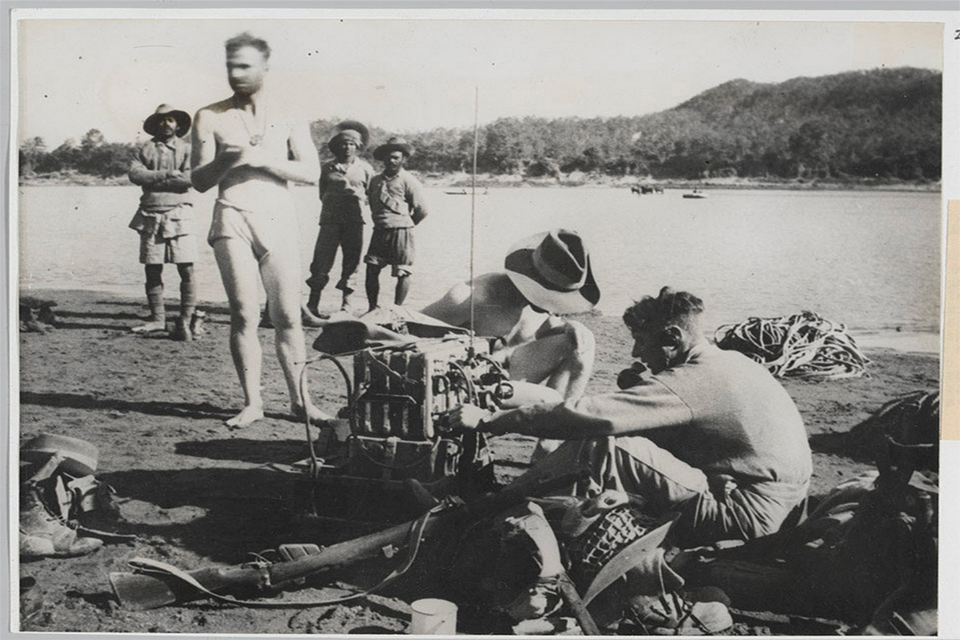
After their retreat, British Forces in India immediately started forming plans to recapture Burma, though the next year saw very little progress. In the early months of 1943, the 77th Indian Infantry Brigade under Brigadier Orde Wingate began Operation Longcloth, driving far behind Japanese lines into the heart of Burma.
RAF signalers attached to the Chindit operations behind Japanese lines in Burma, 1943 The 3,000 man brigade, nicknamed ‘the Chindits’, included British Army and Gurkha regiments and eight RAF sections and signalers. They sabotaged railway lines to limit the movement of the Japanese, and encouraged Burmese resistance groups. However, they suffered heavy casualties. 818 men were killed, wounded or missing – 27 per cent of the original force. Despite their limited results, the Chindits had shown the Japanese were not invincible in the jungle. The British public was inspired by their mission and their operation raised morale among other British troops.
Advance to Victory
‘I have been kicked by this enemy in the place where it hurts, and all the way from Rangoon to India where I had to dust off my pants. Now, gentlemen, we are kicking our Japanese neighbours back to Rangoon.’ - Lieutenant General William Slim to the 11th East African Division, Palel Plain, 1944
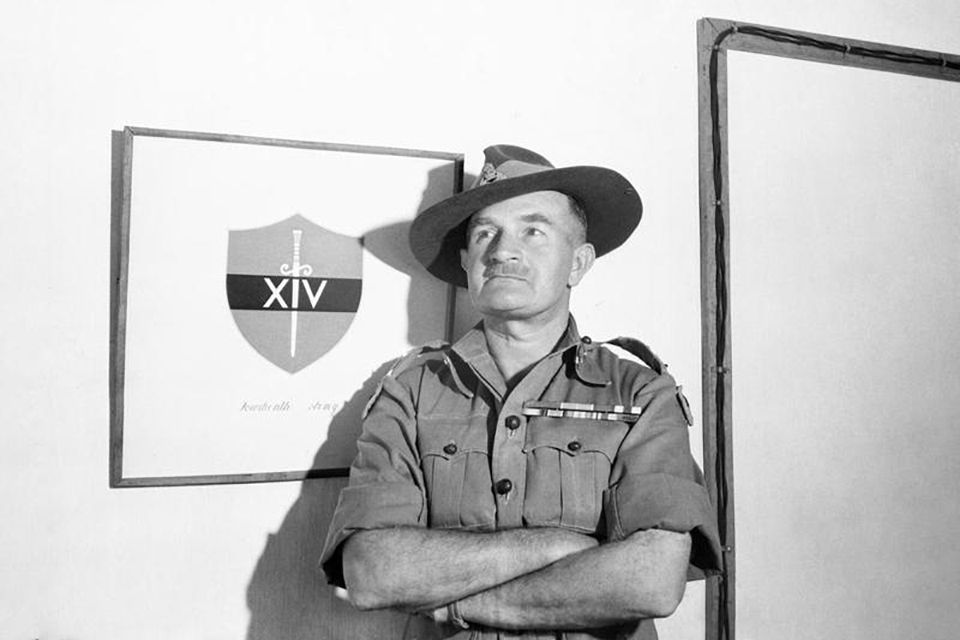
Lieutenant General William SlimIn late 1943, the British created the 14th Army to take over offensive operations against the Japanese under the command of Lieutenant General William Slim. In March 1944, the Japanese launched an attack on British bases behind the Indian Border in Imphal and Kohima. These battles saw some of the worst fighting of the Second World War. At the same time, a second Chindit expedition began, the second-largest airborne invasion of the Second World War with 20,000 British and Commonwealth soldiers and air support provided by the 1st Air Commando, United States Army Air Force. At the Indian base of Kohima, 2,500 British-Indian troops defended Garrison Hill against 15,000 Japanese. In one area, only the width of the District Commissioner Charles Pawsey’s tennis court separated the two sides. When relief forces arrived, the British defensive lines were reduced to a shell-shattered area of only 350 square metres.
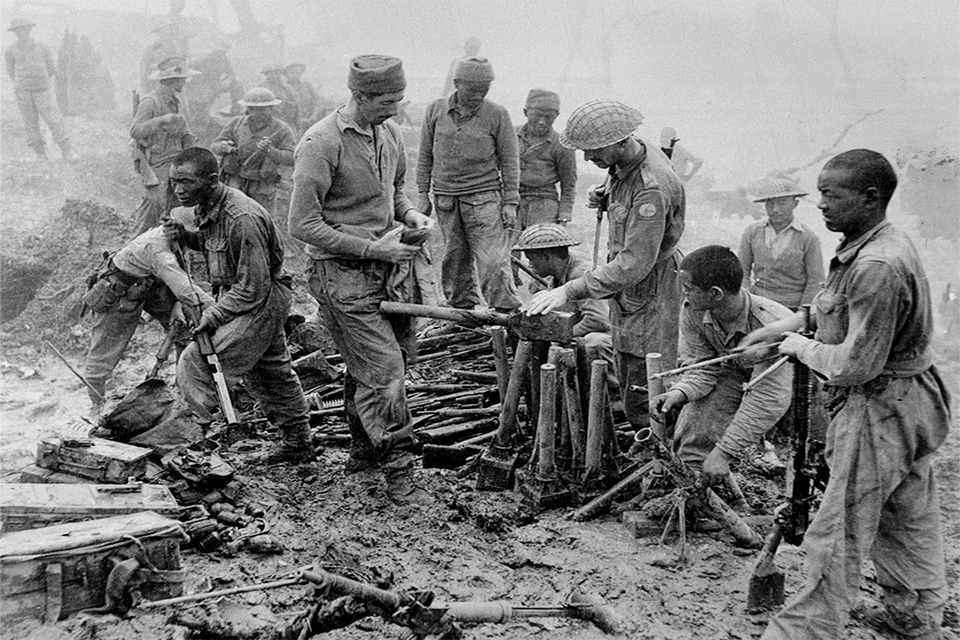
Indian and Gurkha soldiers inspect captured Japanese ordnance during the Imphal-Kohima battle, 1944 (Copyright NAM)
The resolute defence by British and Indian forces, and the monsoon, defeated the Japanese. They had now been broken by multiple battles, and after fierce fighting, central Burmese cities Meiktila and Mandalay were captured in March 1945. This was the decisive battle that effectively ended Japanese hopes of holding Burma. The route south to coastal city Rangoon was now open, and it was a race between the 14th Army and the start of the monsoon. Lieutenant General Slim requested support from the Royal Navy, who redeployed from nearby areas, resulting in a combined air and seaborne victory on 4 May. Burma was a phenomenal victory in the most difficult of circumstances, and was as much a victory over climate and geography as the enemy. It was a victory won through the courage and endurance of troops drawn from across the British Commonwealth, and the superb generalship of Slim. While history has often referred to the Burma campaign as the “forgotten war”, it is clear there is an enormous amount worthy of remembrance.
National Army Museum
The National Army Museum is currently closed for a major redevelopment project, called Building for the Future. Funded by the Heritage Lottery Fund, this £23million project will transform the Museums offer creating five new galleries and offering state of the art facilities. During this closure period, the Museum continues to offer a range of events and activities to get involved in. Find out more atwww.nam.ac.uk.


August 3, 2015, 9:38 pm