Tuesday, August 4, 2015

NAGALAND : Significance of Modi Government's Peace Accord With Nagaland Insurgent Group

SOURCE:
http://indianexpress.com/article/india/india-others/govt-signs-peace-accord-with-nscnim-pm-narendra-modi-says-historic/


Significance of Modi Government's Peace Accord With Nagaland Insurgent Group  
 
 
Published on Aug 3, 2015
 
The Narendra Modi led government and the dominant I-M faction of Nationalist Socialist Council of Nagaland (NSCN) announced Monday the signing of a peace accord which should bring to an end the decades-old insurgency in the hills of Nagaland and districts in the adjoining states.

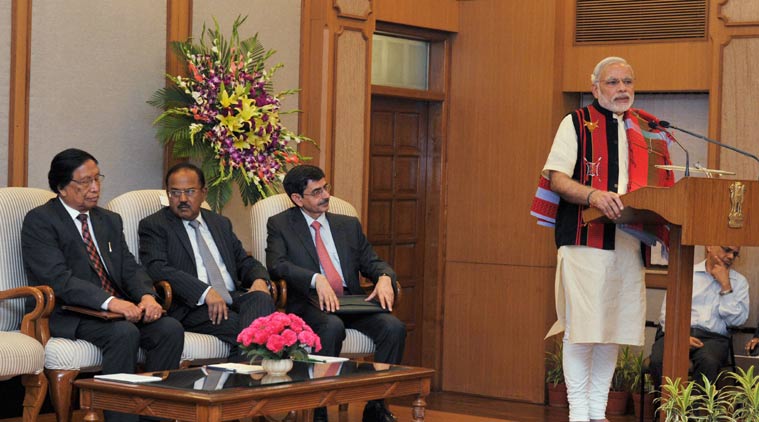
The pact was signed in the presence of the Prime Minister, Home Minister Rajnath Singh and National Security Adviser Ajit Doval by the outfit’s leader T Muivah and government’s interlocutor R N Ravi at the PM’s residence.


********************************************************************************


PM Narendra Modi Announces Historic Peace Deal with Naga Insurgents


It was not immediately clear whether the agreement meets the main demand of NSCN(IM) for integration of all Naga-inhabited areas in the North East across Manipur, Arunachal Pradesh and Assam.


Comments (39)
  • nagaland, NSCN(IM), nagaland peace accord, Narendra Modi, naga insurgent group,  Nagaland, NSCN(IM) peace accord, Government accord NSCN(IM), Nagaland insurgency, Rajnath Singh, Modi peace accord, Modi NSCN(IM), Nation news, india news Prime Minister Narendra Modi.


    Prime Minister Narendra Modi’s peace deal with Nagaland insurgents which he announced Monday rests on a breakthrough formula which does not involve redrawing the state’s borders, highly placed government sources have told The Indian Express.


    Read: How Atal Bihari Vajpayee won Naga hearts


    Instead, the sources said, the deal involves creating a mechanism which would create institutions allowing autonomy to Naga tribes living across the border in Manipur — a significant climbdown by insurgent leaders.


    Related Article
     
     
    chidambaram-m

    Attack no hurdle to Naga peace talks but geography remains tricky as ever
     
    Khaplang-m 

    • The Myanmar Naga who has troubled India for half


    In addition, the sources said, negotiators had agreed to set up a mechanism to discuss decommissioning of arms now held by the NSCN (IM), the National Socialist Council of Nagaland’s Thuingaleng Muviah and Isak Chisi Swu-led faction, the largest of the Naga insurgent groups. The group had been arguing in talks that it needed to retain its weapons to ward off attacks from rival NSCN factions led by Myanmar-based SS Khaplang and Khole Konyak.


    Modi said the agreement did not just mark the end of a problem, but the “beginning of a new future.” He said: “We will not only try to heal wounds and resolve problems, but also be your partner as you restore your pride and prestige. Today’s agreement is a shining example of what we can achieve when we deal with each other in a spirit of equality and respect, trust and confidence; when we seek to understand concerns and try to address aspirations; when we leave the path of dispute and take the high road of dialogue”.

    Read: Towards accord, step by step


    R N Ravi, Modi’s negotiator for the Naga peace talks, said “the agreement will restore the pride of the Naga people and their dignity. Their linguistic traditions will also be promoted. It is only because of misunderstandings that we have been fighting”.


    Video: Significance of Modi Government’s Peace Accord With Nagaland Insurgent Group

          (  app users click here to watch )


                                                                      OR


    Government officials, however, underlined that the agreement was a framework, with many details still to be hammered out. “This deal is without doubt a breakthrough”, said an official involved in the negotiations, “but ensuring it delivers a historic closure to the Naga insurgency will rest on how nimble we are in addressing the many problems that will surface in coming months, especially challenges from rival insurgents”.


    Read: Chronicles of conflict and (attempted) peace


    Though the text of the agreement remained confidential, with officials saying it would be placed in Parliament before being made public, the Prime Minister is understood to have discussed it with former Prime Minister Manmohan Singh, and Congress president Sonia Gandhi, leader of Opposition in Lok Sabha Mallikarjun Kharge, CPM leader Sitaram Yechury, JD(U) leader Sharad Yadav, and even J Jayalalithaa, M Karunanidhi and Sharad Pawar.


    Muivah, who signed the agreement on behalf of NSCN (IM), said the Nagas were entering into a “new relationship” with the government. “Beginning from now, challenges will be great,” he said.


    In a statement issued later, he said that “better understanding” had been arrived at and a “framework agreement has been concluded basing on the unique history and position of the Nagas and recognising the universal principle that in a democracy sovereignty lies with the people.”


    Though New Delhi has been engaged in a ceasefire with the NSCN (IM) since 1997, there was little forward movement on a political settlement. The NSCN (IM) leadership, made up of Tangkhul Nagas from Manipur’s Ukhrul district, insisted that the area be included in a wider pan-Naga entity they called Nagalim — in political terms, a precondition to giving leaders like Muviah a change of holding power in the entire state.


    Ravi, sources said, had held extensive meetings with political leaders and civil society groups in Manipur, where there has been fear that Naga-majority parts of its territory would be ceded to Nagaland in a peace deal. In 2001, tens of thousands of angry protestors burned down the Manipur assembly after the extension of the ceasefire with Naga insurgents, which went into force in 1997.


    The agreement, sources said, marked a personal triumph for Ravi, handpicked as the government’s interlocutor on the North-East by National Security Advisor Ajit Doval, over objections by the Ministry of Home Affairs. Ravi, a former Intelligence Bureau veteran, served for decades in the north-east states. Interestingly, Ravi’s published work suggests he started off as a sceptic on a peace deal with the NSCN-IM.


    In a 2014 article, written soon after his retirement from office, he argued that the “ceasefire with the NSCN (I-M) has resulted in the retreat of the state from the crucial areas of governance and subversion of democratic politics. It is undoing the political and social gains achieved since the creation of the Nagaland State that has been rendered tentative in its aftermath”. He attacked New Delhi’s “abiding faith in the peace process with the NSCN (IM), quintessentially an entity of Tangkhul tribes of Manipur, having little resonance with other Nagas notwithstanding its pan-Naga rhetoric.”


    However, a source familiar with the negotiations said, Ravi’s position changed in the course of multiple consultations he held with civil society groups in Nagaland, with New Delhi coming to the conclusion that an agreement with NSCN (IM) was key towards enhancing democratization.


    The foundations for the agreement were laid in October, 2012, when — as first reported by The Indian Express — the NSCN (IM) agreed, in writing, to accept the Indian Constitution. This meant that it had dropped its decades-long demand for a separate country for the Naga people.


    Following this, the sources said, RS Pandey, the government’s then-negotiator, suggested a deal not involving a contentious redrawing of state boundaries in November, 2013. However, the NSCN (IM) had insisted on the transfer of Naga-dominated areas of the districts of Tamenlong, Senapati, Ukhrul and Chandel in Manipur.


    Events since then may have pushed the NSCN (IM) to settle for a deal short of its Nagalim demand. In December that year, Sumi Naga tribals armed with spears, machetes and shotguns forced the NSCN (IM) to evacuate a camp at Mukalimi in Nagaland’s Zunheboto, burning down down huts, offices and vehicles. NSCN (IM) officials reportedly had to be rescued by Indian Army troops from the mob’s wrath, sparked off by the alleged sexual harassment of two women.


    Earlier that year, protests against proposed reservations for Manipur-based Naga tribes living in Nagaland pitted the newly-formed Naga Tribal Alliance, against the NSCN-IM backed Naga Hoho, which claims to speak for the entire tribe. There have also been protests against the NSCN-IM’s parallel taxation structure, used to fund the insurgent group, which places levies salaries, businesses and contractors.


    Modi promised the agreement would lay the future for a new Nagaland. “You will not only build a bright future for Nagaland”, he said, “but your talents, traditions and efforts will also contribute to making the nation stronger, more secure, more inclusive and more prosperous. You are also the guardians of our eastern frontiers and our gateway to the world beyond”.


    “It is one of the tragedies of Independent India that we have lived with this legacy. There were not many like Mahatma Gandhi, who loved the Naga people and was sensitive to their sentiments”, he said.


    IAS : I. A. S. : ABOLISH THE IAS


                                 ABOLISH THE IAS


                                 Petitioning Head of State, President of India

              Replacement of the IAS and tenured civil services

    with well paid, contractual (hence accountable) public servants


    Continuing with the British imperial services was a wise decision in 1947. However, these services are fundamentally incapable of innovation and efficient delivery of the limited functions that a government should perform.

    The only effective alternative to tenured, unaccountable, inefficient (and being poorly paid, often corrupt) services is market-based recruitment by the head of a department, with all senior roles being on contract. This would allow rapid intake of competent people into the civil services (from across the world, in some cases), and termination without recourse should there be either inefficiency, lack of innovation or (worse) corruption.


    In the past, India has struggled through extreme forms of socialism which distorted production incentives and productivity. These distortions have somewhat alleviated after the liberalisation of 1991, although there is much more to do.

    However, India remains fundamentally ill-equipped to deliver any public policy outcome or service. The biggest drag on India is the IAS and all-India services, as well as associated tenured civil services at the central and state levels. No private organisation will ever survive if tenure were promised. Tenure destroys all incentives that are useful to society.


    We the undersigned call upon you to ask the Parliament - in your next address to the members - to replace India's unaccountable imperial model of administration with a responsive and accountable bureaucracy.

    Indians are a wonderfully competent and innovative, but the Imperial system that we have chosen to impose on ourselves specialises in blocking innovation, competition and progress. Even those who are not corrupt in the IAS and tenured services mostly only care for self-aggrandisement, seeking a tenure in the World Bank or a sinecure as a Governor. 


    You should ask, on behalf of the people of India: Are we to ever grow up and become a free, independent nation, or are we be forever enslaved by civil servants accountable to none?

    How is this change to be brought about? Details are provided in Sanjeev Sabhlok's book, Breaking Free of Nehru (
    http://bfn.sabhlokcity.com/) and in the Sone Ki Chidiya agenda (http://sonekichidiya.in/).


    Note: Sanjeev Sabhlok joined the IAS in 1982 and resigned in January 2001, convinced that continuing in the service is a sure way to participate in the ruin of India. His 18 years experience in the IAS (and more than 14 years in the public service in Victoria, Australia) has convinced him that India is extremely ill-advised to continue with tenured civil services. There are much better models available across the world. But the IAS will never tell you, Mr. President, about them! You have to ask these questions on your own.


      READ THE COMPLETED STAFF WORK


    From: Sanjeev Sabhlok <sabhlok@gmail.com>

    Date: Sun, Aug 2, 2015 at 6:31 AM

    Subject: [PC] My Change.org petition to the President: Replacement of the IAS and tenured civil services with well paid, contractual (hence accountable) public servants
    Do you want good governance in India? One of the critical changes needed is the abolition of the IAS and its replacement with a contractual, accountable public service model.
     
     
    If you agree, please also share it. 
     
    ==THE TEXT OF THE PETITION===


    Continuing with the British imperial services was a wise decision in 1947. However, these services are fundamentally incapable of innovation and efficient delivery of the limited functions that a government should perform.
     
    The only effective alternative to tenured, unaccountable, inefficient (and being poorly paid, often corrupt) services is market-based recruitment by the head of a department, with all senior roles being on contract. This would allow rapid intake of competent people into the civil services (from across the world, in some cases), and termination without recourse should there be either inefficiency, lack of innovation or (worse) corruption.
     
    In the past, India has struggled through extreme forms of socialism which distorted production incentives and productivity. These distortions have somewhat alleviated after the liberalisation of 1991, although there is much more to do.
     
    However, India remains fundamentally ill-equipped to deliver any public policy outcome or service. The biggest drag on India is the IAS and all-India services, as well as associated tenured civil services at the central and state levels. No private organisation will ever survive if tenure were promised. Tenure destroys all incentives that are useful to society.
     
    We the undersigned call upon you to ask the Parliament - in your next address to the members - to replace India's unaccountable imperial model of administration with a responsive and accountable bureaucracy. 
     
    Indians are a wonderfully competent and innovative, but the Imperial system that we have chosen to impose on ourselves specialises in blocking innovation, competition and progress. Even those who are not corrupt in the IAS and tenured services mostly only care for self-aggrandisement, seeking a tenure in the World Bank or a sinecure as a Governor. 
     
    You should ask, on behalf of the people of India: Are we to ever grow up and become a free, independent nation, or are we be forever enslaved by civil servants accountable to none? 
     
    How is this change to be brought about? Details are provided in Sanjeev Sabhlok's book, Breaking Free of Nehru (http://bfn.sabhlokcity.com/) and in the Sone Ki Chidiya agenda (http://sonekichidiya.in/). 
     
    Note: Sanjeev Sabhlok joined the IAS in 1982 and resigned in January 2001, convinced that continuing in the service is a sure way to participate in the ruin of India. His 18 years experience in the IAS (and more than 14 years in the public service in Victoria, Australia) has convinced him that India is extremely ill-advised to continue with tenured civil services. There are much better models available across the world. But the IAS will never tell you, Mr. President, about them! You have to ask these questions on your own.
     
     
    Sanjeev Sabhlok
    BlogLinkedinFacebookTwitter, Skype: sanjeevsabhlok


    Cyber Space : Zero Days- Security Leaks for Sale

    SOURCE:


                       Cyber Space :  Zero Days
                      -Security Leaks for Sale


    THE WEB APPLICTION
     
    HACKERS HAND BOOK
     
    CLICK OPEN READ PRACTICE & USE


    ( CLICK )


    Storyline

    Zero Days
     
      
    The threat of compromised cyber security has become our planet's new weapon of mass destruction. The documentary Zero Days explores the growing concern that the disintegration of online safety has set the stage for potential physical dangers as well. "Our entire power supply can be cut off," a foreboding voice informs us near the opening of the film. "Our systems can be taken over. Hospitals deprived of power would cease to function. It's not if, it's when."
     
     
    The title of the film refers to the oftentimes debilitating vulnerabilities that can be exploited by the seasoned hacker. As outlined in the documentary, the phenomenon of the hacker rose to prominence in the 1980's, as generally innocuous computer nerds made mischief by implanted malware on unsuspecting victims. But what began as little more than a minor annoyance has grown considerably more sophisticated and destructive over the intervening years as these hackers have found a profitable niche in which to employ their considerable skills.
     
     
    Hackers now have the capacity to snatch the personal information of countless millions throughout the globe. They can cripple infrastructure, inspire suspicion between government agencies, and incite hysteria among the masses. They can steal thousands of credit card numbers during a busy holiday season, or manipulate the controls of a nuclear power plant.


    The world's top technological wizards are working around the clock to devise powerful firewalls and encryption, but the threat continues to evolve. These merchants of cyber menace offer their services to the highest bidders. While they exist underground, their employers can be the most public of entities. Governments have been known to utilize the services of hackers in their attempts to gain intelligence or inflict damage on neighboring countries.
     
     
    There is no easy fix to this crisis. Zero Days paints a frightening portrait of a cyber world that is growing far too large and expanding too rapidly to contain. "The bottom line is we are putting so much vulnerable, hackable, connected technology into so many places that this makes us prone to the willpower of any potential adversary or foe," says interview subject and computer security activist Joshua Corman. An impending cyber war will certainly find nourishment from our reliance on the very systems deployed to attack us.

    More Great Documentaries


     MORE HACKERS LITERATURE :

    https://www.google.co.in/?gfe_rd=cr&ei=3ZIMVJP4A-vA8gfGr4CACg&gws_rd=ssl#q=hackers+hand+book+pdf


    Should the Armed Forces Have a Say in Governance?

    SOURCE:


          Should the Armed Forces Have a Say in                  

                             Governance?

                                     By

                        Vishnu Makhijani  


    23rd March 2014

    In 1992, the Indian Army chief, General Sunith Francis Rodrigues, had to apologise to parliament for suggesting that the armed forces had a stake in India's governance.

    One doesn't recall the exact words, but his reasoning went thus:


    "We are first and foremost citizens of India, we pay our taxes, we are willing to lay down our lives for the country; so why should we be at the bidding of politicians without stating our point of view?"


    All hell broke lose, with George Fernandes, who went on to become the defence minister, demanding that Gen. Rodrigues be sacked.

    Despite tremendous public support, the general backed down and issued an apology that was read out in parliament. It took a while before he was rehabilitated, first on the National Security Advisory Board and then as Punjab governor.


    This was not the first time a four-star officer had spoken out his mind.

    Way back in the early 1950s, General K.M. Cariappa, as army chief, had wanted to send additional troops to Jammu and Kashmir but was forestalled by prime minister Jawaharlal Nehru.


    Gen. Cariappa took the unprecedented step of appealing to president Rajendra Prasad, the supreme commander of the armed forces, and Nehru had to backtrack.


    After his retirement, Gen. Cariappa frequently declaimed on the need for effective governance. He was promptly shunted off to Australia as the Indian high commissioner as the government feared he could engineer a coup!

    In the mid-1980s, Lieutenant General S.K. Sinha, then the senior-most officer after the army chief, General K.V. Krishna Rao, and who was expected to move into the top job, was passed over in favour of Lieutenant General A.S. Vaidya, then the General Officer Commanding-in-Chief, Eastern Army Command.


    His "crime"?

    Repeatedly opposing the deployment of the army on internal security duties, the reason being:


     "If I have to ask my troops to fire on their fellow citizens (to quell riots and other disturbances), how do I expect them to lay down their lives for the country in the case of a war?"


    But there was another aspect to this.


     Most unlike a serving armed forces officer, Lt. Gen. Vaidya had openly supported then prime minister Indira Gandhi's decision to enter into an alliance with a tribal outfit in Tripura that had strong militant links.


    But then, things haven't always been negative and a shining example of this is the perfect understanding that existed between Indira Gandhi and the then army chief, General (later Field Marshal) Sam Manekshaw, on the conduct of the 1971 war that led to the creation of Bangladesh out of East Pakistan.


     Ever the no-nonsense officer Gen. Manekshaw made it amply clear that he would not be bulldozed and demanded some nine months to be fully ready.
    Indira Gandhi had no option but to acquiesce and thus, while Bangladesh declared its independence on March 26, 1971, the war began only on December 3 of that year. The result was a clinical victory on the eastern and western fronts.

    The question is:
    Had such a situation existed in the early 1960s, would the 1962 India-China war, whose reverberations are still being felt half a century later, happened?


    The top secret Henderson-Brooks report posted online by Australian journalist Neville Maxwell on his blog earlier - its contents were hardly a secret as it formed the basis of his seminal work "India's China War" - makes it amply clear that there was a yawning mismatch between the government's thinking and that of the armed forces.


    "It is obvious that politically, the Forward Policy (of Jawaharlal Nehru) was desirable and presumably the eviction of the Chinese from Ladakh must be the eventual aim. For this, there can be no argument, but what is pertinent is whether we were militarily in a position at that time to implement that policy," the report says.

    That's not all.


    "The government, who politically must have been keen to recover territory, advocated a cautious policy whilst Army HQ dictated a policy that was clearly militarily unsound," the report adds for good measure.


     Would this mismatch had been there if there were a better interface between the government and the military? Most certainly not!


    In fact, there are reports that a war game conducted in 1960 had pointed to a possible Chinese invasion. However, when the three-star officer who conducted the war game moved to become Indian Army chief, the report was quietly shelved, apparently at the government's instance.


    Why then has such contraditory situations existed for so long?


    Because of the traditional bureaucracy-driven trust-deficit that exists with the armed forces - exemplified most recently when Gen. V.K. Singh was army chief and moved a large body of troops in January 2012, rattling the top echelons of the government.


    It is this trust-deficit that has prevented the implementation of one of the most crucial defence reforms since Independence: the creation of a Chief of Defence Staff (CDS) as a one-point reference for the government on all matters military. The bureaucracy fears that the CDS could become so powerful that he could come to overshadow them.

    The 21st century is far removed from the situation that existed during the First Gulf War (1991), an event that many believe has shaped modern-day strategic thinking as exemplified by the events that followed: the Second Gulf War and the US-led NATO operations in Afghanistan.
    While the armed forces have kept up with contemporary developments, the government, unfortunately, remains tied to the past.

    It's time to shed the sloth and come together for the common good if India is to take its rightful place on the global stage.


    Vishnu Makhijani is an Associate Editor at IANS.

    He can be contacted at vishnu.makhijani@ians.in

    The views expressed are personal.

    ----------------------------------------------------------------------------------------------------
    DOWN " HISTORY LANE " :

    http://www.tribuneindia.com/2006/20060212/spectrum/main2.htm

    RIN mutiny gave a jolt to the British
    Dhananjaya Bhat February 12, 2006
    [The ratings mutiny in the Royal Indian Navy made the British realise it was time to leave India.]

    WHICH phase of our freedom struggle won for us Independence?
     
    Mahatma Gandhi’s 1942 Quit India movement or The INA army launched by Netaji Bose to free India or the Royal Indian Navy Mutiny of 1946?
     
    According to the British Prime Minister Clement Attlee, during whose regime India became free, it was the INA and the RIN Mutiny of February 18-23 ,1946 that made the British realise that their time was up in India.
     
    An extract from a letter written by P.V. Chuckraborty, former Chief Justice of Calcutta High Court, on March 30 1976, reads thus:

     "When I was acting as Governor of West Bengal in 1956, Lord Clement Attlee, who as the British Prime Minister in post war years was responsible for India’s freedom, visited India and stayed in Raj Bhavan Calcutta for two days`85 I put it straight to him like this: ‘The Quit India Movement of Gandhi practically died out long before 1947 and there was nothing in the Indian situation at that time, which made it necessary for the British to leave India in a hurry. Why then did they do so?’ In reply Attlee cited several reasons, the most important of which were the INA activities of Netaji Subhas Chandra Bose, which weakened the very foundation of the British Empire in India, and the RIN Mutiny which made the British realise that the Indian armed forces could no longer be trusted to prop up the British.


    When asked about the extent to which the British decision to quit India was influenced by Mahatma Gandhi’s 1942 movement, Attlee’s lips widened in smile of disdain and he uttered, slowly, ‘Minimal’."
     
    Strangely enough, like the chapattis which went all around India during the 1857 First War of Independence asking the nation drive away the British, it was 20 loaves of bread that started this so-called RIN Mutiny. It was a reaction against the high-handed behaviour by British officers of the RIN.
     
    On January 16, 1946, a contingent of 67 ratings of various branches arrived at Castle Barracks, Mint Road, in Fort Mumbai. This contingent had arrived from the basic training establishment, HMIS Akbar, located at Thane a suburb of Mumbai at four in the evening. The officer on duty informed the galley (kitchen) staff of this arrival. Quite casually, the duty cook, without winking an eyelid, took out 20 loaves of bread from the large cupboard and added three litres of tap water to the mutton curry as well as the gram dal which was lying already cooked before as per the morning strength of the ratings.
     
    On that day, only 17 ratings ate the watery, tasteless meals, while the rest went ashore and ate. When reported to senior officers present, this grievances practically evoked no response and the discontentment continued to build up.
     
    These complaints continued to agitate the ratings and a naval central strike committee was formed on February 18, 1946. It was led by naval rating M.S Khan. Soon, thousands of disgruntled ratings from Mumbai, Karachi, Cochin and Vishakhapatnam joined them.
     
    They communicated with each other through the wireless communication sets available in HMIS Talwar. Thus, the entire revolt was coordinated.
     
    The unrest spread to shore establishments from the initial flashpoint in Bombay to Karachi and Calcutta, involving 78 ships, 20 shore establishments and 20,000 sailors.
     
    The next morning, the Tricolour was hoisted by the ratings on most of the ships and establishments.
     
    The third day came charged with fresh emotions. Sardar Patel’s statement of assurance did improve matters considerably. However, an unruly guncrew of a 25-pounder gun fitted in an old ship, fired a salvo, without orders from the strikers, towards the Castle barracks and blew off a large branch of an old banyan tree. By this time the British destroyers fully armed to go into action arrived and had positioned themselves off the Gateway of India in Mumbai.
     
    The RIN Mutiny was treated as a crisis of the empire by an alarmed British cabinet and Attlee Clement, ordered the Royal Navy to put down the revolt.
     
    Admiral Godfrey, the Flag Officer commanding the RIN, went on air with his order "Submit or perish".
     
    The next day, the RAF (Royal Air Force) threatened the defiant RIN ships by flying a squadron of bombers low over Bombay harbour even as Admiral Rattray, Flag Officer, Bombay, RIN, issued an ultimatum asking the ratings to raise black flags and surrender unconditionally.
     
    Both Muhammad Ali Jinnah and Sardar Patel successfully persuaded the ratings to surrender.
     
    Patel wrote, "Discipline in the army cannot be tampered with. We will want [the] army even in free India".
     
    Mahatma Gandhi, criticised the strikers for mutinying without the call of a ‘prepared revolutionary party’ and without the ‘guidance and intervention’ of ‘political leaders of their choice’.
     
    The issue remained unresolved till the morning of February 23, when the hopeless situation produced a vote of surrender. The black flags went up at six on the morning of February 23.
     
    The negotiations moved fast, keeping in view the extreme sensitivity of the situation and most of the demands of the strikers regarding welfare measures were conceded in principle. Immediate steps were taken to improve the quality of food served in the ratings’ kitchen and their living conditions. But these were followed up by court martials and large-scale dismissals from the service. None of those dismissed were reinstated into either of the Indian or Pakistani navies after Independence.
     
    But the brave sailors had demonstrated to the British that they would rise in defence of their motherland, thus leaving the foreign imperialists little option but to quit.
     
    Today a memorial to the brave RIN ratings, completed by the Indian Navy in 2002, stands in the busy Colaba area in Central Bombay.

    ISLAMIC STATE GRUESOME HISTORY ; Sex Slaves Sold by Islamic State, the Younger the Better


    SOURCE:
    http://www.msn.com/en-in/news/world/sex-slaves-sold-by-islamic-state-the-younger-the-better/ar-BBlmSGq?li=BBirI26


    Sex Slaves Sold by Islamic State, the Younger the Better 


    Bloomberg) -- A senior United Nations official says Islamic State is circulating a slave price list for captured women and children, and that the group’s ongoing appeal and barbarity pose an unprecedented challenge.


    The official, Zainab Bangura, said that on a trip to Iraq in April she was given a copy of an Islamic State pamphlet, which included the list, showing that captured children as young as one fetch the highest price. The bidders include both the group’s own fighters and wealthy Middle Easterners.
     
    The list shows the group’s view of the value of those it captures and surfaced some eight months ago, though its authenticity came under question. Bangura, who is the UN special envoy on sexual violence in conflict and was also in Jordan and Turkey, said she has verified that the document came from Islamic State and reflects real transactions.
     
    “The girls get peddled like barrels of petrol,” she said in an interview last week in New York. “One girl can be sold and bought by five or six different men. Sometimes these fighters sell the girls back to their families for thousands of dollars of ransom.”
     
    For Islamic State fighters, the prices in Iraqi dinars for boys and girls aged 1 to 9 are equal to about $165, Bangura said. Prices for adolescent girls are $124 and it’s less for women over 20.
    The militia’s leaders first take those they wish, after which rich outsiders from the region are permitted to bid thousands of dollars, Bangura said. Those remaining are then offered to the group’s fighters for the listed prices.
     
     
    Verified List
     
    Bangura, a Muslim and former foreign minister of Sierra Leone, said that Islamic State, which rules some 80,000 square miles across swathes of Iraq and Syria, is unlike other insurgent groups and challenges all known models of fighting them.
     
    “It’s not an ordinary rebel group,” she said. “When you dismiss them as such, then you are using the tools you are used to. This is different. They have the combination of a conventional military and a well-run organized state.”


    ---------------------------------------------------
    More on the Islamic State


    ---------------------------------------------------


    Officials and scholars have struggled to understand Islamic State’s success despite breaking what are widely seen as rules for insurgents -- to be sure to mingle with local populations, not take on established militaries or try to hold territory. The group has broken all those rules and draws thousands of foreign fighters despite its well-publicized savagery.
     
     
    Spread Fear

    Kerry Crawford, who teaches at James Madison University in Harrisonburg, Virginia, said that publicizing the violations is used to the group’s advantage by building internal ties and external fear.
     
     
    “If you and your group are doing something that is considered taboo, your doing it together forms a bond,” she said. “Sexual violence does really create fear within a population.”
    She also said that sexual abuse by soldiers has a long history including the so-called rape camps in the former Yugoslavia in the 1990s.
     
     
    Islamic State has made a particular practice of enslaving communities it has conquered that are not Sunni Muslim -- Yazidis and Christians, for example.  It portrays such conquests as God’s work, drawing disaffected Muslims from around the world.
     
     
    Bangura said the international community and the UN have been taken aback by such practices because they do not resemble those of village militias in other countries.
    “They have a machinery, they have a program,” she said. “They have a manual on how you treat these women. They have a marriage bureau which organizes all of these ‘marriages’ and the sale of women. They have a price list.”


    To contact the reporter on this story: Sangwon Yoon in New York at syoon32@bloomberg.net
    To contact the editors responsible for this story: Nikolaj Gammeltoft at ngammeltoft@bloomberg.net; Ethan Bronner at ebronner@bloomberg.net Flavia Krause-Jackson, Ethan Bronner


                         FIFTY EIGHT STORIES
                                  READ
                        BY CLICKING BELOW 
                   TO "PREVIOUS   or NEXT "