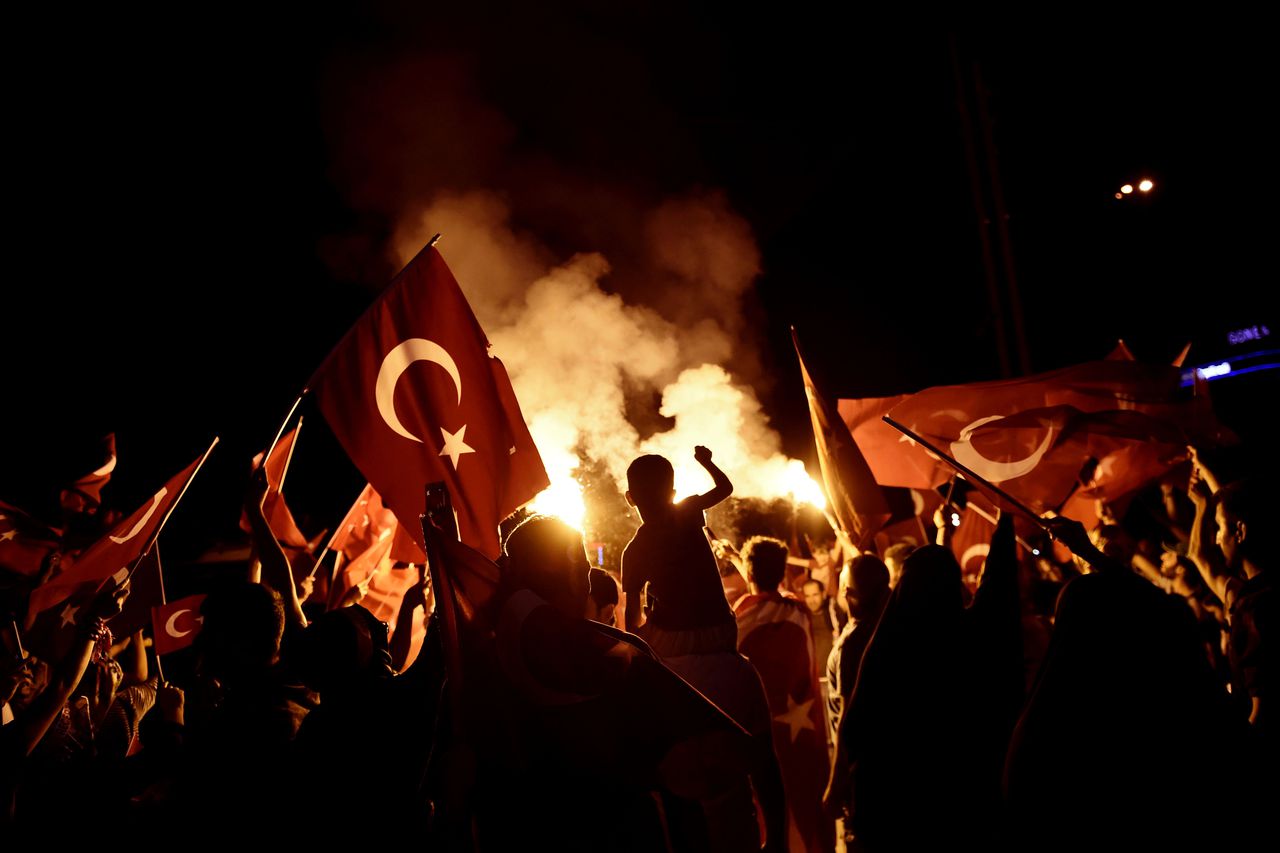
Pro-Erdoğan supporters wave Turkish national flags during a rally at Taksim square in Istanbul on July 18, 2016, following the military failed coup attempt of July 15.ARIS MESSINIS/AFP/Getty Images
A lot is still uncertain about the failed coup in Turkey on July 15, but one thing seems clear: The coup leaders believed they were acting in a long Turkish military tradition of protecting Turkey’s democracy from its elected leaders. Since 1960, the military has seized the reins of power in Turkey four times, acting, in their view, to guard the values of the Turkish republic from those who would threaten it.
This time the threat, they thought, came from Turkish President Recep Tayyip Erdoğan.
Erdoğan, who won a heated presidential election in 2014 after a long span as prime minister, has governed in an increasingly authoritarian fashion: censoring the press, arresting political opponents, brutally quashing protests, and attempting to abrogate greater and greater powers to his office. While eschewing radical Islamist movements and publicly reaffirming secularism, he’s given a stronger role to religious education and ramped up his own Islamic rhetoric.
It’s hard to puzzle out the truth amid the events of what Kerem Öktem, a professor of Southeast European studies and modern Turkey at the University of Graz,described to me as a “hyperreal coup,” where both Erdoğan and some of his opponents are “blurring the line between reality and fabrication.”
On the surface, the coup was the most recent exchange of fire between popularly elected leaders and a military that believes it, not the voters, knows best how to guard the country’s democratic legacy. But behind that, there’s a morass of conspiracy accusations, deep-rooted paranoia, and real plots that goes back decades.
Why does the army think it’s so special?
Since the founding of modern Turkey in 1922, the army has seen itself as the most important part of the country. Much of that is because of the man who made the nation, Mustafa Kemal — better known as Atatürk, “Father of the Turks.” (That’s a surname given to him by a grateful people in 1934, not the world’s greatest case of nominative determinism.) Go anywhere in Turkey and you’ll pass by busts of Atatürk gazing paternally down on the country he made.
Keystone/Getty ImagesMustafa Kemal Atatürk (1881-1938), Turkish general, nationalist leader, and president. Photo circa 1916.
Before Turkey, there was the Ottoman Empire, which by World War I was a crumbling, failed power trying desperately to reform. When the Ottomans picked the losing side in the war, it proved the final blow to the imperial system. Atatürk, one of the few successful Ottoman generals, carved the new, modern Turkish state out of the ruined body of the empire, establishing Turkey as we know it today.
He did so in the teeth of opposition from the victors, who had planned to split the Ottoman territories up between them, dividing up the fallen empire in a treaty signed in Sevres, France, in 1920. Brilliant resistance by Atatürk, including successful campaigning against an invading Greek army and others, produced the new nation.
That gave the army the most respected place in the new Turkey, but it also created a permanent military-political anxiety: “Sevres syndrome,” the belief that the rest of the world was always conspiring to split up Turkey. Outside forces weren’t the only enemy, however: Atatürk was determined to drag his country kicking and screaming into the modern world, and he saw religion as one of the chief obstacles to that.
The Ottomans had positioned themselves as the ordained leaders of Sunni Islam, but for Atatürk, Islam had been a dead weight on the country’s progress. Although he used religious language in public and claimed to be a Muslim in his autobiography, he was probably an atheist, or at least a tough-minded agnostic.
Atatürk borrowed a French idea, laïcité, the control of religion by the state. He brought religious bodies under the hand of the government, suppressed religious courts, changed the weekend from Friday and Saturday (the custom in most Muslim countries, since Friday is Islam’s holy day) to the Western style of Saturday and Sunday, and banned religious headgear for all but a select few.
The religious reforms were just one part of a much wider modernization program that included banning the traditional Turkish hat (called a fez) and switching from Arabic to Roman script, as well as visionary plans to promote women’s education, work, and political involvement. But while nobody was that attached to the fez, religious feeling would prove much harder to root out.
Independent Picture Service/UIG via Getty ImagesStreet vendor selling red fezzes and scarves, Turkey.
However, while the leaders of the new republic were secularists, even atheists, they were decidedly Sunni secularists — men who, as a local adaptation of a popular joke has it, believed “there is no Allah, and he chose Abu Bakr to lead the caliphate.” Mainstream Sunni institutions got softer treatment than more unorthodox forms of Islam like Sufism, yet alone Shia Muslims or Christians.
(This legacy lingered; when I worked at the Greek Orthodox Patriarchate in Istanbul in 1994 as a teenager — I had an unusual childhood — the priests there had to switch from their clerical robes to business suits whenever they went outside to avoid being charged under the secularist laws. It was vanishingly rare for such a charge to be brought against Islamic preachers.)
That gave them the space to survive, and eventually to thrive again — and to play the role in politics that Atatürk had most feared.
Keeping democracy in hand — over and over again
After Atatürk’s death in 1938, “Kemalism,” as his policy of reform, secularization, and national unity came to be known, became the guiding ideal of the army, especially the officer class. With Islam out of fashion, Kemalism was the new faith, and Atatürk’s massive mausoleum, with its murals depicting the army guarding the republic, was its Mecca.
While Turkey was a one-party state, it was easy for the military to directly retain control. But as the country democratized after World War II, the growing power of the civilian government and a revival in religious practice increasingly worried military elites who saw themselves as the guardians of Atatürk’s legacy — especially against Islamic influence. The army still enjoyed plenty of privileges, including separate military courts that made its members virtually immune from civilian oversight or prosecution.
Yet that wasn’t enough. The military intervened repeatedly to keep Turkish democracy on what it thought was the right course in times of instability, staging forceful coups in 1960 and 1980 and effectively dismissing prime ministers from office in 1971 and 1997.
AA/Anadolu Agency/Getty ImagesFormer commander of the Turkish Air Force and one of the leaders of the 1980 military coup Tahsin Sahinkaya (second right), who died at the age of 90 in a hospital in Istanbul, Turkey, on July 9, 2015, is seen with former commander of the Turkish Armed Forces Kenan Evren (center), former Turkish Naval Forces commander Nejat Tumer (left), former chief of the Army Nurettin Ersin (second left), and former commander of the Turkish Gendarmerie Forces Sedat Celasun (right) during a Turkish Victory Day parade on August 30.
It banned numerous political parties, especially ones with strong Islamic ties. But at first, the main targets tended to be the left, particularly groups sympathetic to Turkey’s embattled Kurdish minority. In its self-appointed task as the “guardian of democracy,” the military committed numerous atrocities.
The worst period was in the aftermath of the 1980 coup, when hundreds of thousands of citizens, mostly young people with left-wing sympathies, were arrested and tortured. Each time, democracy was eventually restored, but with considerable restraints imposed by the army
But it’s the 1997 coup that perhaps most typified Kemalist fears. Instead of being triggered by generalized instability, it targeted the power of the Islamic parties. These parties were riding a wave of renewed popularity — in large part because the military’s earlier actions had repressed more secular opposition groups and nearly shattered the left. The army’s thuggish excesses had ended up creating the very thing Kemalists most feared: a widely popular Islamic opposition.
It was this atmosphere that created the massive success of Erdoğan, a former mayor of Istanbul. His four-month prison sentence for reading an aggressively Islamist poem in 1997 only served to give him extra credibility to a public fed up with the military’s controls.
Erdoğan’s Justice and Development Party (more commonly known by its Turkish acronym, AKP) won a sweeping electoral victory against a divided opposition in 2002. Combined with a sudden economic boom in the early 2000s, this gave Erdoğan the mandate he needed to fight off Kemalist resistance.
The military, put off balance by the AKP’s success and as enthusiastic about Turkey’s sudden economic might as anyone else, failed to act. For his part, Erdoğan seemed to prefer pragmatism to Islamism, reassuring the public that he represented an accepting, compromising form of Islamic politics.
Turkey’s “deep state”: a political underworld
But to understand the atmosphere of fear and distrust swirling in Turkey, you need to take into account not just the military, but what Turks call the “deep state.” Buckle up, because things are about to get really weird.
You know your friend on Facebook who posts about how 9/11 was a CIA plot, Sandy Hook a false flag operation, and that Obama secretly conspired with Pakistan to kill Osama bin Laden? Imagine that everything he said was, if not true, at least plausible, and you have some idea of what the deep background of Turkish politics looks like. Attempting to map out the relationships between the powerful ends up looking like one of those crazy boards full of string where the Illuminati control the Boy Scouts.
NICHOLAS KAMM/AFP/Getty ImagesLike this, only slightly more plausible.
The term to know here is “deep state,” or devin devlet, a term coined in the 1970s to describe the shadowy anti-democratic cabals that allegedly linked the military, organized crime, terrorists, foreign and domestic intelligence agencies, the government, and the judiciary in Turkey.
A loose outline goes like this: From the 1950s onward, backed by CIA funds under the anti-communist “Operation Gladio” — a Europe-wide program to create stay-behind forces in the event of Soviet invasion — elements within the Turkish military suborned numerous other groups to pursue their agenda.
This included ties to organized crime and heroin smuggling, especially from the 1970s onward, and the use of ultranationalist terrorist groups such as the Grey Wolves, a fanatic pan-Turkic movement, to create instability and murder the military’s enemies.
There’s no doubt that many of these conspiracies are, or were, real, and that elements in the Turkish military have always been willing to use dirty tricks, murder, terrorism, and repression to achieve their goals. The basement of Turkish politics is deep, dark, and full of spiders.
But the idea that all the various plots are part of one deeper, continuous conspiracy is only half-true. The problem is that the “deep state” has always reflected the worst fears of those making accusations about it. To Islamists, its fundamental purpose is to crush religion; for liberals, it’s anti-democratic; for Kurds, it’s fanatically nationalist and anti-Kurdish; for nationalists, it’s secretly in league with the US; for anti-Semites, it’s an Israeli-backed scheme.
A labyrinth of conspiracies, some overlapping with each other, and many undertaken primarily to line the pockets of their backers, seems far more likely than a single, centrally directed grand conspiracy. But agencies inside the military, such as the “Special Warfare Department” and “Gendarmerie Counter-Terrorism Unit,” were undoubtedly the minotaur at the heart of the labyrinth, crunching on the bones of thousands of sacrificial victims.
By the 2000s, the Turkish public was fed up with being lied to, eager for change, and a massive producer and consumer of new media. Major scandals in the late 1990s exposed the dirty links between the security forces, the government, and organized crime and fueled a desire to see the “deep state” exposed.
The increased openness, and the AKP’s anti-Kemalist sentiments, brought some of the atrocities of the past to light. The perpetrators of past coups were put on trial. Constitutional reforms weakened the role of the military, especially its courts. The reputation of the army plummeted in Transparency International’s surveys, from the most trusted national institution in 2004 to being perceived as just as corrupt as politicians by 2011.
Yet the idea of the deep state also acted as a vehicle for a new wave of political persecutions, and as a shield for the corrupt to defend themselves against accusations. That’s been particularly the case for Erdoğan, an enthusiastic campaigner for the “annihilation” of the deep state.
The exemplar was the 2008 Ergenekon accusations, where hundreds of defendants — a mixture of military officials and civil leaders — were blamed for a secret plot to overthrow the government. That plot possibly existed, in some form or another, but it was also clear that many of the defendants were there for opposing Erdoğan, and that the campaign was a way to further his own power.
Islam Yakut/Anadolu Agency/Getty ImagesSedat Peker, alleged Mafia leader with links to the “deep state” in the Ergenekon coup plot case, is released from Silivri Prison in Istanbul on March 10, 2014.
Think of McCarthyism in the US. There were real Communist infiltrators, but their numbers were tiny compared to the frenzy of accusations hurled by McCarthy for the sake of his own career.
So it is with Erdoğan: As the coup has bloodily shown, he has real and dangerous opponents — but his accusations have always gone far beyond their real numbers, and threaten innocent and guilty alike. (This prescient 2012 New Yorker profile by Dexter Filkins is worth reading in full.) The Sledgehammer accusations in 2010, another supposed military plot, served the same purpose as Ergenekon while being even less plausible.
Instead of bringing a cleansing light to Turkish politics, then, the AKP-led attacks on the “deep state” ended up being part of the transformation of its own support base into a new form of the deep state.
“There is plausible circumstantial evidence that the old deep state, together with new additions, is back on the streets,” Öktem told me. “The kind of violence and symbolic humiliation and extrajudicial killings is extremely reminiscent of the 1990s, when deep state operatives were pretty much ruling the Kurdish provinces. The novelty is the presence of actors who seem to use a jihadist rhetoric and a deeply religious language.”
False flags and exiled teachers
Complicating this is the role of Fethullah Gülen, a charismatic Islamic preacher, businessman, and educator who has built up a massive movement in Turkey since the 1970s (although he’s lived in the US since 1999 for “health reasons”).
His movement emphasizes modernity, community, and social action, and he has strong ties to Sufism, a peaceful, esoteric Islamic tradition with a long history in Turkey. This let him build up his power base while being seen as a potential ally to every side.
Even his form of Islam was acceptable to the Kemalists, with its emphasis on private worship and obedience to the Turkish state; it also struck a chord with millions of Turks who valued faith but didn’t want it to dominate life.
The Gülenist movement emphasized joining the state in order to gradually shift it toward Islamic ideals; thousands of military and police officers, judges, and civil servants were members or sympathizers, often owing their job to other Gülenists.
OZAN KOSE/AFP/Getty ImagesEmbroidered images of Fethullah Gülen (left) and Turkey's Prime Minister Recep Tayyip Erdoğan (right) are displayed in a shop on January 17, 2014, in Gaziantep, near the Turkish-Syrian border.
At first, Gülen was a strong ally of Erdoğan. Gülenist media cheered on the Ergenekon case and called for the destruction of the old “deep state.” The Gülenists could be ruthless in exploiting their power, too; investigative journalist Ahmet Sik was detained for a year, and his work destroyed, when he wrote a book on the movement.
But in late 2013, Erdoğan turned on Gülen and his followers, accusing them of being the new deep state, working to subvert the intelligence services and overthrow his government Although tensions had been building for some time, the immediate cause was a corruption scandal involving the children of senior AKP leaders, including Erdoğan, which the president claimed was a plot by the Gülenists.
Today, Gülen functions in Erdoğan’s rhetoric in much the same way Leon Trotsky did in Joseph Stalin’s: as a traitor and manipulator who can be blamed for everything that goes wrong. Gülen’s supporters have been systematically purged from the police and the government.
It is no surprise, then, that Erdoğan immediately accused the Gülenists of masterminding Friday's coup attempt. While it is unclear at this point whether Gülen and his followers were in any way involved (which they have flatly denied), it’s certainly possible, since the army was virtually the only area that hadn’t yet been ideologically cleansed since 2013.
That meant there was still a substantial collection of officers with Gülenist ties, as there had been in every Turkish institution before the purges. They had good reason to fear that they might be the next target — which could have been what prompted the sloppy and ill-planned coup.
But in a twist typical of conspiratorial politics, Turks opposed to Erdoğan, including Gülen, are already accusing him of being behind the plot. That seems an improbable and highly risky move.
Yet he’s seizing the chance to eliminate his enemies, calling the coup a “gift from God.” The event is being compared to the 1933 Reichstag fire that gave Hitler his final excuse to seize absolute power; Erdoğan has said outright in the past that he admires Hitler’s “reforms.”
The military’s threat to Turkish democracy may now be over, perhaps for good. But with it may go other aspects of the Kemalist legacy: a desire to look to Europe, a preference for the modern and the urban, and the will to keep religion from dominating politics.
Erdoğan’s populist authoritarianism threatens a frightening change in Turkey — a dictatorship with the barest veneer of democracy laid over it as cover, fueled by resentment and religious conviction, and drawing in elements from jihadists to intelligence officers to organized crime to shield itself and assault its enemies.
Disturbing pictures of soldiers lynched on the street are already emerging, although it’s hard to tell whether these represent semi-organized violence by Erdoğan-affiliated militias or the fury of the crowd in response to the army’s own killings. Erdoğan has begun a wave of rolling purges and arrests removing the last vestiges of his political and judicial opposition.
Despite their fear of Erdoğan, the opposition turned out into the streets that night to save democracy from the military. Whether they can keep together to defend the rights the Turkish people faced down tanks to protect is another question.
James Palmer is a writer and historian living in Beijing.
Every Hour of Prime Time TV Aggression Pushes Kashmir a Mile Westward From India By There is an urgent need for India to reclaim “NATIONAL INTEREST ” from its national media. Written by Shah Faesal | Updated: July 19, 2016
On the afternoon of July 13, my one-year-old child was finding it difficult to sleep because the adjacent curfewed street had been rattling with a sinister medley of azadi slogans and tear-gas explosions since daybreak. In a conflict zone, introduction to violence is a part of a child’s baptism. So here I was witnessing the exact moment when my child was getting marked as a Kashmiri — the tabula rasa of his mind impacted by history, much before he would be circumcised and officially marked as a Muslim. Kashmir had knocked at his conscience much before Islam. Three decades ago, I was in a similar moment with my father stroking me to sleep while mortar shells were pounding the hills in our backyard. Interestingly, the afternoon marked yet another familiar yet bloody rendezvous between the Valley’s past and present — it was 85th [ count from 1931] Martyr’s day. But the street unrest had a rather unusual trigger this time — the death of a young militant commander at Kokernag on July 8. Around the same time, I was alerted by an unknown caller that Zee News had been running a marathon discussion for past two days on the current crisis, and my photographs and videos were also being juxtaposed with the visuals, dead and alive, of young local militants from Kashmir, as some sort of a clash of role models. It perturbed me a lot — not only for the sheer insensitivity and shallowness with which this was being done but also for the security risk that it posed to my life. I was puzzled because with a Rs 50,000 monthly salary and a Rs 50 lakh housing loan I was certainly not the best example of a successful Kashmiri youngster.
More so when the only measure of greatness here is the size of one’s funeral procession. Who would want to die for Rs 50,000 and die unattended, at that. My fears were proven right: Soon, I was told, there was a huge mob outside our colony, rallying against the remarks of the Zee News anchor asking the dead militants to be burnt along with garbage instead of being buried in India’s land; the studio and the street were competing with each other. Next day, I left for my office, incognito, wearing a kurta-pyjama and a farmer’s cap, hopping across check posts like a thief, knowing well that if a group of enraged youngsters recognised me, I might be in trouble, and rightly so, for falling on the wrong side of the Kashmiri vs Indian binary at such a critical juncture. Abusive comments on my Facebook wall had the same refrain. In the last few years, a section of the national media has been misrepresenting the idea of India in Kashmir, as part of a business strategy. It has also been projecting lies about Kashmir to rest of the country. It happened in 2008, in 2010, and in 2014. So there is nothing surprising about the tilt and the timing of this debate. Almost all the programmes on Kashmir right now are aimed to provoke people, the coverage is selective, and intention appears to be to compound the problems for the state government. The print media, though, has always maintained balance. What made the current round of commercial savagery by a few news channels even more tragic was that they continued to promote falsehoods, dividing people, creating hatred, completely disregarding the values of democracy and secularism, even when people were dying and the government was trying hard to calm down people’s passions. It did not stop even after appeals were made to de-escalate. This brazenness to market TRPs as national interest and do business over the dead bodies of young men was the worst aspect of these loud newsrooms. Kashmir or no Kashmir, the biggest challenge for India, this time, is how to reclaim the custody of “national interest” from its national media, and restore communication with its neighbours and people. I have no hesitation in saying that Zee News, Times Now, NewsX and Aaj Tak are at the vanguard of a movement that will take India from a dialogical civilisation to a dumb, illogical civilization. In the Indian tradition, the state is supposed to communicate with its people through accommodation, not harangue, and through welfare, not violence. Ashoka put together a network of pillars and edicts to communicate with his people. During the Mughal rule, Diwan e Aam also symbolised direct communication between the state and its subjects. The firmans could only be issued by the sovereign, not by scribes and minstrels, as is the case today. In the Islamic tradition, too, truth, patience and perseverance are central to communicating. As a confluence of Indo-Islamic experience, Kashmir needs a mix of honesty, truth and directness. Communication that divides will only hurt India’s case further. When we are looking for the causes of the ongoing unrest, we must also look at how we have outsourced, or rather abdicated, communications to TV channels, which are only interested in provoking and alienating. The Indian state can’t afford to leave the Kashmir project to intellectual renegades, political turncoats, opportunists, intelligence agencies, and most importantly, to self-appointed vigilantes of the national interest. In Kashmir, people often confuse the outrageous editorial policy of the national media with the oppressive state policy. When Kashmiri representatives are bullied in TV debates, their aspirations ridiculed, their grievances shouted down, the symbols of Kashmiri pride insulted, or when non-issues are given precedence over the killing of the innocents, when military bravado is encouraged over civilian agony, when positive initiatives of the state government are overlooked, and truth is not shown at all, and most importantly, when cows are made to feel more important than the Kashmiri people, the frustration and anger will, expectedly, be directed against India. Every hour of prime time TV news aggression pushes Kashmir a mile westward from India. It may not be easy to intervene or even shut down these mirror-houses of hateful journalism because there are constitutional safeguards for freedom of speech. But the unity and integrity of the country is a far bigger imperative and we will have to restore the original, traditional and additional channels of communication between Delhi and Srinagar that can cut down the noise and bile, and make newsroom nationalism irrelevant. We may as well have to convince these media houses to tone down their jingoistic rhetoric and pay heed to the feedback from the ground. Ask teenagers in Srinagar and they will tell you how all these years India has been communicating to Kashmiris through rigged elections, dismissal of elected governments, through encounters and corruption. They will tell you how India has become synonymous with a military bunker or a police vehicle or a ranting panelist on prime time television. Is this the idea of India which can win Kashmiri hearts? Accepting what India and its symbols stand for in the eyes of a Kashmiri is the first step towards untangling this Gordian knot. Kashmiris are very sensitive people. But they are by nature sceptics as well. Any dialogue with Kashmiris will bear fruit only in an atmosphere of warmth and will have to be done on equal terms, not as ehsan. The prime minister, who has single-handedly transformed India’s global image, should take upon himself the task of transforming India’s image in Kashmir. (This article first appeared in the print edition under the headline “Between the studio and the street.”)
The writer, an IAS officer, is director, school education, Kashmir. Views are personal
Burhan Muzaffar Wani’s killing in an encounter on July 8 has resulted in absolute bedlam in the Kashmir Valley, with death toll rising to 39 as of yesterday evening. The 21-year-old commander of the Hizbul Mujahideen has been compared to Bhagat Singh – both to credit and discredit Wani’s struggle, depending on who’s doing the juxtaposition. But notwithstanding the often ignored evolution of the moral spectrum on the use of violence in contrasting eras, the crucial differential between the two was their ideological positions. Wani was the offspring of the global jihadist movement that emerged in the last quarter of the previous century, hammering Muslim-majority freedom movements into Islamist struggles wherever the occupying force was ‘non-Muslim’– including Palestine, Kashmir and East Turkestan. And the problem with any Islamist ‘freedom’ movement is that it intrinsically contradicts the very idea of freedom. Hizbul Mujahideen, whose supreme commander Syed Salahuddin had claimed responsibility for the Pathankot attack as the chairman of the United Jihad Council, is a jihadist organisation whose very vocal ambitions aren’t limited to ‘liberating’ Kashmir from India. Hizb overlaps with Jaish-e-Muhammad and Lashkar-e-Taiba that in turn work in tandem with al-Qaeda and the Taliban, to lay a radical Islamic network from South Asia to the Middle East, with Turkistan Islamic Movement and its Syrian branch combining with Islamic Movement of Uzbekistan to fasten together this massive jihadist conglomerate. This expansionist jihadist superstructure feeds off movements like those in Kashmir and Palestine to discredit genuine struggles for self-recognition and battles for human rights. The greatest partners in crime for Islamist terror-mongers masquerading as freedom fighters are often the left-leaning opinion-makers, the torchbearers of resistance against all kinds of colonialism, which (mis)use prevailing economic disparity and their dutiful obsession with demographical morality, to create alibis for violently imperialistic jihadism. It is these same liberals – who might not have offered the same courtesy to Hafiz Saeed or Masood Azhar for example – that have bought the Islamist narrative making Wani the poster boy for Kashmiris’ fight. If Wani is representative of Kashmiri Muslims, their Islamic supremacist movement shouldn’t be confused with freedom-fighting. And if the Hizb commander does not reflect the average Muslim mindset, there’s no bigger disservice to the Kashmiri cause than extolling Wani’s ‘struggle’. Wani, like countless other youngsters, unfortunately fell prey to jihadism in a land becoming increasingly fertile for radical Islam. Losing elder brother Khalid Muzaffar Wani at the hands of the Indian Army’s brutalities last year pushed him further toward militancy. Hurriyat leader Syed Ali Geelani has reduced the probability of his relatives being victimised by Indian forces, with both his sons living hundreds of kilometers away from Kashmir in Rawalpindi and Delhi. Meanwhile in October last year, Hurriyat Conference Chairman Mirwaiz Umar Farooq warned Kashmiris to “beware of the expansionist plan of the Ahmadis in Kashmir” in his latest call for Ahmadis to be declared non-Muslims in India, during the Friday khutba. With Islamists like Geelani and Umar Farooq spearheading the Kashmir movement, and Wani becoming the face of resistance, little wonder that the struggle has continued to diminish in the recent past, mirroring the Palestinian movement being usurped by jihadism as well. Just like Kashmiri leaders’ Islamist fantasies, the Palestinian National Authority embedded Sharia as the ‘main source of legislation’ in their Constitution framed after the Oslo Accords. In fact it is the Ottoman Land Code of 1858 – a persistent remnant of Palestine’s Islamist colonial past – which paradoxically facilitated Jewish settlements in West Bank, East Jerusalem and Golan Heights. Hamas’ takeover of Gaza has further exacerbated the plight of Palestinian Christians that have already been reduced to around 1% of the Palestinian Arab population from 8% in 1946. This is similar to the Pandits expulsion from Kashmir, with 99% of the total Pandit population (150,000 to 160,000) believed to have left the Kashmir Valley by 1990. Both Palestinian Christians and Kashmiri Pandits have been – and many still are – strong proponents of their respective nation’s right to self-determination from Israeli and Indian occupation. But when those nations chose – and continue to choose – to define themselves along religious lines, the movement for freedom became a paradox. The Kurdish struggle for autonomy in Turkey – oft ignored by the Muslim world owing to the identical religious identities of the occupier and the occupied – is a classic example of modern-day freedom struggles striving on political nous more than militancy. The militant Partiya Karkeren Kurdistane’s (PKK) achievements are nonexistent compared to pro-Kurdish People’s Democratic Party’s (HDP). Balochistan pragmatists have long suggested that the quest for Baloch autonomy should take a similar route. That HDP’s gains in June elections last year were undone by ISIS bombing the Turks into voting for the right-wing, security-driven Justice and Development Party (AKP) in the November reelections, perfectly outlines the discrepancy between political struggle for freedom and jihadist expansionism. A similar story can be found in the contrasting fates of the Hui and Uighur Muslims, despite the prevalence of East Turkestan Islamic Movement (ETIM) in Western China. None of this is to deny the brutalities and human rights abuse of Indian and Israeli (or Turkish, Chinese and Pakistani) occupations. But the geopolitical realities of the 21st century dictate that actual battles for freedom are fought in the political chambers, and not on the ground. Any struggle claiming to be a freedom movement would need to exhibit the ideals that it demands among its own ranks. Case in point: HDP’s persistent support for secular and liberal causes and human rights – spearheaded by women and LGBTQ rights. And so, actual well-wishers of Kashmiris and Palestinians should be vocal in their denunciation of any form of supremacism and bigotry instead of misrepresenting jihadism as fight for freedom and summoning apologia for terror-mongering. For, armed liberation attempts aided by jihadist neighbours have failed in both territories for the past 70 odd years. Realism dictates abandoning the gun, and battling the opposition in the political arena. For, no occupier in the history of humankind has given up an inch of territory, just because it was the ‘right thing’ to do.
/cdn0.vox-cdn.com/uploads/chorus_asset/file/6812357/GettyImages-3315792.jpg) Keystone/Getty Images
Keystone/Getty Images/cdn0.vox-cdn.com/uploads/chorus_asset/file/6812469/GettyImages-143078248.jpg) Independent Picture Service/UIG via Getty Images
Independent Picture Service/UIG via Getty Images/cdn0.vox-cdn.com/uploads/chorus_asset/file/6812509/GettyImages-480045494.jpg) AA/Anadolu Agency/Getty Images
AA/Anadolu Agency/Getty Images/cdn0.vox-cdn.com/uploads/chorus_asset/file/6812759/GettyImages-76664071.jpg) NICHOLAS KAMM/AFP/Getty Images
NICHOLAS KAMM/AFP/Getty Images/cdn0.vox-cdn.com/uploads/chorus_asset/file/6812627/GettyImages-477760673.jpg) Islam Yakut/Anadolu Agency/Getty Images
Islam Yakut/Anadolu Agency/Getty Images/cdn0.vox-cdn.com/uploads/chorus_asset/file/6812951/GettyImages-463325299.jpg) OZAN KOSE/AFP/Getty Images
OZAN KOSE/AFP/Getty Images


