Wednesday, April 20, 2022

PART 1 : MOUNTAIN WARFARE [ WIKI ]

 SOURCE:  

[A] MOUNTAIN OPERATIONS-   https://irp.fas.org/doddir/army/fm3-97-6.pdf

 (B)  MTNWAR  PAST & PRESENT : https://www.marxists.org/archive/marx/works/1857/01/mountain-warfare.htm

(C)  MTN WARFARE:  https://en.wikipedia.org/wiki/Mountain_warfare 

 D) Engels on War | 1857 Works | Marx/Engels Archive

(F) TRG MTN WINTER WARFARE :   https://history.army.mil/books/agf/agf23.htm

(G)  MTN & COLS WEATHER FIGHTING:  https://apps.dtic.mil/sti/pdfs/ADA485557.pdf


INDEX 

 (a) MTNWAR  PAST & PRESENT :   PART 1:  https://bcvasundhra.blogspot.com/2022/04/part-2-mountain-warfare-in-past-and.html

(b)   MTN WARFARE:   PART 2 :    https://bcvasundhra.blogspot.com/2022/04/mountain-warfare.html


Mountain warfare (also known as alpine warfare) is warfare in mountains or similarly rough terrain. Mountain ranges are of strategic importance since they often act as a natural border, and may also be the origin of a water source (for example, the Golan Heights).

Attacking a prepared enemy position in mountain terrain generally requires a greater ratio of attacking soldiers to defending soldiers than a war conducted on level ground. Mountains present natural hazards such as lightning, strong gusts of wind, rock falls, avalanches, snow packs, ice, extreme cold, and glaciers with their crevasses. The general uneven terrain and the slow pace of troop and material movement are all additional threats to combatants. Movement, reinforcements, and medical evacuation up and down steep slopes and areas where even pack animals cannot reach involves an enormous exertion of energy.[1]

History

Second Punic War[edit]

In 218 BC (DXXXVI a.u.c.) the Carthaginian army commander Hannibal marched troops, cavalry and African elephants across the Alps in an effort to conquer Rome by approaching it from north of the Italian peninsula. The Roman government was complacent because the Alps were apparently a secure natural obstacle to would-be invaders. In December 218 BC the Carthaginian forces defeated Roman troops, in the north, with the use of elephants. Many elephants did not survive the cold weather and disease that was typical of the European climate. Hannibal's army fought Roman troops in Italy for 15 years but failed to conquer Rome. Carthage was ultimately defeated by Roman general Scipio Africanus at Zama in North Africa in 202 BC (DLII a.u.c.).[2]

Early history[edit]

The term mountain warfare is said to have come about in the Middle Ages after the monarchies of Europe found it difficult to fight the Swiss armies in the Alps because the Swiss were able to fight in smaller units and took vantage points against a huge unmaneuverable army. Similar styles of attack and defence were later employed by guerrillaspartisans and irregulars who hid in the mountains after an attack, making it challenging for an army of regulars to fight back. In Bonaparte's Italian campaign and the 1809 rebellion in Tyrol, mountain warfare played a large role.[3]

Another example of mountain warfare was the Crossing of the Andes carried out by the Argentinean Army of the Andes (SpanishEjército de los Andes) commanded by General José de San Martín in 1817. One of the divisions surpassed 5000 m in height.[4]

Italian Front in 1915–1917: eleven Battles of the Isonzo and Asiago offensive. In blue, initial Italian conquests.

World War I[edit]


Mountain warfare came to the fore once again during World War I, when some of the nations involved in the war had mountain divisions that had hitherto not been tested. The Austro-Hungarian defence repelled Italian attacks as they took advantage of the terrain in the Julian Alps and the Dolomites, where frostbite and avalanches proved deadlier than bullets.[5] During the summer of 1918, the Battle of San Matteo took place on the Italian front; this battle was fought at the highest elevation of any in the war. In December 1914, another offensive was launched by the Turkish supreme commander Enver Pasha with 95,000–190,000 troops against the Russians in the Caucasus. Insisting on a frontal attack against Russian positions in the mountains in the heart of winter, the result was devastating and Enver lost 86% of his forces.[6] The Italian Campaign in World War II and the Siachen conflict were also large-scale mountain warfare examples.[7]

World War II

Examples of mountain warfare used during WWII include Battles of NarvikBattle of the CaucasusKokoda Track campaignOperation RentierOperation Gauntlet, and Operation Encore.

Kashmir conflicts

Since the Partition of India in 1947, India and Pakistan have been in conflict over the Kashmir region. They have fought two wars and numerous additional skirmishes or border conflicts in the region.[8] Kashmir is located in the Himalayas, the highest mountain range in the world.[9]

The first hostilities between the two nations, in the Indo-Pakistani War of 1947, showed that both were ill-equipped to fight in biting cold, let alone at the highest altitudes in the world.[10] During the Sino-Indian War of 1962, hostilities broke out between India and China in the same area.[8]

The subsequent Indo-Pakistani War of 1965 between India and Pakistan was mainly fought in Kashmir's valleys rather than the mountains themselves, although several mountain battles took place. In the Kargil War (1999) Indian forces sought to flush out opponents who had captured high mountain posts. The proxy warfare in 1999 was the only modern war that was fought exclusively on mountains.[11] Following the Kargil War, the Indian Army implemented specialist training on artillery use in the mountains, where ballistic projectiles have different characteristics than at sea level.[12]

Falklands War


Landscape of South Georgia

Most of the Falklands War took place on hills in semi-Arctic conditions on the Falkland Islands. However, during the opening stage of the war, there was military action on the bleak mountainous island of South Georgia, when a British expedition sought to eject occupying Argentine forces. South Georgia is a periantarctic island, and the conflict took place during the southern winter, so Alpine conditions prevailed almost down to sea level. The operation (codenamed Operation Paraquet) was unusual, in that it combined aspects of long-range amphibious warfarearctic warfare and mountain warfare. It involved several ships, special forces troops and helicopters.[13]

War in Afghanistan

Afghanistan topography
Australians patrolling in the mountains of Oruzgan Province

Throughout history but especially since 1979, many mountain warfare operations have taken place throughout Afghanistan. Since the coalition invasion of Afghanistan in 2001 these have been primarily in the eastern provinces of Kunar and Nuristan.[14]


Kunar and eastern Nuristan are strategic terrain. The area constitutes a major infiltration route into Afghanistan, and insurgents can enter these provinces from any number of places along the Pakistani border to gain access to a vast network of river valleys. In this part of Afghanistan (Regional Command East), the US military has adopted a hybrid style of mountain warfare incorporating counterinsurgency (COIN) theory in which the population is paramount as the center of gravity in the fight.[15]


In counterinsurgency, seizing and holding territory is less important than avoiding civilian casualties. The primary goal of counterinsurgency is to secure the backing of the populace and thereby to legitimize the government rather than focus on militarily defeating the insurgents. Counterinsurgency doctrine has proved difficult to implement in Kunar and Nuristan. In the sparsely-populated mountain regions of Eastern Afghanistan, strategists have argued for holding the high ground—a tenet of classical mountain warfare. The argument suggests that if the counterinsurgent does not deny the enemy the high ground, the insurgents will be able to attack at will. In the Kunar and Nuristan regions, US forces continue to pursue a hybrid style of counterinsurgency warfare, with its focus on winning hearts and minds, and mountain warfare, whereby the US forces seize and hold the high ground.


 Training

The expense of training mountain troops precludes them from being on the order of battle of most armies except those who reasonably expect to fight in such terrain. Mountain warfare training is arduous and in many countries is the exclusive preserve of elite units such as special forces or commandos, who as part of their remit should have the ability to fight in difficult terrain (e.g. the Royal Marines). Regular units may also occasionally undertake training of this nature.


See also

Sources

  • Frederick Engels, (January 27, 1857) "Mountain Warfare in the Past and Present" New York Daily Tribune MECW Volume 15, p 164


 Further reading

[   https://history.army.mil/books/agf/agf23.htm ]


         [ https://apps.dtic.mil/sti/pdfs/ADA485557.pdf ]


EXTERNAL LINKS

  • Official page of documentary film GLOBAL WARNING on the Mountain War 1915–1918 Global Warning


  • High Altitude Warfare School of the Indian Army [1]

  • Official Italian Army website page on Alpine Troops Command [2]

  • Official page of 11th Mountain Infantry Battalion (Brazil)[3]


REFERENCES :

  1.  "Research report" (PDF). www.rand.org. Retrieved 2020-01-26.
  2. ^ Ball, Philip (April 3, 2016). "The truth about Hannibal's route across the Alps" – via www.theguardian.com.
  3. ^ "PBS - Napoleon: Napoleon at War"www.pbs.org.
  4. ^ "Data" (PDF). www.loc.gov. Retrieved 2020-01-26.
  5. ^ Chow, Brian Mockenhaupt, Stefen. "The Most Treacherous Battle of World War I Took Place in the Italian Mountains"Smithsonian Magazine.
  6. ^ "Siachen Glacier: Mountain Warfare"www.siachenglacier.com.
  7. ^ "Info" (PDF). www.cfc.forces.gc.ca. Retrieved 2020-01-26.
  8. Jump up to:a b "The Kashmir conflict: How did it start?"Culture. March 2, 2019.
  9. ^ "Himalayan Peaks"www.its.caltech.edu.
  10. ^ "Indo-Pakistani Conflict of 1947-48"www.globalsecurity.org.
  11. ^ Abbas, Zaffar (July 30, 2016). "When Pakistan and India went to war over Kashmir in 1999"Herald Magazine.
  12. ^ "Archived copy" (PDF). Archived from the original (PDF) on 2018-04-13. Retrieved 2020-01-07.
  13. ^ "Sink the Belgrano", Mike Rossiter, 2007, Transworld, London, pp 189–233
  14. ^ "On the ground in Afghanistan" (PDF)www.marines.mil. 2012. Retrieved 2021-03-20.
  15. ^ Marks, Thomas A. (2005). "Counterinsurgency and Operational Art". Low Intensity Conflict & Law Enforcement. 13 (3): 168–211. doi:10.1080/09662840600560527S2CID 144725353.


RUSSIAN OFFENSIVE CAMPAIGN ASSESSMENT, APRIL 19

 SOURCE:

 (A)  https://www.understandingwar.org/ 

 (B) https://www.understandingwar.org/backgrounder/russian-offensive-campaign-assessment-april-19

(C)   https://www.understandingwar.org/user/3100/track

(D) GRAPHIC PRESENTATION:

 https://www.graphicnews.com/en/pages/42526/Russian_offensive_campaign_assessment_%E2%80%93_day_33?utm_source=dlvr.it&utm_medium=twitter&utm_campaign=gngraphicnews

  (E) Russia Military: Quick Reference Guide:   https://irp.fas.org/world/russia/tradoc-refguide.pdf

 (F )UKRAINE WAR LIVE ON MAP;     https://liveuamap.com/     

 (G)  ALL WORLD WAR ACTIVE ZONES LIVE ON MAP:    https://t.co/63fVbMXIWl 


INDEX  

( )  ORBAT : https://bcvasundhra.blogspot.com/2022/03/section-2-revised-23-mar-2022-orbat.html

(1) HOT ENGAGEMENTS:    https://bcvasundhra.blogspot.com/2022/03/list-of-military-engagements-during.html 

 ( ) TIME LINE :    https://bcvasundhra.blogspot.com/2022/03/a-timeline-of-2022-russian-invasion-of.html

 ( ) MAR 25:  https://bcvasundhra.blogspot.com/2022/03/march-25-assessment-russian-offensive.html

 ( )   MAR 26:  https://bcvasundhra.blogspot.com/2022/03/march-26-assessment-russian-offensive.html 

 (  )   MAR 27:   https://bcvasundhra.blogspot.com/2022/03/march-27-assessment-russian-offensive.html

 (  )  MAR 28:    https://bcvasundhra.blogspot.com/2022/03/source-b-c-index-1-httpsbcvasundhra.html

 ( )  MAR 29:     https://bcvasundhra.blogspot.com/2022/03/march-29-assessment-russian-offensive.html

 ( )  MAR 30:  https://bcvasundhra.blogspot.com/2022/03/march-30-assessment-russian-offensive.html

 ( )   MAR 31:      https://bcvasundhra.blogspot.com/2022/04/march-31-assessment-russian-offensive.html

 ( )  APR 01 :     https://bcvasundhra.blogspot.com/2022/04/april-o1-assessment-russian-offensive.html

 ( ) APR 02 :   https://bcvasundhra.blogspot.com/2022/04/april-o2-assessment-russian-offensive.html

 ( )  APR 03 :  https://bcvasundhra.blogspot.com/2022/04/blog-post.html                                                           

 ( ) APR 04 :    https://bcvasundhra.blogspot.com/2022/04/april-o4-assessment-russian-offensive.html 

 ( ) APR 05 :   https://bcvasundhra.blogspot.com/2022/04/april-o5-assessment-russian-offensive.html

 ( )APR 06 :  ((i)  https://bcvasundhra.blogspot.com/2022/04/april-o6-assessment-russian-offensive.html 

 ( ) APR 06:  (ii)  https://bcvasundhra.blogspot.com/2022/04/situation-on-06-apr-2022-on-ukrainian.html

 ( ) APR 07:  https://bcvasundhra.blogspot.com/2022/04/april-o7-assessment-russian-offensive.html            

 ( ) APR 08:  https://bcvasundhra.blogspot.com/2022/04/file-attachments.html  

  ( ) APR 09 : https://bcvasundhra.blogspot.com/2022/04/assessments-special-edition-russian.html 

   ( ) APR 10:  https://bcvasundhra.blogspot.com/2022/04/source-b-c-d-graphic-presentation.html

  ( )  APR 11:  https://bcvasundhra.blogspot.com/2022/04/apr-11-2022-surmising-revised-russian.html

   ( )  APR 12:   https://bcvasundhra.blogspot.com/2022/04/assessment-russian-offensive-campaign.html

   (  )  APR 13:  https://bcvasundhra.blogspot.com/2022/04/assessment-russian-offensive-campaign_13.html

RUSSIAN ARMY LITERATURE


       ( A ) THE RUSSIAN WAY OF WAR:              https://www.armyupress.army.mil/portals/7/hot%20spots/documents/russia/2017-07-the-russian-way-of-war-grau-bartles.pdf                                                                                                

     ( B )  2017- The Russian Force Structure, Tactics and Modernization of the Russian Ground Forces    https://community.apan.org/wg/tradoc-g2/fmso/m/fmso-books/199251#  

     ( C ) The Russian Army and Maneuver Defense  :   

     https://community.apan.org/wg/tradoc-g2/fmso/m/fmso-monographs/376503 

    (D)THE RUSSIAN WAY OF WAR 

 https://www.google.com/search?q=2017-07-the-russian-way-of-war-grau-bartles.pdf&rlz=1C1CHBD_enIN988IN988&sourceid=chrome&ie=UTF-8  

     ( E ) ORBITS  WORLD BATTLES : 

    https://en.wikipedia.org/wiki/Category:Orders_of_battle

 (F)  (U) Russian Forces in the Western Military District    https://www.cna.org/CNA_files/PDF/Russian-Forces-in-the-Western-Military-District.pdf 

                                                     (G) Russian Ground Forces OOB_ISW CTP_0.pdf    https://www.understandingwar.org/sites/default/files/Russian%20Ground%20Forces%20OOB_ISW%20CTP_0.pdf

 (H)   Russia Military: Quick Reference Guide:   https://irp.fas.org/world/russia/tradoc-refguide.pdf

  (J) 2017-07-the-russian-way-of-war-grau-bartles.pdf   https://www.armyupress.army.mil/portals/7/hot%20spots/documents/russia/2017-07-the-russian-way-of-war-grau-bartles.pdf


ASSESSMENT

RUSSIAN OFFENSIVE CAMPAIGN

                                           APR 19,2022


                   MASON CLARK, GEORGE BARROS, 

                                              AND

                           KATERYNA STEPANENKO 


                                 APR 19, 6:30 pm ET


Russian and Ukrainian officials announced that the next phase of the Russian invasion of Ukraine began on April 19. Russian forces conducted intensive artillery and air bombardments of many areas along the front line from around Izyum to Mykolaiv but relatively few ground offensive operations. Russian forces continue to receive personnel and equipment reinforcements as well as command-and-control and logistics capabilities even as they conduct air and artillery preparations and some mechanized advances. 

The Russians have not fully set conditions for a large-scale offensive operationThe Russians have not had enough time to reconstitute forces withdrawn from the Battle of Kyiv and ready them properly for a new offensive in the east. The Russians appear to be still building logistics and command-and-control capabilities even as they start the next round of major fighting. The tempo of Russian operations continues to suggest that President Vladimir Putin is demanding a hasty offensive to achieve his stated objectives, possibly by “Victory Day” on May 9. The haste and partial preparation of the Russian attack will likely undermine its effectiveness and may compromise its success. 

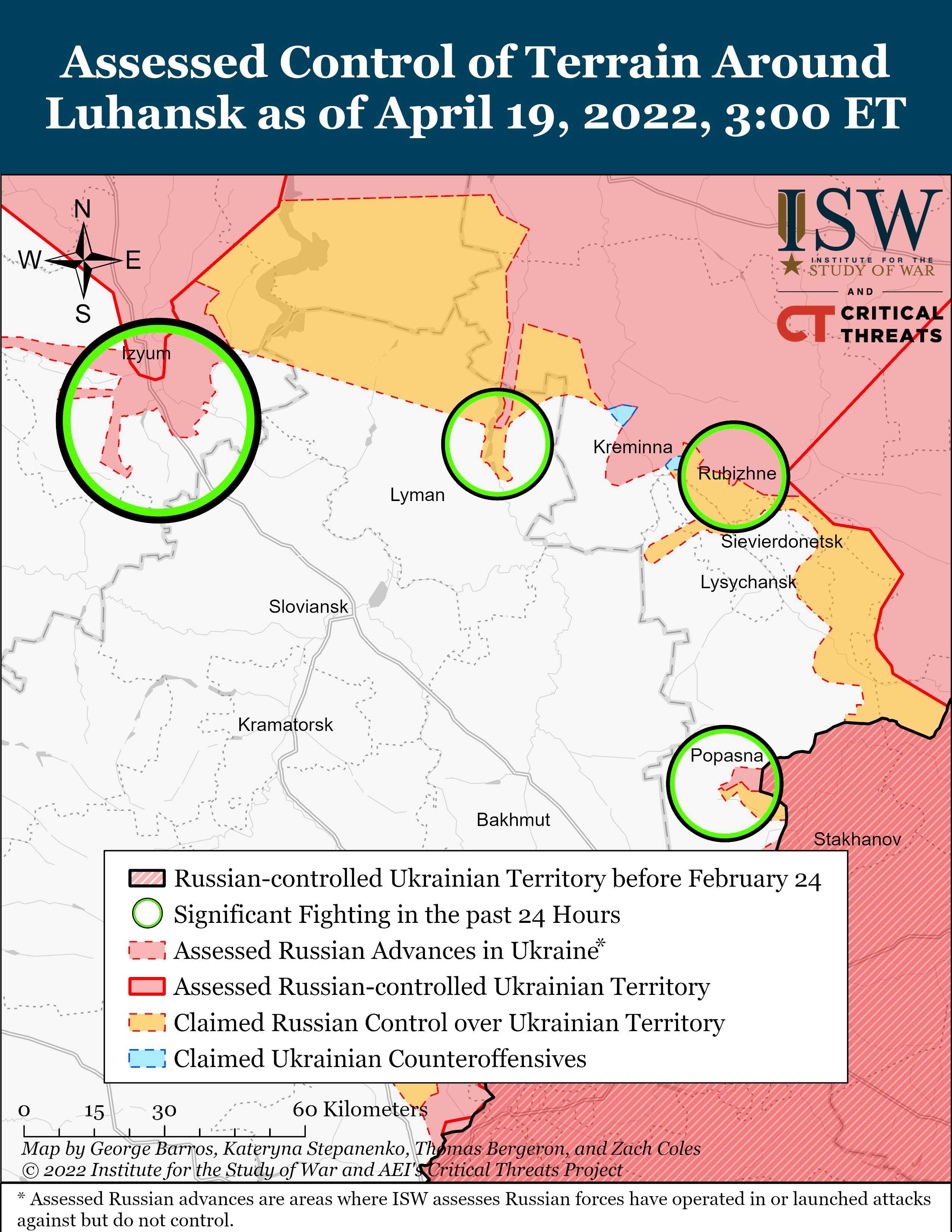
Russian forces appear to be attempting to conduct a wide encirclement of Ukrainian troops along axes from Izyum to the southeast and from Donetsk City to the north even as they push west from Popasna and positions north of Severodonetsk. Russian ground offensives in the last 24 hours occurred around Izyum, Kreminna (north of Severodonetsk), and from Donetsk City toward Avdiivka. Only the advance to and possibly through Kreminna made significant progress. An encirclement on this scale would likely take considerable time to complete against Ukrainian resistance. Even if the Russians did complete such an encirclement and trapped a large concentration of Ukrainian forces inside one or more pockets, the Ukrainian defenders would likely be able to hold out for a considerable period and might well be able to break out. 

The Russians may alternatively try to complete several smaller encirclements simultaneously, each trapping fewer Ukrainian forces and therefore taking less time to complete and then reduce. Coordinating such operations is complicated and beyond the planning and execution capacities, the Russian army has demonstrated in the conflict thus far.

 Ukrainian forces continue to defend parts of the Azovstal complex in Mariupol, but Russian officials and media are gathering in and near the city, likely in preparation to declare victory in the coming days whether or not fighting continues

Key Takeaways

  • The next phase of the Russian offensive in Ukraine’s east has reportedly begun, largely with artillery and air bombardments supporting a few small-scale ground offensives.
  • Russian officials and media are likely preparing to declare victory in Mariupol in the coming days, possibly before Ukrainian forces in the Azovstal facility have been fully defeated.
  • The Russians may be attempting a single wide encirclement of Ukrainian forces from Izyum to Donetsk City or a series of smaller encirclements within that arc. It is too soon to assess the intended Russian scheme of manoeuvre.
  • Russian operations continue to proceed hastily as if President Vladimir Putin has set an arbitrary date by which they must succeed. Putin may have decided that he will announce a Russian success and the completion of the operation on Victory Day, May 9. The haste with which Russian forces are moving may compromise the success of their operations.


We do not report in detail on Russian war crimes because those activities are well-covered in Western media and do not directly affect the military operations we are assessing and forecasting. We will continue to evaluate and report on the effects of these criminal activities on the Ukrainian military and population and specifically on combat in Ukrainian urban areas. We utterly condemn these Russian violations of the laws of armed conflict, Geneva Conventions, and humanity even though we do not describe them in these reports.

ISW has updated its assessment of the four primary efforts Russian forces are engaged in at this time:

  • Main effort—Eastern Ukraine (comprised of two subordinate supporting efforts);
  • Supporting effort 1—Kharkiv and Izyum;
  • Supporting effort 2—Southern axis;
  • Supporting effort 3—Sumy and northeastern Ukraine.

Main effort—Eastern Ukraine

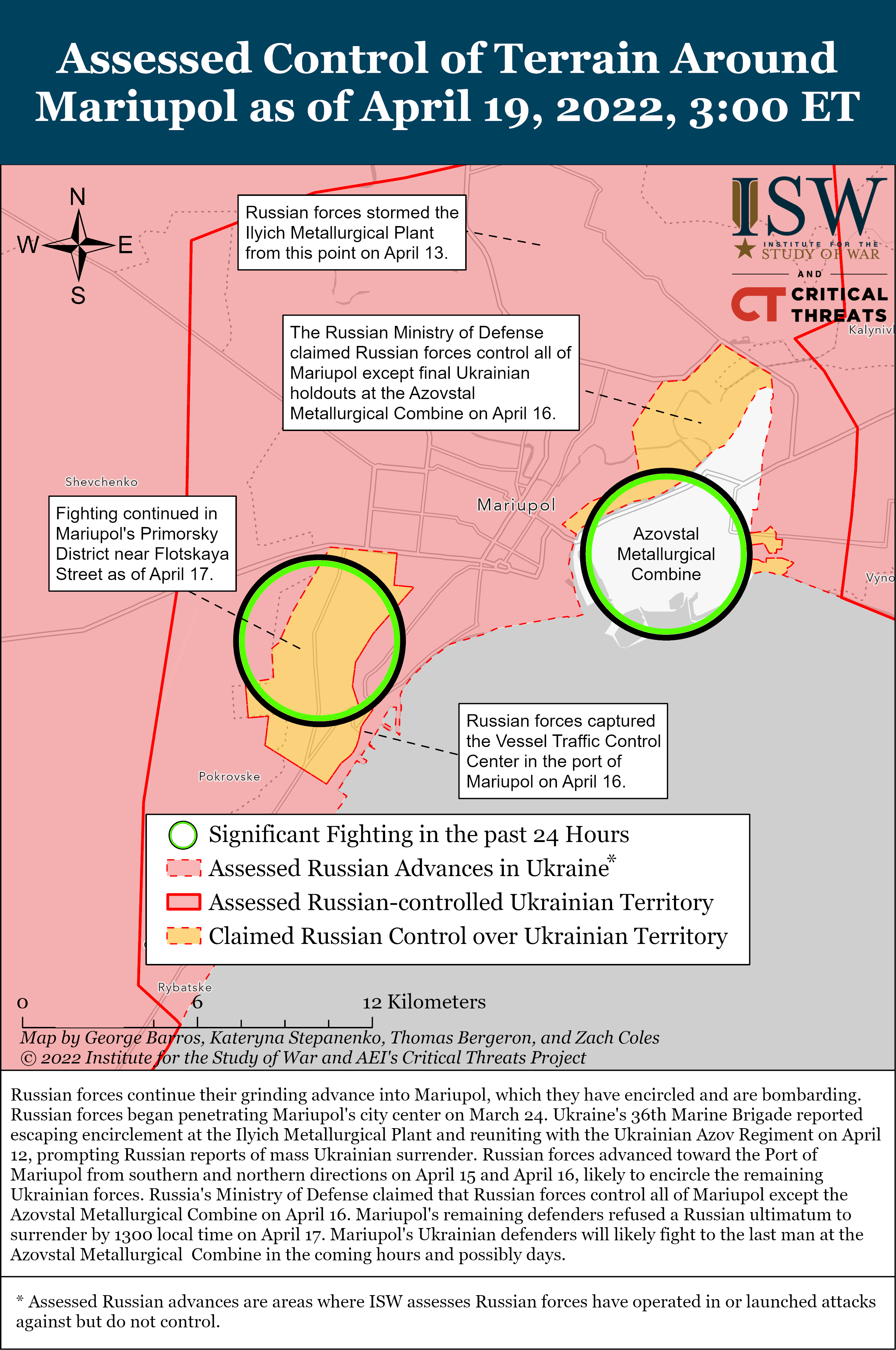
Subordinate Main Effort—Mariupol (Russian objective: Capture Mariupol and reduce the Ukrainian defenders)

Russian forces continued to prioritize the capture of the Azovstal steel plant from the north but did not make any significant advances as of April 19. Donetsk People’s Republic (DNR) Head Denis Pushilin announced that the capture of Azovstal is the DNR’s main priority, and People’s Militia Spokesperson Eduard Basurin said that an assault with Russian forces began on April 19.[1] The advisor to the Ukrainian mayor of Mariupol, Petro Andryushenko, said that Russian forces gathered heavy weaponry and tanks in the city’s Left Bank District near the plant but continued to shell residential streets in the neighbourhood.[2] Russian forces conducted an airstrike on the northern end of the plant on April 18.[3] Russian social media accounts published photos of Russian forces entering a warehouse near Azovstal, but ISW cannot confirm the authenticity or location of the images.[4]

Russia’s Defense Ministry made another demand for Ukrainian Azov Regiment fighters to surrender, which Mariupol’s defenders refused. Ukrainian forces maintained their positions at the plant and continued limited street fighting in central Mariupol.[5]

The Kremlin is likely attempting to accelerate the capture of Mariupol for the domestic Russian information space judging from the large presence of Kremlin-sponsored journalists in the area.[6] The Russians may announce success even if Ukrainian forces retain their hold on portions of Azovstal, or they may wait until Russian or proxy forces have secured the entire facility.

Subordinate Main Effort—Donetsk and Luhansk Oblasts (Russian objective: Capture the entirety of Donetsk and Luhansk Oblasts, the claimed territory of Russia’s proxies in Donbas)

Russian forces intensified offensive operations in Donetsk and Luhansk oblasts on April 19.[7] Russian artillery fire continued to target Popasna, Rubizhe, Lysychansk, and Severodonetsk and shell various settlements in Donetsk Oblast over the last 24 hours.[8] The Ukrainian Ministry of Defense stated that Russian troops are consolidating in the vicinity of Adviivka and Mariinka.[9] Ukrainian forces reportedly repelled attempted Russian advances into Avdiivka, Popasna, and Rubizhne on the night of April 18.[10] Pro-Russian sources additionally claimed that Russian troops entered Torske in order to encircle Ukrainian positions in Lysychansk, Severodonetsk, and Rubizhne, but ISW cannot independently verify this claim.[11]


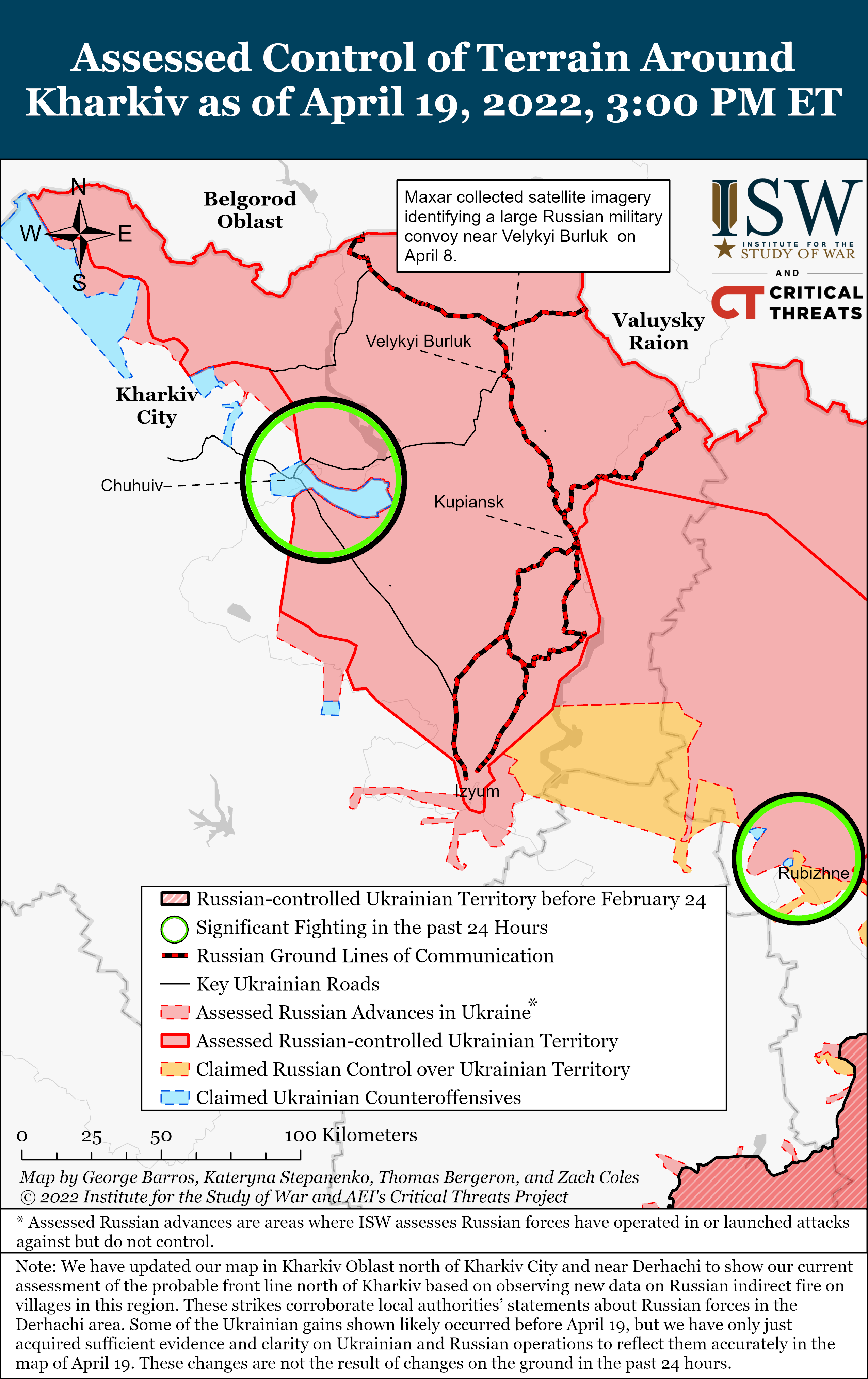
Supporting Effort #1—Kharkiv and Izyum: (Russian objective: Advance southeast to support Russian operations in Luhansk Oblast; defend ground lines of communication (GLOCs) to the Izyum axis)

Russian forces continued to shell settlements in Kharkiv Oblast and maintain a partial blockade of Kharkiv city on April 19.[12] The Ukrainian General Staff stated that Russian troops mounted an unsuccessful offensive to the south of Izyum and are generally conducting offensive operations along the east bank of the Siversky Donets River.[13] Vyacheslav Zadorenko, the mayor of Derhachi—which is about 10 miles northwest of Kharkiv City, stated that Russian forces are likely blocking approximately six settlements around Derhachi as of April 10.[14]


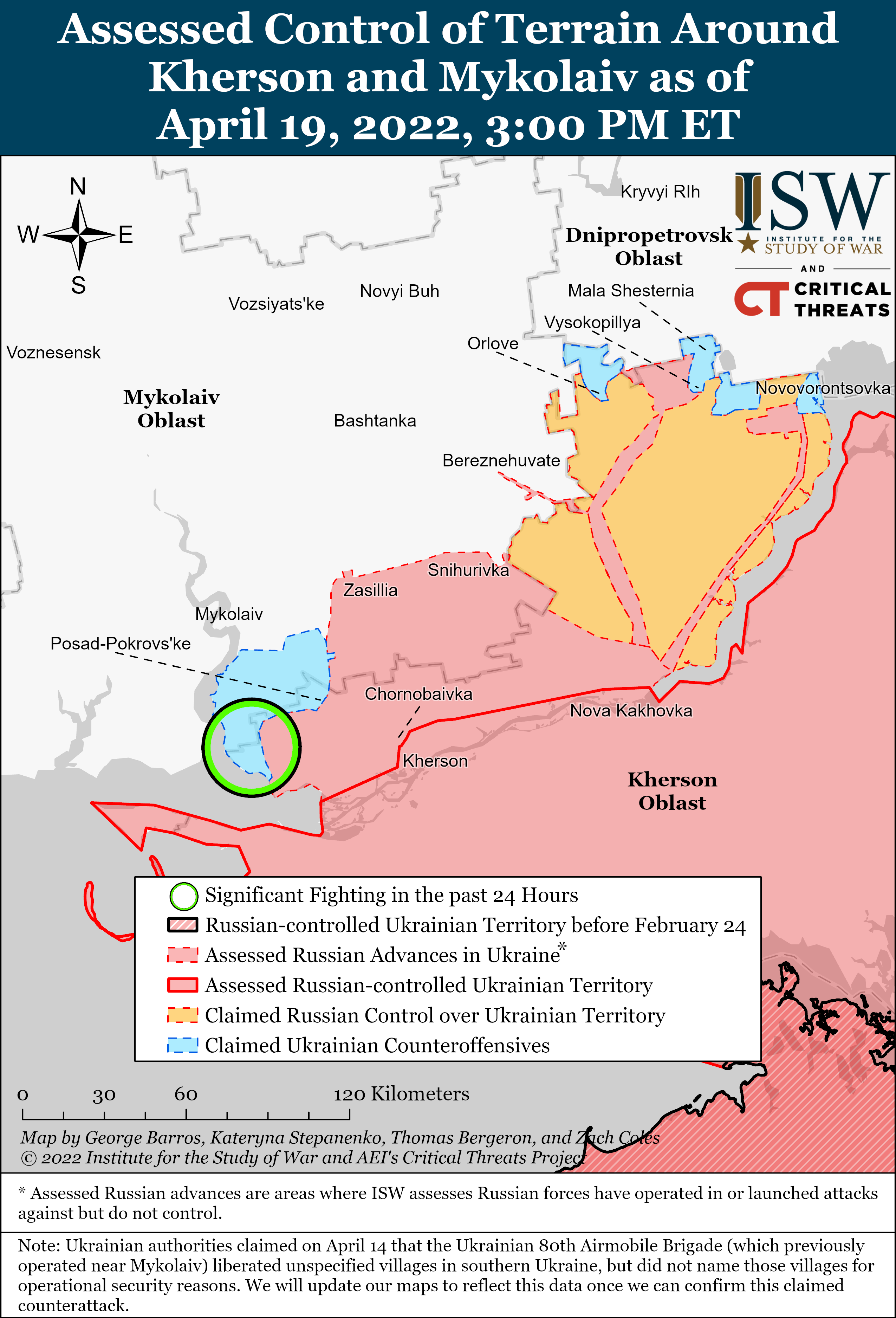
Supporting Effort #2—Southern axis: (Objective: Defend Kherson against Ukrainian counterattacks)

Russian forces continued fighting outside Oleksandrivka on April 19 without any significant territorial changes.[15] Zaporizhia Oblast Head Oleksandr Staruckh reported that Russian units are concentrating in Polohy, central Zaporizhia Oblast.[16] Russian forces may intend to stop Ukrainian counteroffensives in this area or could be planning a more ambitious advance to reach the N15 highway running east from Zaporizhia City.


Supporting Effort #3—Sumy and Northeastern Ukraine: (Russian objective: Withdraw combat power in good order for redeployment to eastern Ukraine)

There was no significant change in this area in the past 24 hours.

Immediate items to watch

  • Russian forces will likely continue attacking southeast from Izyum, west from Kreminna and Popasna, and north from Donetsk City via Avdiivka.
  • Russian troops and aircraft will continue to pound the Azovstal facility, and Russian officials may declare victory in Mariupol even before the facility is fully cleared.
  • Russian forces will likely increase the scale of ground offensive operations in the coming days, but it is too soon to tell how fast they will do so or how large those offensives will be. It is also too soon to assess how the Russians will likely weigh their efforts in the arc from Izyum to Donetsk City. 

References

[1] https://t dot me/readovkanews/31316; 

https://riafan nru/23114128mopushilin_nazval_glavnoi_zadachei_nm_dnr_os...

[2] https://t dot me/andriyshTime/329; https://www.cnn.com/europe/live-news/ukraine-russia-putin-news-04-19-22/...

 https://hromadske dot ua/posts/u-mariupoli-okupanti-obstrilyuyut-azovstal-ta-zhitlovij-sektor-u-yakih-vchora-pustili-civilnih-radnik-mera

[3] https://twitter.com/GeoConfirmed/status/1516431666318913538

[4] https://twitter.com/IntelCrab/status/1516129910917672967; https://twitt...

[5] https://twitter.com/GeoConfirmed/status/1516429756887150600; https://tw...

[6] https://t dot me/nm_dnr/7665; 

https://twitter.com/GeoConfirmed/status/1516450745654169602

[7] https://www.facebook.com/GeneralStaff.ua/posts/298021502510935

[8] https://t dot me/luhanskaVTSA/1758;

https://t dot me/pavlokyrylenko_donoda/3068;

 https://t dot me/pavlokyrylenko_donoda/3068; https://t dot me/guberniaband/3283

[9] https://armyinform dot com.ua/2022/04/19/okupanty-ne-prypynyayut-sprob-vstanovyty-povnyj-kontrol-nad-mistom-mariupol-ta-zoseredzheni-na-zahoplenni-popasnoyi-rubizhnogo-ta-syevyerodoneczka/

[10] https://t.me/pavlokyrylenko_donoda/3068; https://t.me/stranaua/37373

[11] https://t.me/stranaua/37442

[12] https://t.me/stranaua/37450; https://t.me/synegubov/2923; https://twit...

[13] https://www.facebook.com/GeneralStaff.ua/posts/298410722472013; https:/...

[14] https://ru.interfax dot com.ua/news/general/820747.html; 

https://24tv dot ua/okupanti-obstrilyali-selishhe-slatine-harkivshhini-5-lyudey-zaginulo_n1945900

[15] https://www.facebook.com/GeneralStaff.ua/posts/298410722472013; 

https://www.facebook.com/GeneralStaff.ua/posts/298021502510935

[16] https://www.facebook.com/GeneralStaff.ua/posts/298021502510935;

 https://t dot me/stranaua/37454; https://twitter.com/IntelCrab/status/1516154323377561602/photo/1; https...


  Tags  

Ukraine Project