Thursday, April 21, 2022

PART 3 : MOUNTAIN WARFARE ELABORATED R

SOURCES:  ( A)  https://military-history.fandom.com/wiki/Mountain_warfare


Mountain warfare refers to warfare in the mountains or similarly rough terrain. This type of warfare is also called Alpine warfare, after the Alps mountains. Mountain warfare is one of the most dangerous types of combat as it involves surviving not only to combat with the enemy but also the extreme weather and dangerous terrain. Mountain ranges are of strategic importance since they often act as a natural border, and may also be the origin of a water source of (e.g. Golan Heights – water conflict). Attacking a prepared enemy position in mountain terrain requires a greater ratio of attacking soldiers to defending soldiers than would be needed on level ground.[1] Mountains at any time of year are dangerous – lightning, strong gusts of wind, falling rocks, extreme cold, and crevasses are all additional threats to combatants. Movement, reinforcements, and medical evacuation up and down steep slopes and areas where even pack animals cannot reach involves an enormous exertion of energy.ContentsGebirgsjäger is the German word for mountain infantry (Gebirge meaning "mountain range", and Jäger meaning "hunter" or "ranger"). The word Jäger is the traditional German term for light infantry. The mountain infantry of Austria have their roots in the three "Landesschützen" regiments of the Austro-Hungarian Empire. The mountain infantry of Germany carry on certain traditions of the Alpenkorps (Alpine corps) of World War I. Both countries' mountain infantry share the Edelweiss insignia. It was established in 1907 as a symbol of the Austro-Hungarian Landesschützen regiments by Emperor Franz Joseph I. These troops wore their Edelweiss on the collar of their uniforms. When the Alpenkorps came to aid the Landesschützen in defending the Austro-Hungary's southern frontier against the Italian attack in May 1915, the grateful Landesschützen honoured the men of the Alpenkorps by awarding them their own insignia: the Edelweiss.

Today the traditions of the Austrian mountain infantry (Gebirgsjäger) are maintained by the 6th Jägerbrigade in Innsbruck, subdivided in three battalions (Jägerbataillon 23, Jägerbataillon 24 and Jägerbataillon 26).

Honouring tradition, upon the creation of the Bundeswehr in 1955, the mountain infantry returned as a distinctive arm of the German army. Until 2001, they were organized as the 1. Gebirgsdivision, but this division was disbanded in a general reform. The successor unit is Gebirgsjägerbrigade 23 which has its headquarters in Bad Reichenhall (Bavaria). Battalions of these mountain infantry are deployed in southern Bavaria. The soldiers of the mountain infantry wear a grey cap (“Bergmütze”) with an Edelweiss on its left side. This distinguishes them from all other German army soldiers who wear berets. The formal uniform, which is based on traditional skiing outfits, is also different from the standard German military uniform, and consists of ski jacket, stretch trousers and ski boots.

The “Kaiserjägermarsch” (March of the Kaiserjäger) from 1914 is the traditional military march of the German and Austrian mountain infantry.

Bulgaria

Bulgaria's 101st Alpine Battallion (101-ви алпийски батальон), based and in Smolyan, is currently the only Bulgarian unit specialized in mountain warfare. A unique feature is their armament - Mosin-Nagant rifles, which were selected due to their excellent performance in high-altitude warfare. The battalion, also has portable 60-mm mortars. The unit is experienced in the terrain of the Rhodope Mountains, and during the Cold War it has extensively trained for operations against Greek and Turkish forces.

France


Chasseurs alpins
Until 1859, Italy wasn't yet a unified state but a sum of kingdoms and independent republics (Kingdom of Naples, Republic of Venice, Papal States, etc.). The situation changed with the unification of Italy. France saw this geopolitical change as a possible threat from the other side of the Alps border, partially as the Italians were the first to raise a corps of mountain warfare troops - the Alpini. The French solution was to create its own mountain corps in order to oppose a possible Italian invasion through the Alps. By December 24, 1888, a law created a troupes de montagne ("mountain troops") corps. 12 of the 31 existing Chasseurs à Pied ("Hunters on Foot") battalions were selected to be converted. These first units were named Bataillons Alpins de Chasseurs à Pied ("Hunters on Foot Alpine Battalions"), later shortened to Bataillons de Chasseurs Alpins ("Alpine Hunters Battalions").

Since 1999 they have been (with other units) part of the 27th Mountain Infantry Brigade (Brigade d'Infanterie de Montagne), and are currently organised into three battalions:

  • 7th Battalion, Bourg-Saint-Maurice
  • 13th Battalion, Chambéry
  • 27th Battalion, Cran-Gevrier (Annecy)

All three battalions are based in cities in the French Alps, thus the name of the units.

The Chasseurs are easily recognised by their wide beret (when not in battle uniform), named tarte (= pie). The British Army adopted the beret in the 1920s after having seen similar berets worn by the 70th Chasseurs Alpins (now disbanded).

Other mountain troops in the French armed forces comprise artillery (currently the 93rd Mountain Artillery Regiment - 93ème RAM) light armoured cavalry (4ème Régiment de Chasseurs) and the 2nd Foreign Engineer Regiment (2ème REG). The Gendarmerie Nationale has her own mountain units PGM and PGHM devoted to mountain rescue and law enforcement.

India

The Indian Army is among the most experienced and best trained in mountain warfare having fought numerous conflicts in the Himalayas in Arunachal Pradesh and Jammu and Kashmir while maintaining one of the largest active contingents of mountain warfare forces in the world, giving the Indian Army some of the most extensive and well-developed Mountain Warfare capabilities. Major conflicts include the 1962 Sino-Indian War and the Kargil War in 1999. Siachen Glacier is the world's highest battlefield, with about 3000 Indian troops on year round deployment on the edge of a glacier. For over two decades, India & Pakistan have fought numerous skirmishes in this most inhospitable of mountain territories, at altitudes over 6000 meters (20,000 feet) and at temperatures as low as -50 Celsius. Due to the instability in the region and the need for permanent deployments in the mountainous regions, India's mountain warfare units were vastly expanded after the 1962 war, with the creation of 6 Mountain Divisions.[3] The Indian Army presently has 10 Army Divisions dedicated to mountain warfare (8 Mountain Divisions and 2 Mountain Strike divisions) and another infantry division earmarked for high altitude operations. Each division has a personnel strength of 10,000-13,000 troops and consists of 3 brigades with 3,000 to 4,500 men each, including support elements such as signals, provost, and intelligence units.[4] In 2008, the Indian Army has sanctioned plans to raise two additional mountain divisions, with goals to be operational in five years. The two divisions will also have extensive air assets, including Utility helicoptersHelicopter gunships and Attack helicopters.[4] Training:
The Indian Military Academy (IMA), Dehradun conducts preliminary mountaineering and mountain warfare training for all Officer Cadets. The Bhadraj Camp and Parvatraksha Camp are two camps focussed on mountain warfare right at basic military training in IMA itself. The culmination of bhadraj is a course of a 40 km run and climbing a 5500 feet cliff with a fully loaded pack at night.[5] Camp Parvatraksha exercises other mountain warfare skills.

For more specialized training, the Army operates the Parvat Ghatak School (Hindi: पर्वत घातक, Mountain Strike or Mountain Warrior) at Tawang, Arunachal Pradesh. This high-altitude commando school is the highest of its kind at 15,000 feet. The mercury dipping to minus 20 degrees providescentre a freezing tougher terrain to impart training in conditions similar to Siachen.[6] Another school, the High Altitude Warfare School (HAWS) is located near Gulmarg, Jammu and Kashmir. Set up in 1948 as the 19 Infantry Division Ski School, HAWS has over the years become the Indian Army's nodal center for "specialised training and dissemination of doctrines" in high-altitude, mountain and snow warfare. HAWS Mountain warfare courses are conducted in the Sonamarg area and snow-craft & winter warfare training in the Gulmarg area. HAWS played an important role during the Kargil War by conducting crash courses for troops prior to their deployment.[7] Given the extensive experience of the Indian Army in mountain warfare, troops from other nations regularly train and conduct joint exercises at these schools. Because of its experience in fighting wars in mountain regions for over 50 years, as well as its history of recruitment of natives from the Himalayan regions of India and Nepal (such as Gurkha, Kumaon, Garhwal and Dogras), Indian Mountain Warfare Units are considered among the best in the world. Numerous army units across the world are now implementing training modules modelled after Indian Mountain Warfare training systems.[7] These include forces from UK,[8] US,[9] Russia, etc. In 2004, US special forces teams were sent to India to learn from Indian Army experiences of the Kargil War prior to their deployment for operations in Afghanistan. Russian troops also trained at the High Altitude Warfare School in Gulmarg for operations in Chechnya.[10][11] They also visited Siachen and other Army posts.[12]

Israel

The Alpinist Unit is the Israeli mountain unit, said to live in caves for days and execute civilian rescues, evacuations, and such 20 times a day. Unlike most of the Israeli Forces, they are not trained by the ages 18–19, but after their standard serving time (by their request), no earlier than 22-23.

Italy


Italian Alpini from the 7th Alpini Regiment during an exercise

  The Alpini are the elite mountain warfare infantry of the Italian Army. They are currently organised in the Julia and Taurinense alpine brigades, which are subordinated to the Alpine Troops Command. The singular is "Alpino".

Formed in 1872, their mission was to protect Italy's northern mountainous borders. On June 7, 1883, the Alpini were awarded the "fiamme verdi" (green flames) collar patch, thus elevating them to an speciality within the Italian Infantry Corps. Also adopted was their distinctive headdress; the "Cappello Alpino" with its black feather, which led to them being nicknamed "Le Penne Nere" or "the black feathers".

They distinguished themselves during World War I as they fought against Austro-Hungarian soldiers in what has since been called the "War in snow and ice". During World War II, the Alpini fought mostly on the Eastern Front being tasked to hold the front in the Don river plains.

In the 1990s, after the end of the Cold War, three of the five Alpini brigades and many support units were disbanded due to the reorganization process of the Italian Army. Currently, despite having some of the best trained and best equipped mountain troops in the world, the military role of Alpines is seen in terms of peacekeeping missions and minor disputes interventions.

The 4th Alpini Parachutist Regiment is a Special Operations Force unit specialized in the airborne assault role and comparable to the United States Army Rangers. It originated from the Alpini Paratrooper platoons in each of the five Alpini Brigades, which were merged on 1 April 1964 in the Alpine Paratroopers Company.

The "Centro Addestramento Alpino" Aosta is the Armys school responsible for the mountain training of its troops.

Romania

Romanian Vânători de Munte.

The Vânători de Munte ("Mountain Hunters/Rangers", Romanian pronunciation: [vɨnəˈtorʲ de ˈmunte]) are the elite mountain troops of the Romanian Land Forces. They were first established as an independent Army Corps in 1916 during World War I, and became operational in 1917 under Corpul de Munte designation.

Thought as of being elite troops, the Romanian Vânători de Munte saw action in World War II on the Eastern Front in some of the harshest battles - including the battles of Sevastopol and Stalingrad - where their performance lived up to their reputation: virtually all their commanders from brigade level and up received the Knight's Cross of the Iron Cross.

There are currently two brigades operational, one subordinated to the 1st Territorial Army Corps (the 2nd Mountain Troops Brigade), and another one subordinated to the 4th Territorial Army Corps (61st Mountain Troops Brigade). Mountain troops are participating in peacekeeping missions in Afghanistan.

Pakistan

In the Pakistan Army, mountain training is considered part of the overall training and all soldiers and units are expected to be proficient at it. Almost all units of all arms serve tours in Kashmir and Northern Areas, often inactiveat duties on the LOC or Siachin. The Pakistan Army’s High-Altitude School, at Rattu in Northern Kashmir,[13] is an ideal location on the confluence of the Hindukush, Himalayas, and Karakorum ranges. The school conducts training throughout the year and includes mountain climbing on peaks ranging from 15,000 to 20,000 feet and survival on glaciated terrain and in snowy and icy conditions.[14]

 Poland

Soldiers of the 21st Podhale Rifles Brigade in full gala dress-suit, Warsaw, 2006

Podhale rifles (Polish: Strzelcy podhalańscy) is a traditional name of the mountain infantry units of the Polish Army. Formed in 1918 out of volunteers of the region of Podhale, in 1919 the smaller detachments of Podhale rifles were pressed into two mountain infantry divisions, the 21st Mountain Infantry and 22nd Mountain Infantry Divisions, as well as into three brigades of mountain infantry. The units were roughly equivalent to the German Gebirgsjäger troops. Currently Polish Army maintains one brigade of mountain infantry.

Former Soviet Union

The USSR maintained several thousand mountain troops and used them to good effect in the Caucasus and in Afghanistan.

Spain

Spain has a Brigade of Mountain troop:

  • Brigada de Cazadores de Montaña "Aragón" I (1st Mountain Brigade)
  • Regimiento de Cazadores de Montaña "Galicia" 64 (64th Mountain Regiment)
  • Regimiento de Cazadores de Montaña "America" 66 (66th Mountain Regiment)
  • Grupo de Artillería de Montaña I (1st Mountain Artillery Battalion)
  • Grupo Logístico de Montaña I (1st Mountain Logistic Battalion)
  • Batallón de Cuartel General I (1st Headquarters Battalion)
  • Unidad de Zapadores de Montaña 1 (1st Mountain Sapper Company)

Sweden

Mountains constitute almost half the area of Sweden, including its northern border. Winter and mountain warfare skills were therefore always important to the country. Between 1945 and 2000 Sweden trained and deployed several companies per year at the Army Ranger School and later the Lapland/Arctic Mountain Ranger regiment (I22) in Kiruna (located some 150 kilometres north of the arctic circle in Lapland). The school/regiment drew on experiences gained during World War II from guarding and patrolling the mountainous northern borders and uninhabited inland mountain regions, as well as from light infantry and ski fighting in Finland in the wars against the Soviet Union. Later the army as a whole benefited from the Army Ranger School, as commanding and training officers as well as complete fighting units undertook training there. Exchanges were also organised with similar units in, for example, Finland, Norway, Germany, Austria, Switzerland, France, the UK, and the USA. As part of major armed forces reductions in 2000 the Lapland ranger regiment (I22) in Kiruna was disbanded, and its several trained and equipped battalion and company sized field units were deactivated. More recently the army has created a dedicated mountain platoon. This is now based at the ranger detachment (known as Arméns Jägarbataljon or simply AJB) in Arvidsjaur (located 100 kilometres south of the arctic circle), since AJB is a detachment, it is a part of I19Norrbottens regemente in Boden. The task for this single battalion is to guide other smaller units in the mountains besides taking on reconnaissance and fighting tasks.

   Turkey wintertimewintertime

The Turkish Army has a mountain warfare specialized brigade (Bolu Commando Brigade) located at the city of Bolu in northwestern Turkey, which actually operates at the province of Hakkari and northern Iraq. The Hakkari Mountain Commando Brigade mostly performs counter-terrorism operations in this extremely rugged region of south-eastern Turkey, with an average elevation of 3500 meters and winter time temperatures below -30 degrees Celsius. The officers and soldiers of this brigade as well as other troops are trained in Egirdir Mountain and Commando School in Egirdir, near the city of Isparta. The training and facilities offered by the school are utilized by other members of NATO, and non-NATO countries such as Pakistan, Azerbaijan and some Eastern European countries.

Hakkari Mountain Commando Brigade has been at the forefront of counter-terrorism operations against PKK terrorist organization since thelate 1980s, and has participated in several cross-border operations and incursions into Iraq in hot pursuit of PKK militants. Most recently, in February 2008, the brigade harticipated in the ation Sun, in which 10,000 troops Turkish Armed Forces has entered and temporarily seized Iraqi territory utilized by PKK. The entire operation took part in the region of northern Iraq near the Qandil Mountains in extreme winter conditions.

United Kingdom

In the United Kingdom the Royal Marines are the principal regular unit trained in mountain and cold weather warfare and have a specialised instructor cadre: the Mountain Leader Training Cadre. The capability is fielded by 3 Commando Brigade. The British Army also have the Mountain Troops of Special Air Service squadrons. During the Cold War the Royal Marines were assigned to the NATO Northern Flank, their task was to be part of the force defending the mountainous Nordic region from the Soviet Union.

United States
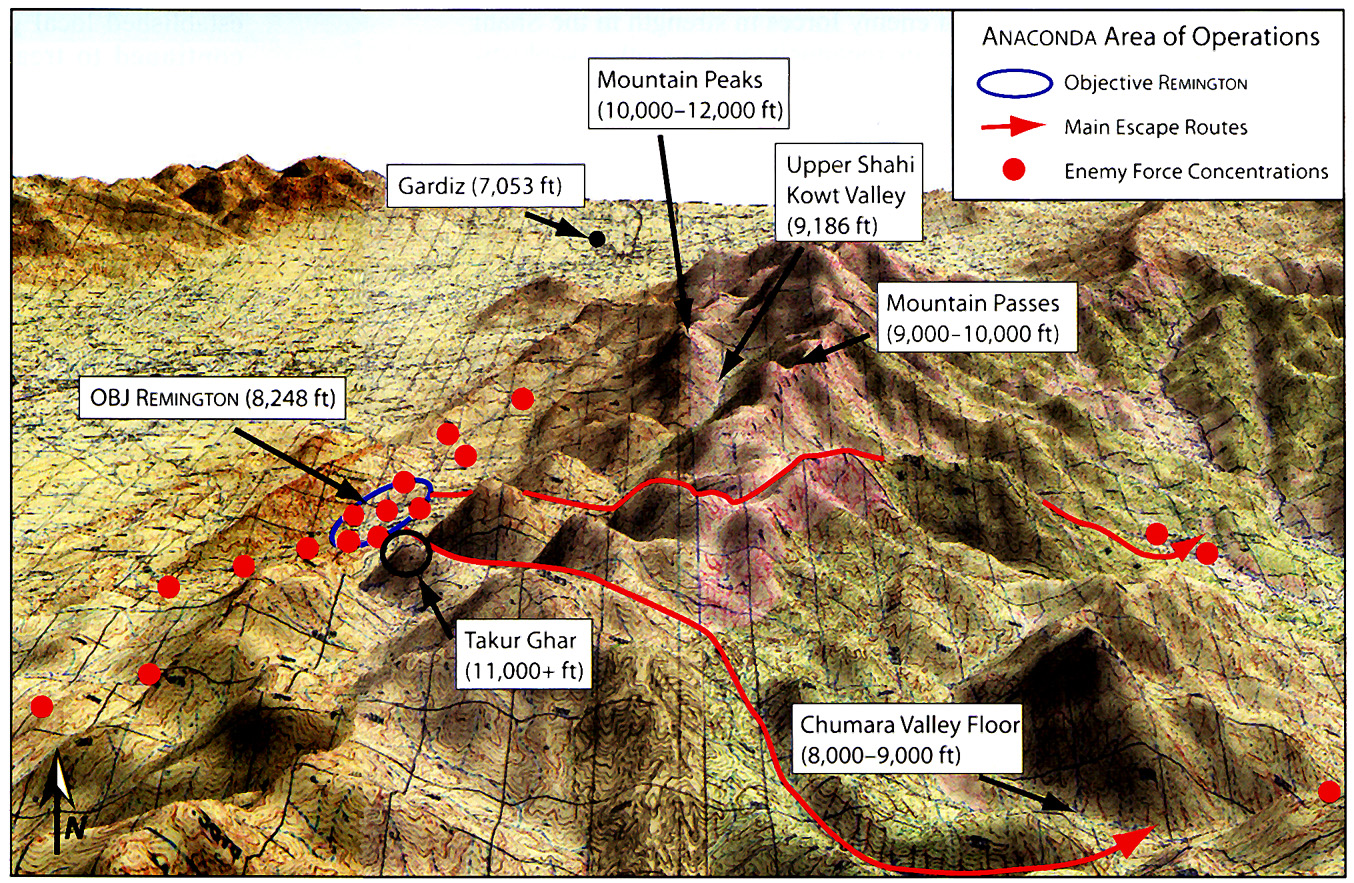
A map of the ANACONDA area of operations.

The US has a history in mountain warfare, the 10th Mountain Division served in the Italian Apennine Mountains in World War II. The Army National Guard has the Mountain 86th Infantry Brigade Combat Team consisting of battalions around New England. In the United States there are four training facilities dedicated to preparing for mountain and cold weather warfare: the Special Forces Advanced Mountain Operations School (SFAMOS) located in Ft Carson, CO, Army Mountain Warfare School located in Jericho, Vermont, the Northern Warfare Training Center located in Black Rapids, Alaska and the Marine Corps Mountain Warfare Training Center located in Pickel Meadows, California. These facilities offer challenging training in the most austere of training environments. American experience in mountain warfare continues to the present: see Operation Anaconda.

   Brazil     

The 11th Mountain Infantry Battalion served beside the US 10th Mountain Division in the Italian Apennine Mountains in World War II. Located in São João del-Rey city this battalion develop the mountaineering techniques for the Brazilian Army. There are formed the Brazilian Mountain Guides. Today the 11th battalion has troops deployed in Haiti integrating the MINUSTAH.

Other countries

At present the following armies have specialised alpine units or Mountain troops:

Besides those mentioned above: ArmeniaRussia, Turkey and Ukraine are also among the nations that field units specialized in mountain warfare.

Notes

  1.  It is generally accepted that the ratio required for the force launching an offensive to have a good chance of success is 3:1. In mountainous terrain, the required ratio is much more.
  2.  "Sink the Belgrano", Mike Rossiter, 2007, Transworld, London, pp 189-233
  3.  Thomas Brady, India Recruiting six new Divisions; Mountain Training pushedNew York Times Archives, 25 March 1963.
  4. ↑ Jump up to:4.0 4.1 N.C. Bipindra, India plans to strengthen mountain warfare machineryRediff News, 13 June 2008
  5.  Bhavna Vij, IMA revives its mountain training after a decadeIndian Express, 25 June 1999
  6.  Outlook IndiaHigh School, 3 April 2000, on Bharat Rakshak.
  7. ↑ Jump up to:7.0 7.1 Pandit, Rajat, High Altitude Warfare School takes global aim, Times of India, 1 May 2004
  8.  India, UK forces to conduct anti-terror war game in LadakhThe Hindu, 19 August 2007.
  9.  Jawed Naqvi, US lists military deals, special ties with IndiaThe Dawn, 23 August 2004.
  10.  Russia, India to share experience in training mountain troopsRIA Novosti, 24 June 2008
  11.  Russian officers learn Indian mountain war tactics, UPI, 15 July 2008
  12.  Indian and Russian Army Chiefs meetFIDSNS, 25 June 2008.
  13.  "Army High Altitude School". Pakistanarmy.gov.pk. 2009-09-01. Retrieved 2012-07-26.
  14.  http://smallwarsjournal.com/documents/malik.pdf
  15.  "132nd Mountain Battalion". Slovenskavojska.si. Retrieved 2012-07-26.
  16.  "Multinational Centre of Excellence for Mountain Warfare". Slovenskavojska.si. Retrieved 2012-07-26.
  17.  "Brigata fanteria montagna 9". He.admin.ch. Retrieved 2012-07-26.
  18.  "Brigade d'infanterie de montagne 10". He.admin.ch. 2012-05-12. Retrieved 2012-07-26.
  19.  "Gebirgsinfanteriebrigade 12". He.admin.ch. 2012-07-11. Retrieved 2012-07-26.

References

  • Frederick Engels, (January 27, 1857) "Mountain Warfare in the Past and Present" New York Daily Tribune MECW Volume 15, p 164

Further reading

External links

This page uses Creative Commons Licensed content from Wikipedia (view authors).

PART 2 Mountain Warfare in the Past and Present

 SOURCE:  

[A] MOUNTAIN OPERATIONS-   https://irp.fas.org/doddir/army/fm3-97-6.pdf

 (B)  MTNWAR  PAST & PRESENT : https://www.marxists.org/archive/marx/works/1857/01/mountain-warfare.htm

(C)  MTN WARFARE:  https://en.wikipedia.org/wiki/Mountain_warfare 

( D) Engels on War | 1857 Works | Marx/Engels Archive


INDEX 

 (a) MTNWAR  PAST & PRESENT :   PART 1:  https://bcvasundhra.blogspot.com/2022/04/part-2-mountain-warfare-in-past-and.html

(b)   MTN WARFARE:   PART 2 :    https://bcvasundhra.blogspot.com/2022/04/mountain-warfare.html


Works of Frederick Engels 1857

Mountain Warfare in the Past and Present

Written

by Engels between January 1 and 10, 1857


First published: First article — in the New York Daily Tribune, January 27, 1857, Second article in Marx and Engels, Works, Moscow, 1977.

Engels wrote this article for the New York Daily Tribune early in January 1857 at Marx’s request. In his letter to Engels of January 10, Marx informed him of the receipt of the article.

The article was prompted by the Neuchâtel conflict and the plans for the invasion of Switzerland by Prussian troops, widely discussed in the press. It consisted of two parts, the first being published in the New-York Daily Tribune on January 27, 1857. The editors of the Tribune decided not to print the second part, and Charles Dana informed Marx of this in a letter of March 5, 1857, because on January 16, 1857 the Swiss government made concessions to Prussia by releasing the arrested monarchists. “The miserable collapse of Switzerland’s braggadocio” — such as Marx’s appraisal of the latest events of the Neuchâtel conflict  Crisis  in his letter to Engels of January 20.  https://en.wikipedia.org/wiki/Neuch%C3%A2tel] 


  In the present edition the first part of the article is reproduced from the New-York Daily Tribune collated with an extant excerpt of the rough manuscript. The most important passages in the manuscript, which were omitted in the printed text, are given in the footnotes. The second part of the article is published according to the manuscript copied by Marx. 


The recent possibility, not yet entirely removed, of an invasion of Switzerland, has naturally revived the public interest not only concerning the defensive resources of the mountain Republic but with regard to mountain warfare in general. People are generally inclined to regard Switzerland as impregnable, and think of an invading force as of those Roman gladiators whose “Ave Caesar, morituri te salutant” [Hail Caesar; those who are about to die salute you] has become so famous. We are reminded of Sempach and Morgarten, Murten and Granson [205] and we are told that it may be easy enough for a foreign army to get into Switzerland, but that, like the fool Albert of Austria said, it will be difficult to get out again. Even military men will recite the names of a dozen mountain passes and defiles, where a handful of men might easily and successfully oppose a couple of thousands of the best soldiers. 

This traditional impregnability of the so-called mountain-fortress of Switzerland dates from the time of the wars with Austria and Burgundy, in the fourteenth and fifteenth centuries.[206] in the former the armour-clad cavalry of the chivalry was the chief arm of the invaders; its strength lay in the irresistible charge against armies undefended by firearms. Now, this charge was impossible in a country like Switzerland, where cavalry, except the lightest kind, and in small numbers, is even now useless. How much more so were the knights of the fourteenth century, encumbered with nearly a hundredweight of iron. They had to dismount and fight on foot; thus, their last remnant of mobility was lost; and the invaders were reduced to the defensive, and when caught in a defile were defenceless even against clubs and .sticks. During the Burgundian wars, infantry, armed with pikes, had become a more important portion of an army, and firearms had been introduced, but the infantry was still cramped by the weight of defensive armour, the cannon were heavy, and small arms clumsy and comparatively useless. The whole equipment of the troops was still so cumbersome as to unfit them completely for mountain warfare, especially at a time when roads can scarcely be said to have existed. The consequence was that, as soon as these slow-moving armies were once entangled in difficult ground, they stuck fast, while the lightly-armed Swiss peasants were enabled to act on the offensive, to out-maneuver, surround, and finally defeat their opponents. 

For three centuries after the Burgundian wars, Switzerland was never seriously invaded. The tradition of Swiss invincibility grew venerable, until the French Revolution, an event that tore into shreds so many venerable traditions, destroyed this one too, at least for those acquainted with military history. Times had changed. The iron-clad cavalry and the heavy pikemen had passed away; tactics had been revolutionized a dozen times over; mobility was becoming the chief quality of armies; the line tactics of Marlborough, Eugene and Frederick the Great were being upset by the columns and skirmishers of the revolutionary armies; and from the day that General Bonaparte passed, in 1796, the Col di Cadibone, threw himself between the scattered Austrian and Sardinian columns, defeated them in front, while at the same time intercepting their retreat in the narrow valleys of the Maritime Alps, making the most of his opponents prisoners-from that day dates the new science of mountain warfare which has put an end to the impregnability of Switzerland. 

During the period of line tactics, which immediately preceded that of modern warfare, all difficult ground was studiously avoided by either adversary. The more level the plain, the better it was deemed for a battlefield if it only afforded some obstacle to support one or both wings. But with the French revolutionary armies, a different system began. An obstacle before the front, covering ground for skirmishers, as well as for the reserves, was anxiously sought for in any defensive position. Difficult ground, upon the whole, was preferred by thein; their troops were far lighter in their movements; and their formations, extended order and columns, admitted not only’ of rapid movements in all directions, but even made it advantageous to them to profit by the shelter afforded by broken ground, at the same time that their opponents were quite lost in it.

In fact, the. term “impracticable ground” was all but erased from the military

 terminology. 


 The Swiss were made to feel this in 1798, when four French divisions, in spite of the obstinate resistance of part of the inhabitants, and of a three times repeated insurrection of the old forest cantons, made themselves masters of the country which, for the next three years, became one of the most important theatres of the war between the French Republic and the Coalition.[207] How little the French were afraid of the inaccessible mountains and narrow gorges of Switzerland, they showed as early as March 1798, when Masséna at once marched upon the roughest and most mountainous canton, the Grisons, then occupied by the Austrians. The latter held the upper valley of the Rhine. In concentric columns, Masséna’s troops marched into that valley through mountain passes hardly passable to horses, occupied all the outlets, and after a short resistance forced the Austrians to lay down their arms. The Austrians very soon profited from this lesson; under Hotze, a General who gained considerable proficiency in mountain warfare, they returned to the charge, repeated the same manoeuvre, and drove out the French. Then came the retreat of Masséna to the defensive position of Zurich, where he defeated Korsakoff’s Russians, the invasion of Switzerland over the St. Gotthard by Souwaroff, his disastrous retreat, and finally another advance of the French through the Grisons into Tyrol, where Macdonald in the depth of winter passed over three mountain ridges then scarcely thought passable in single file.[208] The great Napoleonic campaigns which then followed were fought out in the great river basins of the Danube and the Po; the grand strategical conceptions on which they were based, all tended to cut off the hostile army from the center of its resources, to destroy that army, and then to occupy the center itself, implied a less intercepted ground and the concentration of masses for decisive battles not to be obtained in Alpine countries. But from the first Alpine campaign of Napoleon in 1796, and his march across the Julian Alps to Vienna in 1797, up to 1801, the whole history of warfare proves that Alpine ridges and valleys have completely lost their terror for modern troops; nor have the Alps ever since, up to 1815, offered any defensive positions worth speaking of to either France or the Coalition.

When you pass through one of these deep ravines which wind up the roads that lead from the northern slope of the Alps to their southern declivity, you find the most formidable defensive positions at every turn of the road. Take the well-known Via Mala, for instance. There is not an officer but will tell you he might hold that defile with a battalion against an enemy, if he was sure of not being turned. But that is precisely the point. There is no mountain pass, even in the highest ridge of the Alps, but can he turned. Napoleon’s maxim for mountain warfare was: “Where a goat can pass, a man can pass; where a man, a battalion; where a battalion, an army.” And Souwaroff had to do it, when he was closely shut up in the valley of the Reuss, and had to march his army along shepherds’ tracks, where but one man could pass at a time, while Lecourbe, the best French General for mountain warfare, was at his heels.

It is this facility of turning an enemy which makes up and more for the strength of defensive positions, to attack which in front would often be perfect madness. To guard all roads by which a position can be turned would imply, in the defending party, such dissemination of forces as must ensure immediate defeat. They can, at best, be observed only, and the repulse of the turning movement must depend upon the judicious use of reserves and on the judgment and rapidity of the commanders of single detachments; and yet, if of three or four turning columns one only is successful, the defending party is placed in as bad a condition as if they had all succeeded. Thus, strategically speaking, the attack in mountain warfare is decidedly superior to the defence.

It is the same when we come to look at the subject in a purely tactical light. The defensive positions will always be narrow mountain gorges, occupied by strong columns in the valley and protected by skirmishers on the hights. These positions may be turned either from the front, by skirmishing parties climbing up the sides of the valley and outflanking the sharp-shooters of the defence, or by parties marching along the top of the ridge where this is practicable, or by a parallel valley — the turning body profiting by a pass to fall on flank or rear of the defending post. In all these cases the turning parties have the advantage of command; they occupy the higher ground and overlook the valley occupied by their opponents. They may roll rocks and trees down upon them; for nowadays no column is so foolish as to enter into a deep gorge before its sides are cleared; so that this late favourite mode of defence is now turned against the defenders. Another disadvantage of the defense is that the effect of firearms, on which it mainly rests, is very much reduced on mountainous ground. Artillery is either all but useless or, where it is seriously used, is generally lost on a retreat. The so-called mountain artillery, consisting of light howitzers carried on the backs of mules, is of scarcely any effect, as the experience of the French in Algeria amply proves.[209] As to musketry and rifles, the cover offering itself everywhere in such ground deprives the defence of very great advantage — that of having in front of the position open ground which the enemy must pass under fire. Tactically, then, as well as strategically, we arrive at the conclusion of the Archduke Charles of Austria, one of the best generals in mountain warfare and one of the most classical writers on that subject, that in this kind of war the attack is vastly superior to the defence.

 Is it then perfectly useless to defend a mountainous country? 

Certainly not. It only follows that the defence must not be a merely passive one, that it must seek its strength in mobility, and act, wherever opportunity offers, on the offensive. In alpine countries battles can hardly occur; the whole war is one continuous s ‘ series of small actions, of attempts, by the attacking party, to drive the thin end of the wedge in one point or the other of the enemy’s position, and then to press forward. Both armies are necessarily scattered; both must expose themselves at every step to an advantageous attack; both must trust the chapter of accidents. Now, the only advantage the defending army can take is to seek out these feeble points of the enemy and to throw itself between his divided columns. In that case, the strong defensive positions on which a merely passive defence would alone rely, become so many traps for the enemy where he may be allured into taking the bull by the horns, while the main efforts of the defence are directed against the turning columns, each of which may in its turn be turned and brought into the same helpless condition into which is intended to bring the defending party. It is, however, at once evident that such an active defensdefencee presupposes active, experienced and skilful generals, highly disciplined and mobile troops, and above all very skilful and reliable leaders of brigades, battalions, and even companies; for, on the prompt, judicious action of detachments, everything depends in this case.

There is still another form of defensive mountain warfare which has become celebrated in modern times; it is that of national insurrection and the war of partisans, for which a mountainous country, at least in Europe, is absolutely required. We have four examples of it: the Tyrolese insurrection, the Spanish guerrilla war against Napoleon, the Carlist Basque insurrection,[210] and the war of the Caucasian tribes against Russia.[211] Though they have caused great trouble to the invaders, none of them, considered by itself, has proved successful. The Tyrolese insurrection was formidable only as long as it was supported, in 1809, by Austrian regular troops. The Spanish guerrillas, though they had the immense advantage of a very extensive country, owed the long continuance of their resistance chiefly to the Anglo-Portuguese army, against which the principal efforts of the French had always to be directed. The long duration of the Carlist war is explained by the degraded state to which the Spanish regular army had then been reduced, and by the constant negotiations between the Carlist and the Christina generals; and it cannot be taken as a fair specimen. Finally, in the Caucasian struggle, the most glorious of all to the mountaineers, their relative success has been due to the offensive tactics predominant in the defence of their ground. Wherever the Russians — they and the British being of all troops the least fit for mountain warfare — attacked the Caucasians, the latter have generally been defeated, their villages destroyed, and their mountain passes secured by Russian fortified posts. But their strength lay in continued sallies from their hills into the plains, in surprises of Russian stations or outposts, in rapid excursions far to the rear of the Russian advanced line, in ambushes laid for Russian columns on the march. In other words, they were lighter and more movable than the Russians and profited from this advantage. In fact, in every instance, then, of even temporarily successful insurrections of mountaineers, this success has been owing to offensive operations. In this, they totally differ from the Swiss insurrections of 1798 and 1799, where we find the insurgents taking up some apparently strong defensive position and there awaiting the French, who in every instance cut them to pieces.


(Second article)

The history of modern mountain warfare, of which we gave a short abstract in a previous article, most clearly proves that the mobility of the armies of our day is perfectly capable to overcome or turning all the natural obstacles that besides an alpine country like Switzerland may oppose to their manoeuvres. Suppose, then, a war actually to break out between the king of Prussia that besides and Switzerland, the Swiss must certainly look to other defences besides their much-vaunted “mountain-fortresses” for the security of their country.

In the case supposed above, the line on which Switzerland could be attacked would extend from Constance along the Rhine to Basel: for we must consider both Austria and France as neutrals, as the active interference of either of them would secure such a crushing force to the attack that any strategical combinations against it would be useless. The northern frontier, therefore, is alone supposed to be open to invasion. It is protected in the first line by the Rhine, an obstacle of no great importance. This river runs along the attacked frontier for some 70 miles, and though deep and rapid, offers many favourite places for a passage. In the French revolutionary wars.[212] Its possession has never been seriously contested, and indeed, a strong attacking army may always force the passage of any river on a portion of its course 70 miles long. False alarms, and feigned attacks, followed up by sudden concentration of troops on the real points of passage are sure to succeed in each case. There are, besides, several stone bridges across it which the Swiss would scarcely attempt to destroy so seriously as to make them useless for the period of a campaign; and lastly, Constance being a German town situated on the southern bank of the Rhine offers a convenient bridge-head for the Prussians to turn the whole of the line.

But there is another obstacle at a short distance behind the Rhine, which heightens its indirect defensibility in a similar way as the Balkans, in Bulgaria, heightens the defensibility of the Danube. Three affluents of the Rhine, the Aare from the Southwest, the Reuss and Limmat from the Southeast, unite near Brugg, the two latter forming a right angle to the Aare, and then run due north towards the Rhine which they join at Coblenz (this Coblenz on the Aare and Rhine is of course not to be confounded with the fortress of that name on the Moselle and Rhine) about 10 miles from their unction. Thus the Aare from Brugg to the Rhine cuts in two the country covered by this latter stream, so that an invading army, having passed the Rhine, either above or below Coblenz, has before its front either the Limmat or the Aare, and is therefore stopped again by a defensible river. The salient angle, formed by the junction of the Aare and the Limmat (the Reuss forming but a strong second line to that of the Limmat) thus offers an important second position for defence. Its flanks are covered, to the left (west) by the lakes’ of Zurich, Wallenstadt, Zug and of the Four Cantons; neither of which a Prussian army, under the above-supposed circumstances, darest venture to turn. The position of the Aare and Limmat, with the Rhine in the rear of any army that came to attack it, therefore forms the principal strategical defence of Switzerland against an invasion from the North. Suppose the Swiss repulsed an attack on it and followed up the victory by a countercharge and active pursuit, the beaten army would be lost, broken up, cut off, and ruined before it could retreat over the few bridges it might have on the Rhine.

On the other hand, if the line of the lower Aare and Limmat were once forced, what would remain for the Swiss? Here again,is  we must consult the configuration of the ground. Large armies cannot live in the high mountains, nor can they establish their chief bases of operations or magazines there. That some of the reasons why campaigns in alpine countries, if entered upon with considerable forces, have always been of very short duration. The Swiss could not, therefore, think of retreating in force into the high mountains; they must keep as long as possible to the more level territory where they find towns with all their resources and roads to facilitate transport. Now if a line is drawn from the point where the Rhône enters the lake of Geneva at Villeneuve, to the point where the Rhine enters the Lake of Constance near Rheineck, this line will cut Switzerland into two portions the north-western of which (leaving the Jura out of consideration) will comprise the Swiss Lowlands, while the South Eastern comprises the Highlands or Alpine country. The strategy of the Swiss is thereby clearly defined. Their main body will have to retreat on the line Zurich — Berne — Lausanne — Geneva, defending the open country inch by inch and leaving the South-eastern mountains to the protection of such portions of the army as may have been cut off, and to the irregular warfare fire of the mountaineer Landsturm[213] and free corps. The main body would be supported in this line of retreat by all the Southern affluents of the Aare, all of which run parallel to the Reuss and Limmat, and at Berne by the Aare itself which in its upper course also runs from the East to the North-west. The upper Aare once forced and Berne taken, there would remain but little chance to the Swiss to bring the war to a successful issue unless the mountaineers and the newly formed bodies from the South East succeeded in again occupying part of the plain and menacing the Prussian rear so seriously that a general retreat had to follow. But that chance may well be left out of consideration altogether.

Thus the Swiss would have several good lines of defence: first, the Aare and Limmat, then the Aare and Reuss, third the Aare and Emme (not to mention the intervening smaller affluents of the Aare) and fourthly the upper Aare, the left-wing Neuchatel behind the morass extending from the lake of NeuchAtel to that river. 

 The attack has its strategy equally as well prescribed by the configuration of the country as the defence. If the Prussians were to send their main body across the Rhine above Coblenz and attack the position of the Limmat, they would take the bull by the horns; they would not only have to storm the position which Masséna in 1799 so successfully defended against the Austrians and Russians, but after taking it, find 5 miles further on the position of the Reuss, fully as strong; and then, from 2, 3, or 5 miles, another mountain-current would bar their path, until at last, after a succession of delays, combats, and losses, they would again find the Swiss posted behind the Emme, which river forms as serious an obstacle nearly as the Limmat. Unless political reasons. which we leave entirely beside, induced the Prussians to remain at a respectful distance from the French frontier, this way of attack would, therefore, he absolutely faulty. The real road into Switzerland crosses the Rhine between Basel and Coblenz; or, if part of the army should cross above Coblenz, a communication across the Aare between Brugg and Coblenz would have to be established at once so as to concentrate the main body on the left bank of the latter river. The direct attack on the line of the Aare turns the lines both of the Limmat and the Reuss, and may he made to turn the lines, too, of all the minor southern affluents of the Aare, almost as far as the Emme river. The line of the Limmat, too, is short, extending on its attackable front, from Zurich to Brugg, not more than 20 miles while the line of the Aare, from Brugg to Solothurn, offers to the attack an extent of 36 miles, and is not even absolutely secure from front attack above Solothurn. The left of the position, between Solothurn and Aarberg, is its weak point; once forced there, the line is not only lost to the Swiss, but they are cut off from Berne, Lausanne and Geneva, and have no retreat left but to the Southeastern highlands.  

The defence, however, is here supported by tactical obstacles. The more you ascend the Aare towards Solothurn, the more the higher ridges of the Jura approach the river, and obstruct military operations by their peculiar longitudinal valleys running all parallel to the Aare. The intervening ridges are far from being impassable, but yet the concentration of a large corps in such ground would presuppose very complicated manoeuvres always unpleasant in the face of the enemy and not easily undertaken by a general unless he has plenty of confidence in himself and his troops. The latter quality not being very common in the old Prussian generals who scarcely can be said to have seen active service since 1815, it is not likely that they would risk such a manoeuvre, but rather stick to half-measures on the flanks and concentrate their chief efforts on the lower.


Footnotes from MECW


205 In the Battle of Sempach (Canton of Lucerne) on July 9, 1386 the Swiss defeated the Austrian troops of Prince Leopold III.

            (a) The Battle of Morgarten between Swiss volunteers and the troops of                  Leopold of Habsburg on November 15, 1315 ended in victory for the                                         volunteers.

            (b)  At Murten (Canton of Freiburg) on June 22, 1476, and at Granson                          (Canton Vaud) on March 2, 1476, the Swiss defeated the troops of Charles              the Bold, Duke of Burgundy.

 206 Engels is referring here to the wars of the League of Three Forest Cantons against the Habsburgs. As a result of them a Swiss Confederation consisting of eight lands was set up in 1389; the independence of Switzerland was recognised in 1499. 

207 The troops of the French Directory entered Switzerland in the spring of 1798 to support the economically advanced cantons which were for the abolition of the feudal relations in the country. On April 12, 1798 a Helvetian Republic was proclaimed in Switzerland, and a constitution modelled on the French constitution of 1795 was adopted. The measures introduced by the new constitution favoured the economically advanced cantons and provoked stubborn resistance from the agrarian cantons in the central and eastern parts of the country. By the insurrections of the old forest cantons Engels means their actions against the French in April, May and August 1798. The Helvetian Republic became fully dependent on France with the conclusion of a defensive-offensive union, which led to the republic’s participation in the war against the Second Coalition on France’s side. The coalition was formed in 1798 and included Austria, England, the Kingdom of Naples, Russia, Turkey and other countries.

208 During the war of the Second Coalition (see Note 207) against France, the Russian and Austrian forces under the command of Alexander Suvorov freed almost the whole of Northern Italy from the French in the spring and summer of 1799. At the insistence of the Austrian Government Suvorov’s army was then sent to Switzerland to link up with the Russian corps of Rimsky-Korsakov, which was being pressed by the forces of the French General Masséna. After the Russian army had heroically fought its way across the Saint Gotthard and several other mountain passes it was encircled by superior French forces, which had defeated Korsakov’s corps at Zurich on September 25. Under extremely hard conditions Suvorov’s troops succeeded in making their way through a number of Alpine mountain passes and on October 12 reached the upper Rhine. In his work Po and Rhine Engels wrote: “This passage was the most impressive of all Alpine crossings in modern times”. 

 209 In 1830 the French Government launched a colonial war in Algeria. The Algerian people put up a stubborn resistance to the colonialists; it took the French 40 years to turn Algeria into their colony. 

 210 The Tyrolese insurrection — the insurrection of the Tyrol peasants which broke out in April 1809 and was headed by Andreas Hofer. It was directed against the French occupants and the Bavarian authorities. Under the Treaty of Pressburg of 1805 Tyrol was annexed from Austria to Bavaria by Napoleon 1. The Austrian Government used the growing discontent of the Tyrolese with the new order in its own interests and supported the insurrection which at its initial stage was successful. After the Treaty of Schönbrunn (1809) by which Austria recognised the annexation of Tyrol to Bavaria, Napoleon I moved considerable forces against the Tyrolese peasants. The insurrection was suppressed in 1810.

 211 A reference to the war waged by the peoples of the North Caucasus (Adyghei, Chechens, Avars, Lezghins, etc.) against the Tsarist government. In the 1820s the liberation struggle of these peoples against the Tsarist colonialists and the arbitrary rule of the local feudal lords was headed by Shamyl, who was proclaimed Imam of Daghestan in 1834. The movement reached its peak in the 1840s and was suppressed in 1859. 

 212 Engels is referring to the wars, which lasted from 1792 to 1815, between revolutionary and Napoleonic France and the coalitions of European states.  

213 The Landsturm — an armed force, a second-rate militia. It was organised in Tyrol in 1809. In the nineteenth and the beginning of the twentieth centuries the Landsturm existed in Germany, Austria-Hungary, Holland, Switzerland and Sweden. It was called out in the event of a national emergency. In Switzerland all citizens from seventeen to fifty years of age outside the regular army or the Landwehr were enrolled in it.


OTHER WORKS :