Saturday, April 23, 2022

RUSSIAN OFFENSIVE CAMPAIGN ASSESSMENT, APRIL 23

(P)    WAR ACTIVE ZONES LIVE ON MAP: 

          https://t.co/63fVbMXIWl 

(Q)  (UKRAINE CRISIS COVERAGE:
https://www.understandingwar.org/ukraine-crisis-coverage


SOURCE:

 (A)  https://www.understandingwar.org/ 

 (B) https://www.understandingwar.org/backgrounder/russian-offensive-campaign-assessment-april-23

(C)   https://www.understandingwar.org/user/3100/track

(D) GRAPHIC PRESENTATION:

 https://www.graphicnews.com/en/pages/42526/Russian_offensive_campaign_assessment_%E2%80%93_day_33?utm_source=dlvr.it&utm_medium=twitter&utm_campaign=gngraphicnews

  (E) Russia Military: Quick Reference Guide:   https://irp.fas.org/world/russia/tradoc-refguide.pdf

 (F )UKRAINE WAR LIVE ON MAP;     https://liveuamap.com/     

 (G)  ALL WORLD WAR ACTIVE ZONES LIVE ON MAP:    https://t.co/63fVbMXIWl 


INDEX  

( )  ORBAT : https://bcvasundhra.blogspot.com/2022/03/section-2-revised-23-mar-2022-orbat.html

(1) HOT ENGAGEMENTS:    https://bcvasundhra.blogspot.com/2022/03/list-of-military-engagements-during.html 

 ( ) TIME LINE :    https://bcvasundhra.blogspot.com/2022/03/a-timeline-of-2022-russian-invasion-of.html

 ( ) MAR 25:  https://bcvasundhra.blogspot.com/2022/03/march-25-assessment-russian-offensive.html

 ( )   MAR 26:  https://bcvasundhra.blogspot.com/2022/03/march-26-assessment-russian-offensive.html 

 (  )   MAR 27:   https://bcvasundhra.blogspot.com/2022/03/march-27-assessment-russian-offensive.html

 (  )  MAR 28:    https://bcvasundhra.blogspot.com/2022/03/source-b-c-index-1-httpsbcvasundhra.html

 ( )  MAR 29:     https://bcvasundhra.blogspot.com/2022/03/march-29-assessment-russian-offensive.html

 ( )  MAR 30:  https://bcvasundhra.blogspot.com/2022/03/march-30-assessment-russian-offensive.html

 ( )   MAR 31:      https://bcvasundhra.blogspot.com/2022/04/march-31-assessment-russian-offensive.html

 ( )  APR 01 :     https://bcvasundhra.blogspot.com/2022/04/april-o1-assessment-russian-offensive.html

 ( ) APR 02 :   https://bcvasundhra.blogspot.com/2022/04/april-o2-assessment-russian-offensive.html

 ( )  APR 03 :  https://bcvasundhra.blogspot.com/2022/04/blog-post.html                                                           

 ( ) APR 04 :    https://bcvasundhra.blogspot.com/2022/04/april-o4-assessment-russian-offensive.html 

 ( ) APR 05 :   https://bcvasundhra.blogspot.com/2022/04/april-o5-assessment-russian-offensive.html

 ( )APR 06 :  ((i)  https://bcvasundhra.blogspot.com/2022/04/april-o6-assessment-russian-offensive.html 

 ( ) APR 06:  (ii)  https://bcvasundhra.blogspot.com/2022/04/situation-on-06-apr-2022-on-ukrainian.html

 ( ) APR 07:  https://bcvasundhra.blogspot.com/2022/04/april-o7-assessment-russian-offensive.html            

 ( ) APR 08:  https://bcvasundhra.blogspot.com/2022/04/file-attachments.html  

  ( ) APR 09 : https://bcvasundhra.blogspot.com/2022/04/assessments-special-edition-russian.html 

   ( ) APR 10:  https://bcvasundhra.blogspot.com/2022/04/source-b-c-d-graphic-presentation.html

  ( )  APR 11:  https://bcvasundhra.blogspot.com/2022/04/apr-11-2022-surmising-revised-russian.html

   ( )  APR 12:   https://bcvasundhra.blogspot.com/2022/04/assessment-russian-offensive-campaign.html

   (  )  APR 13:  https://bcvasundhra.blogspot.com/2022/04/assessment-russian-offensive-campaign_13.html


RUSSIAN ARMY LITERATURE

     ( A ) THE RUSSIAN WAY OF WAR:                                        https://www.armyupress.army.mil/portals/7/hot%20spots/documents/russia/2017-07-the-russian-way-of-war-grau-bartles.pdf                                                                                                

     ( B )  2017- The Russian Force Structure, Tactics and Modernization of the Russian Ground Forces    https://community.apan.org/wg/tradoc-g2/fmso/m/fmso-books/199251#  

     ( C ) The Russian Army and Maneuver Defense  :   

     https://community.apan.org/wg/tradoc-g2/fmso/m/fmso-monographs/376503 

     (D)THE RUSSIAN WAY OF WAR 

 https://www.google.com/search?q=2017-07-the-russian-way-of-war-grau-bartles.pdf&rlz=1C1CHBD_enIN988IN988&sourceid=chrome&ie=UTF-8  

     ( E ) ORBITS  WORLD BATTLES : 

    https://en.wikipedia.org/wiki/Category:Orders_of_battle

 (F)  (U) Russian Forces in the Western Military District    https://www.cna.org/CNA_files/PDF/Russian-Forces-in-the-Western-Military-District.pdf 

                                                     (G) Russian Ground Forces OOB_ISW CTP_0.pdf    https://www.understandingwar.org/sites/default/files/Russian%20Ground%20Forces%20OOB_ISW%20CTP_0.pdf

 (H)   Russia Military: Quick Reference Guide:   https://irp.fas.org/world/russia/tradoc-refguide.pdf

  (J) 2017-07-the-russian-way-of-war-grau-bartles.pdf   https://www.armyupress.army.mil/portals/7/hot%20spots/documents/russia/2017-07-the-russian-way-of-war-grau-bartles.pdf


ASSESSMENT

RUSSIAN OFFENSIVE CAMPAIGN

                                           APR 23,2022


                   MASON CLARK, GEORGE BARROS, 

                                              AND

                           KATERYNA STEPANENKO 


                                      April 23, 6:30 pm ET


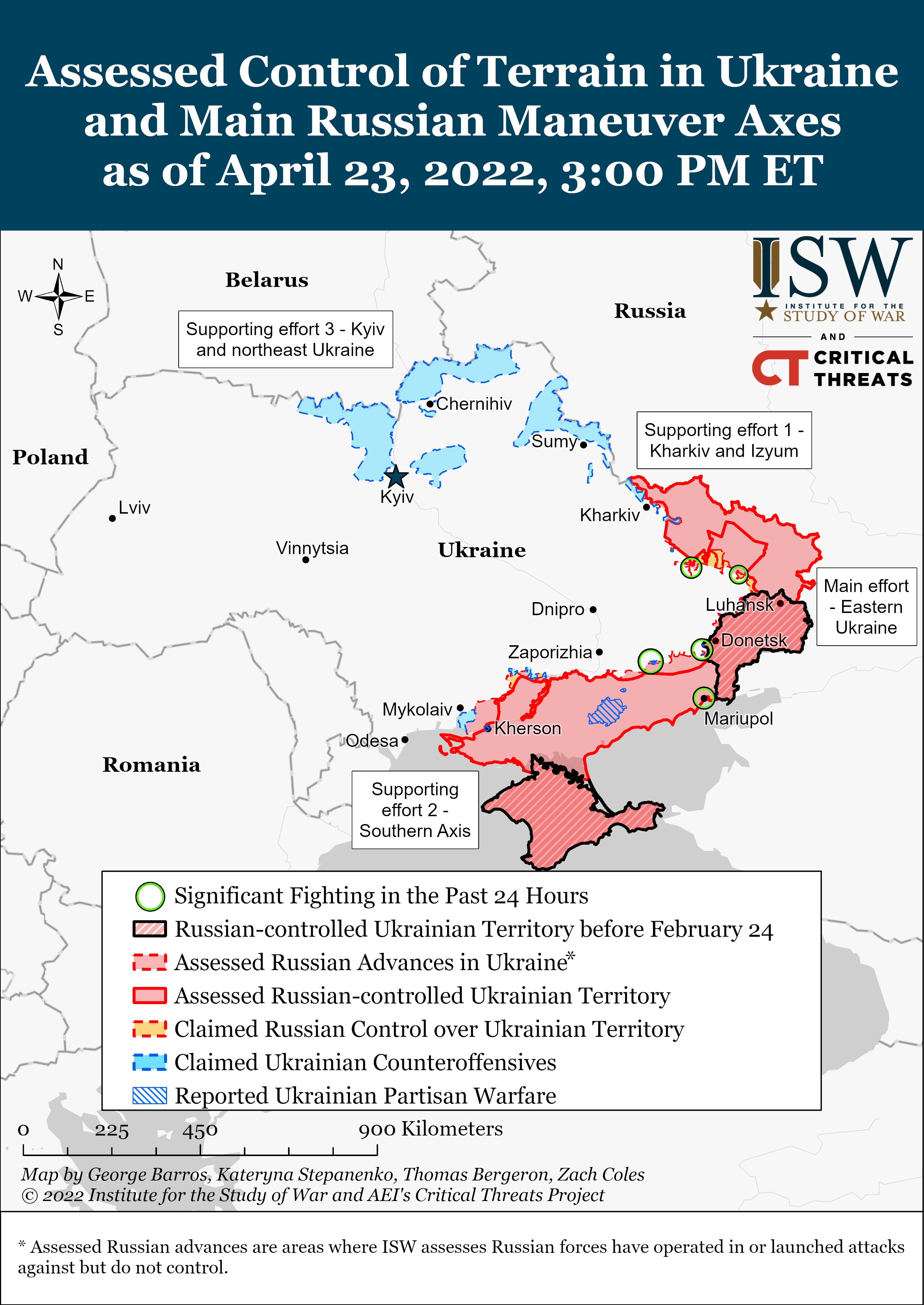
Russian forces continued offensive operations along multiple axes even as they completed moving reinforcements drawn from the retreat from Kyiv into the east and continued redeploying some forces from Mariupol to the north. The Russians have not taken time to refit troops moving from Kyiv or Mariupol before recommitting them to combat operations. They are not pausing offensive operations to wait until they have concentrated overwhelming combat power, and they do not appear to be massing forces on a few decisive axes of advance. They are continuing the pattern of operations they have followed throughout the war: committing small collections of units to widely dispersed attacks along multiple axes and refusing to accept necessary operational pauses to set conditions for decisive operations.

Russian forces have thus far only committed a handful of battalion tactical groups (BTGs) to offensive operations in their various sectors, however, and could still launch a massed offensive operation. We assess that such an operation is unlikely given observed patterns and the inherent limitations of available actual combat power in troops that have fought hard and suffered many casualties, as well as observed challenges with command-and-control at the regiment/brigade and division level. It is possible that the Russians are addressing or attempting to address some of those challenges and will soon launch an offensive in a new and better-coordinated form, but it remains unlikely.

The objectives of Russian offensives around the Izyum-Donetsk City salient are unclear. Russian forces may seek to reach the Izyum-Debaltseve road along two or more axes to encircle a large concentration of Ukrainian forces and built-up areas. Ukrainian officials suggested on April 23 that Russian forces near Rubizhne and Popasna may seek to encircle the Severodonetsk-Lysychansk area rather than pursue the deeper envelopment.[1] It is too soon to evaluate the likelihood of this Russian course of action or the probability of its success.

Key Takeaways

  • Russian forces continued their pressure on the Azovstal facility in Mariupol.
  • Russian troops drawn from the retreat from Kyiv are re-entering combat in eastern Ukraine.
  • Russian forces from around Mariupol are redeploying to the vicinity of Donetsk City and are likely to enter combat again soon and without rest or refit.
  • Russia continued conducting small-scale ground offensives at multiple points along the front from Izyum to Zaporizhia Oblast.

We do not report in detail on Russian war crimes because those activities are well-covered in Western media and do not directly affect the military operations we are assessing and forecasting. We will continue to evaluate and report on the effects of these criminal activities on the Ukrainian military and population and specifically on combat in Ukrainian urban areas. We utterly condemn these Russian violations of the laws of armed conflict, Geneva Conventions, and humanity even though we do not describe them in these reports.

ISW has updated its assessment of the four primary efforts Russian forces are engaged in at this time:

  • Main effort—Eastern Ukraine (comprised of two subordinate supporting efforts);
  • Supporting effort 1—Kharkiv and Izyum;
  • Supporting effort 2—Southern axis;
  • Supporting effort 3—Sumy and northeastern Ukraine.

Main effort—Eastern Ukraine

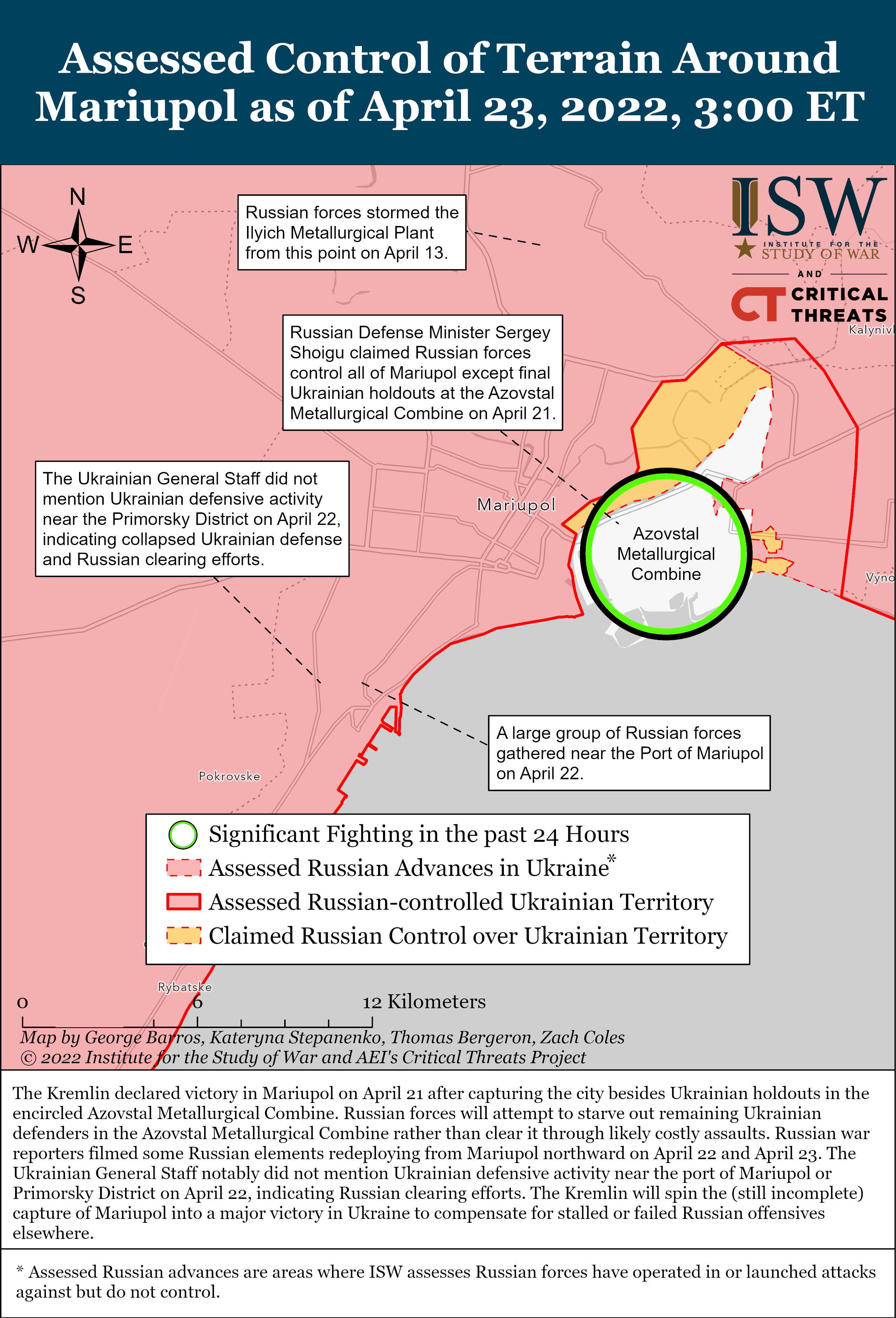
Subordinate Main Effort—Mariupol (Russian Objective: Capture Mariupol and reduce the Ukrainian defenders)

Russian forces continued to attack Ukrainian defenders in the Azovstal Steel Plant and are likely attempting to starve out those remaining within the facility.[2] Advisor to the Head of the Ukrainian President’s Office Oleksiy Arestovych stated that Russian troops tried to storm the plant and “strangle” Ukrainian resistance, though ISW cannot independently verify this claim.[3] Russian forces allegedly organized buses for civilian evacuation from Mariupol but canceled the evacuation on the grounds that Ukrainian ”nationalists” were planning on attacking the civilians.[4] Such actions that spoil the evacuation process likely represent further attempts to shape the information space in Mariupol and globally, as well as to extend administrative control in captured portions of the city.[5]

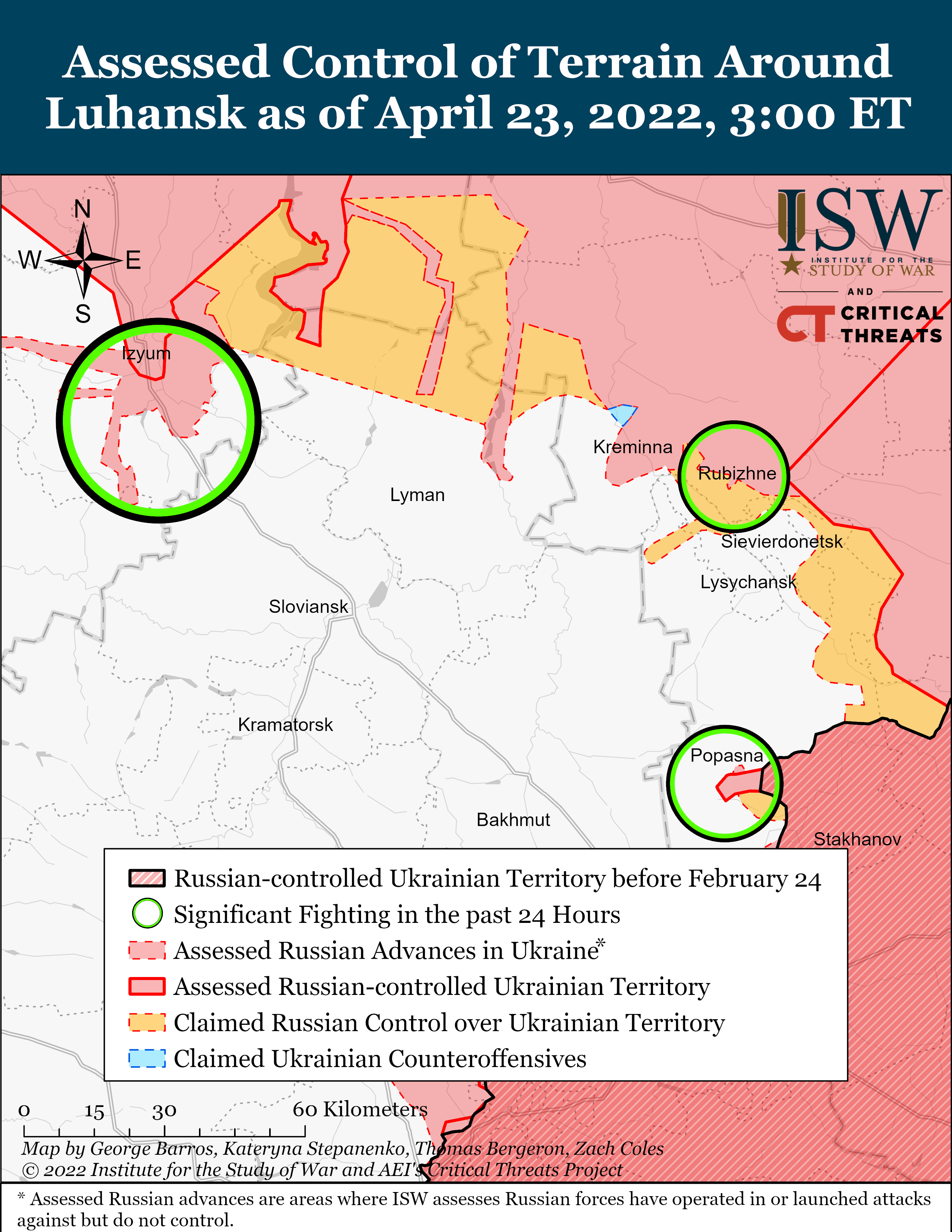
Subordinate Main Effort—Donetsk and Luhansk Oblasts (Russian objective: Capture the entirety of Donetsk and Luhansk oblasts, the claimed territory of Russia’s proxies in Donbas)

Russian forces conducted limited ground offensives in Rubizhne, Popasna, and Marinka on April 23 but did not make any significant territorial gains.[6] The Ukrainian General Staff said that Russian forces are focusing on preparing to assault Severodonetsk while continuing unsuccessful ground attacks in the direction of Slovyansk and shelling settlements all along the frontline.[7] Social media users and foreign journalists geolocated Russian forces to the northeastern part of Rubizhne, where street fighting continued as of April 23.[8] Russian forces paused offensive operations on Avdiivka, just north of Donetsk City, after consistently targeting the settlement throughout the week. Donetsk People’s Republic (DNR) and Russian units have reportedly been arriving in the vicinity of Donetsk City from Mariupol since April 21, and the Russian command will likely recommit these degraded units to offensives in Donetsk and Luhansk oblasts.[9]
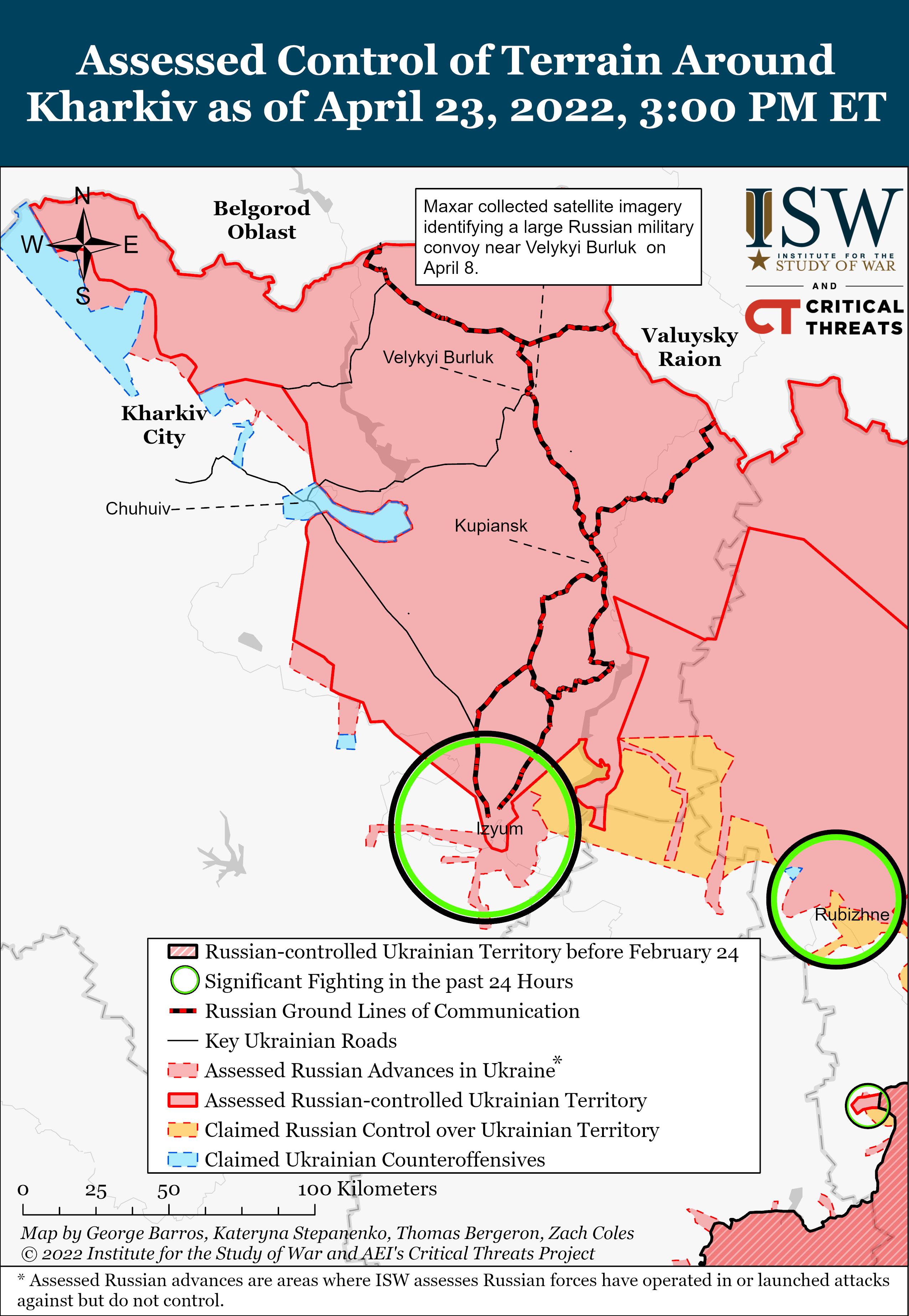
Supporting Effort #1—Kharkiv and Izyum: (Russian Objective: Advance southeast to support Russian operations in Luhansk Oblast; defend ground lines of communication (GLOCs) to the Izyum axis)

Russian forces conducted ground attacks from Izyum on April 23.[10] Arestovych said that Russian troops seized Lozova, approximately 100 km west of Izyum, on April 23.[11] The Ukrainian General Staff reported that elements of the 35th Combined Arms Army’s 1st Tank Army and the 68th Army Corps are participating in active combat in the area as of April 23.[12] The Ukrainian General Staff stated that elements of the 64th Separate Motorized Rifle Brigade of the 35th Combined Arms Army, which had fought in Bucha, are operating in the vicinity of Izyum.[13] Elements of the 64th Separate Motorized Rifle Brigade sustained losses while fighting on the Kyiv axis earlier in the invasion, redeployed to the Izyum axis quickly, and therefore likely add limited combat power to the fight.[14]

Russian forces maintained their positions northeast of Kharkiv city and continued to shell surrounding areas on April 23.[15] Reports of Russian reinforcements from the Kyiv axis in Kharkiv Oblast likely indicate that Russia intends to maintain pressure on Kharkiv city, contradicting the Russian claim that Moscow’s focus is on securing the borders of Luhansk and Donetsk oblasts. Russian ground lines of communication (GLOCs) do not currently run through or even near Kharkiv city, and the most recent Ukrainian counteroffensives near the city are unlikely to threaten Russian GLOCs from Belgorod to Izyum.
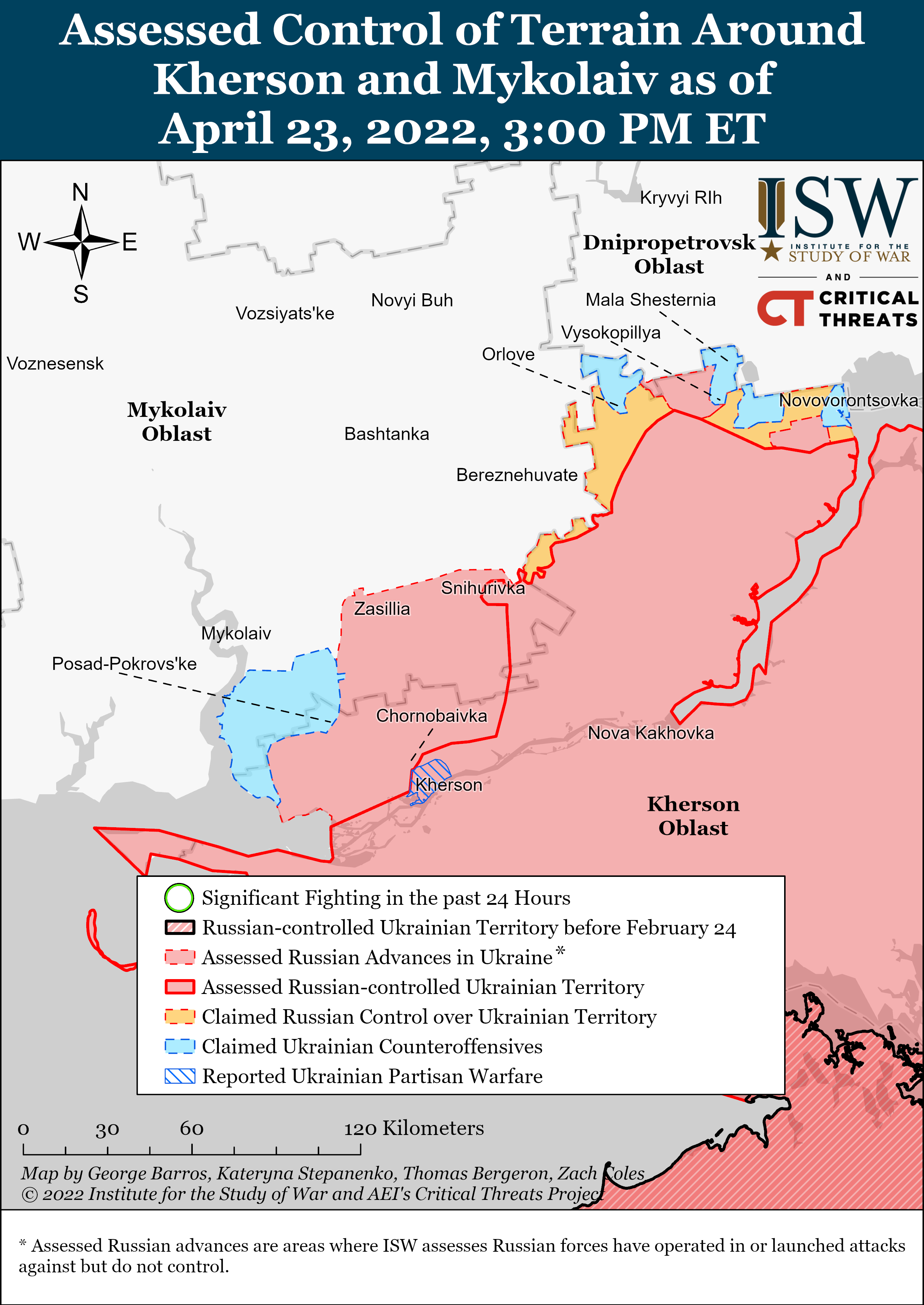
Supporting Effort #2—Southern axis: (Russian Objective: Defend Kherson against Ukrainian counterattacks)

Russian forces continued a limited offensive in Zaporizhia Oblast but paused ground offensive operations in northern Kherson Oblast on April 23.[16] Oleksiy Arestovych, chief advisor to Ukrainian President Volodymyr Zelensky, said that Russian forces advanced several kilometres in the direction of Hulyaipole, Zaporizhia Oblast, likely intending to stop Ukrainian counteroffensives in the area or to secure the N15 highway.[17] The Ukrainian General Staff reported that one Russian BTG from the 19th Motorized Rifle Division of the 58th Combined Arms Army moved in the direction of Zaporizhia. This unit was likely one of three sent to Melitopol early in March and is not likely a fresh unit, although it may have had time to refit and replace losses.[18] Russian forces are reportedly regrouping separate units of the 8th and 49th Combined Arms Armies, the 22nd Army Corps, Black Sea Coastal Troops, and airborne troops to retain occupied frontiers in southern Ukraine.[19]

Ukraine’s Military Intelligence Directorate claimed that Ukrainian forces struck a command post of the 49th Combined Arms Army in an unspecified frontline location in southern Ukraine on April 22, killing at least two generals and destroying the post.[20] ISW cannot independently verify this strike or its casualties. The Ukrainian Resistance Center also reported that an organized resistance movement has killed 100 Russian occupation personnel since the start of the war, including 30 since April 12.[21] Russian forces are attempting to forcibly mobilize residents of temporarily occupied settlements in Kherson and Zaporizhia oblasts, despite growing resistance movements.[22]
Supporting Effort #3—Sumy and Northeastern Ukraine: (Russian Objective: Withdraw combat power in good order for redeployment to eastern Ukraine)

There was no significant change in this area in the past 24 hours.

Immediate items to watch

  • Russian forces will likely continue attacking southeast from Izyum, west from Kreminna and Popasna, and north from Donetsk City via Avdiivka or another axis.
  • Russian forces will attempt to starve out the remaining defenders of the Azovstal Steel Plant in Mariupol and will not allow trapped civilians to evacuate.
  • Russian forces will likely increase the scale of ground offensive operations in the coming days, but it is too soon to tell how fast they will do so or how large those offensives will be. It is also too soon to assess how the Russians will weight their efforts in the arc from Izyum to Donetsk City.


References:

[1] https://www.facebook.com/GeneralStaff.ua/posts/301224008857351

[2] https://www.facebook.com/GeneralStaff.ua/posts/300852938894458; 

https://twitter.com/GeoConfirmed/status/1517822030149828608;

 https://twitter.com/zcjbrooker/status/1517593674498162688

https://twitter.com/GeoConfirmed/status/1517594859422552066;

 https://twitter.com/GeoConfirmed/status/1517822030149828608

[3] https://www.facebook.com/watch/?v=775822470053693&ref=sharing

[4] https://t dot me/andriyshTime/444

[5]https://twitter.com/GeoConfirmed/status/1517821496244252673; https://twitter.com/GeoConfirmed/status/1517575907006840832

[6] https://t dot me/luhanskaVTSA/1906; 

https://www.facebook.com/GeneralStaff.ua/posts/301224008857351;

 https://www.facebook.com/GeneralStaff.ua/posts/300852938894458

[7] https://www.facebook.com/GeneralStaff.ua/posts/300852938894458;

 https://t dot me/luhanskaVTSA/1918;

 https://www.facebook.com/GeneralStaff.ua/posts/300852938894458;

 https://t.me/pavlokyrylenko_donoda/3130; 

https://t.me/pavlokyrylenko_donoda/3126

[8] https://twitter.com/GeoConfirmed/status/1517822790396690432;

 https://twitter.com/nabihbulos/status/1517615210877624324

[9] https://twitter.com/GeoConfirmed/status/1517825445739347969

https://vk.com/video-211194011_456239107

[10] https://t dot me/synegubov/2969;

https://twitter.com/Angelo4justice3/status/1517413394575282176 ; 

https://twitter.com/GeoConfirmed/status/151782682531303424

 [11] https://focus dot ua/voennye-novosti/513227-vs-rf-otchasti-prodvinulis-v-zaporozhskom-i-izyumskom-napravleniyah-arestovich-video

[12] https://www.facebook.com/GeneralStaff.ua/posts/300852938894458

 [13] https://www.facebook.com/GeneralStaff.ua/posts/300852938894458

[14] https://gur.gov dot ua/content/rosiiskykh-viiskovykh-iaki-chynyly-zvirstva-v-buchi-znovu-povertaiut-v-ukrainu.html;

 https://gur.gov dot ua/content/voennye-prestupnyky-neposredstvenno-uchastvuiushchye-v-sovershenyy-voennykh-prestuplenyi-protyv-naroda-ukrayny-v-h-bucha-voennosluzhashchye-64-otdelnoi-motostrelkovoi-bryhady-35-oa-vvo.html; 

 https://inforesist dot org/razvedka-obnorodovala-imena-voennyh-rossijskoj-brigady-kotoraya-byla-v-buche/

[15] https://www.facebook.com/GeneralStaff.ua/posts/301224008857351; 

https://t dot me/mod_russia/14663;

 https://www.facebook.com/GeneralStaff.ua/posts/300852938894458;

[16] https://www.facebook.com/GeneralStaff.ua/posts/301224008857351

[17] https://focus dot ua/voennye-novosti/513227-vs-rf-otchasti-prodvinulis-v-zaporozhskom-i-izyumskom-napravleniyah-arestovich-video

[18] https://www.facebook.com/GeneralStaff.ua/posts/267245612255191;

 https://www.facebook.com/GeneralStaff.ua/posts/300852938894458

[19] https://www.facebook.com/GeneralStaff.ua/posts/300852938894458

[20] https://www.facebook.com/DefenceIntelligenceofUkraine/posts/297545889223505

[21] https://sprotyv dot mod.gov.ua/2022/04/22/u-melitopoli-partyzany-znyshhyly-ponad-100-okupantiv/; 

https://www.understandingwar.org/backgrounder/russian-offensive-campaign...

[22] https://www.facebook.com/GeneralStaff.ua/posts/301224008857351;

 https://www.facebook.com/DefenceIntelligenceofUkraine/posts/297511365893624

  Tags 

 Ukraine Project 

  File Attachments: 


PART 5 : Russia’s View of Mission Command of Battalion Tactical Groups in the Era of “Hybrid War”

SOURCE : 

(A)Bn Tac Gp:     https://en.wikipedia.org/wiki/Battalion_tactical_group 

(B) Bn Tac Gp: https://www.thefivecoatconsultinggroup.com/the-coronavirus-crisis/perspective-ukraine  

(C) Bn Tac Gp:    https://www.thefivecoatconsultinggroup.com/the-coronavirus-crisis/ukraine-context-d40  

(D)  DEFEAT  BTG:   https://www.benning.army.mil/armor/earmor/content/issues/2017/spring/2Fiore17.pdf

 ( E) Russian BTG & hybrid warfare   2018-06-11 Russias View of Mission Command of Battalion Tactical Groups (Bartles an

 (F) Russian “Hybrid warfare”: https://www.researchgate.net/publication/337844663_Hybrid_Warfare_and_Russia's_Ground_Forces

 (G)  211th Rifle Division : https://en.wikipedia.org/wiki/211th_Rifle_Division

(H) 40th Army :  https://en.wikipedia.org/wiki/40th_Army_(Soviet_Union)

INDEX

PART 1 :  Russian BTG-    https://bcvasundhra.blogspot.com/2022/04/battalion-tactical-group.html

PART 2 :  Battle Damage Assessment:  https://bcvasundhra.blogspot.com/2022/04/a-b-invasion-of-ukraine-d40-sitrep-207.html

PART 3 :   BTG-   https://bcvasundhra.blogspot.com/2022/04/part-2-battalion-tactical-group-btgs.html

PART 4 :    DEFEAT  BTG:     https://bcvasundhra.blogspot.com/2022/04/defeating-russian-battalion-tactical.html

PART 5 :  Russian BTG & “Hybrid War” :


BTG

Russia’s View of Mission Command of Battalion Tactical Groups in the Era of “Hybrid War” 

                    Charles Bartles and Lester W. Grau


American battle command is not Russian battle command. The US Army’s operations process is not the Russian Army operations process and the U.S. Army Military Decision Making Process (MDMP) process does not exist in the Russian Army. There are no Russian courses of action development. The Russian commander initiates the planning process by making his decision about how the mission will be accomplished and then the staff conducts the necessary coordination and war-gaming to convert the decision into orders. American officers have a variety of professional experiences throughout their careers and command is one of those experiences. By comparison, Russian officers, who are in the command track, are either commanding, attending school or serving as chief of staff while waiting for their next command. Russian command tours are long and, after six years of commanding a battalion, the planning process is relatively quick and easy for the commander. The formation where tactical leadership is most applied is the Brigade and the Battalion Tactical Group—the kinds of formations currently in and near eastern Ukraine. At this level, the Russian leaders are not concerned with Western concepts such as hybrid warfare. They are concerned with tactics against a particular enemy. Russian combined arms leadership is an extension of their own historical experience and not the interpolation of the experience of others in contemporary conflicts.


Contemporary Relevance of the Great Patriotic War

During the Soviet era, the Soviet Army experimented with the creation of combined arms battalions whereby one or two tank companies, an artillery battery and one or two motorized rifle companies would combine into a single permanent battalion for high-speed manoeuvre combat on the fragmented European or Chinese battlefield of the future. The Soviet Army task-organized to fight this way in much of its field training and developed habitual relationships as the same units were usually attached to the same battalions over the years. Soviet officers commanded longer and at a younger age than their Western counterparts. The major difficulty expected was training officers who could lead these multi-branch battalions in garrison. In this system, maintenance would still be centrally managed at regiment  and higher 1

There were some difficulties in creating permanent combined arms battalions. The Soviet view of future war fixated on the operational level. The Soviet Union had defeated Nazi Germany at the operational level of war and during the Soviet counteroffensive after Stalingrad, the Germans were never able to move their operational level reserve in time before the Red Army had broken through and were driving deep into German operational depths. Soviet future war demanded maximum operational flexibility to choreograph forces and firepower into a lethal high-tempo event and the way to achieve this operational flexibility was through tactical rigidity. The Soviets were far more operationally flexible than their Western counterparts—and far more rigid at the tactical level. Tactics were based on a series of drills which were practised over and over again until they became muscle memory that would prevail when the soldier was tired, frightened, confused or even back in the army as a mobilized reservist 15 years after conscript service. The Soviets wanted tactical predictability which could be entered into a mathematical model to guarantee operational success. This was also an excellent system for a conscript army with no professional NCO corps

Ground Force Wars following the Great Patriotic War

The Soviet Union went to war in Afghanistan and soon discovered that large operations were unproductive in a counter-guerrilla war. They were faced with a tactical war and their existing tactical drills were mostly inappropriate for it. They lacked professional NCOs and their junior officers and warrant officers were accustomed to waiting for orders rather than seizing the initiative. The Soviets had to develop a tactically competent army while fighting a tactically focused war. The Soviets committed 5(FIVE)  2/3rds division-equivalents to Afghanistan-a small portion of the 211 division Soviet Army. [  https://en.wikipedia.org/wiki/211th_Rifle_Division ] On any given day, 85% of the ground force was committed to the area or convoy security. The other 15%, primarily airborne, air assault and Spetsnaz [Special Forces] units conducted ambushes, raids, patrols and other offensive combat against the Mujahideen resistance. The Soviet airborne forces have always been a separate service from the ground forces. By the nature of their mission, they were tactically oriented and used to fighting separated from the main force. They are committed as combined arms forces, including air delivered artillery and armoured vehicles. Air assault and Spetsnaz were also part of the airborne service. It was in these branches that Soviet tactics experienced their greatest development in Afghanistan. Barely 10 per cent of Soviet armour, artillery and motorized rifle officers served in the Soviet 40th Army in Afghanistan, but a majority of Soviet airborne, air assault and Spetsnaz officers did.2 The other ground forces developed tactics more slowly, but ad hoc combined arms battalions formed in Soviet base camps where habitual relationships led to joint basing and unit identification. 

When the Soviets withdrew from Afghanistan, the temporary tactical fixation of the Soviet 40th Army dwindled. Ground forces officers, most of whom did not serve in Afghanistan, felt that the operationally-flexible, tactically-rigid model was best for national defense. The Soviet Union dissolved in 1991 and the Russian Armed Forces began to disintegrate along with other state institutions. Officers went without pay for six months or longer, units did not go to the field for training since there was no available fuel or training ammunition, inductees refused to show up at the draft center without reprisal. The economy collapsed, the ruble was worthless and Russia’s future was bleak. Three years after the dissolution, Russia was again at war-in breakaway Chechnya. There was not a single combat-ready division in the entire Russian Army. The General Staff had to cobble together a half-trained army, primarily using rail, assembling individual companies and battalions from all over Russia. Units that had never been together were now going to fight together. There was no time to choreograph the lethal operational ballet of maneuver and firepower. The Russian Army entered Grozny determined to intimidate the Chechens by their mere presence and past reputation. This force was shattered and driven from the city. Their reputation exited with the corpses of their defeated soldiers. Chechnya would devolve into a bitter series of tactical fights. The Russian Army slowly became more tactically flexible, but not soon enough. The defeated Russian Army withdrew from Chechnya in 1996. Russia recognized Chechnya’s defacto independence. The Russians were not done with Chechnya however and they spent the time creating a credible army that could prevail in the cities and mountains of their break-away republic

The Russian Army that invaded Chechnya in 1999 was far better trained, equipped, supplied and led. They had a better approach to counter-insurgency and they brought Chechnya back into the Russian Federation under the friendly Chechen rule. Airborne, air assault and Spetsnaz forces proved to be the most tactically flexible of the committed ground forces, but the regular ground forces were also tactically adroit.

The five-day Russo-Georgian War of 2008 (Peace Enforcement Operation in Russian parlance) exposed shortcomings in the Russian Armed Forces, but the airborne and ground forces did well at the operational level. Despite the lack of ready units, forces were assembled, trained and committed in a coherent, well-planned and executed fashion.4 Tactically there were still problems, but this was a quick war won on the operational level.5 The Serdyukov reforms were only just beginning, but one of the forces committed was a battalion of the 33rd Special Mountain Brigade(Russia), an indicator that the Russian ground forces were starting a major reform that would change force structure, training and modularity

Tactics in the Russian Armed Forces 

The system of tactics in the Russian military system can directly be attributed to the Russian Army that formed post World War II. The major Russian lesson learned from World War II was that the ability to project massive amounts of combat power quickly was essential for the swift resolution of any conflict thought to be inevitable. Since the Soviet Union believed that any future wars with the West would be quite similar to the major battles of World War II, the Soviet Union created a mass mobilization army with an emphasis on armour, motorized infantry, and artillery that would be capable of quickly subduing the enemy in order to avoid the huge civilian losses that the Soviet Union experienced in World War II. Although there were many changes in the Russian military since World War II including the advent of nuclear weapons and the rapid introduction of new technologies, the Russian military still remained a mass mobilization army until only the last several years when massive reforms began in the Russian military.

The Russian military’s mass mobilization past can still be seen in the Russian military tactics of today. Due to the Soviets belief that the most effective way of winning a future war with the West was through a massive army, the Soviet Union decided that the best force structure would be a professional cadre of officers that led conscripts. This system was believed to be most beneficial because it ensured that almost every male had some military service and would continue to be in a standby reserve status until recalled during a mass mobilization. This was seen to be the most advantageous way for the mobilization of the entire country to achieve the country’s military ends. The mass mobilization army concept would be the primary driver of Russian tactics. Soviet tactics had to be simple and effective and be able to be mastered by a conscript in two years. A consequence of the transition to a two year conscription model was the loss of the strong Soviet NCO corps, which the Soviets had inherited from the Tsarist army. In this system, individual initiative was neither encouraged nor desired. In the Soviet/Russian view, it is better to do a few simple tasks very well, than all tasks mediocre. 7

From a U.S. MDMP perspective, Russian military commanders have limited options for developing plans to accomplish given tasks. Commanders must pick from the “menu” of known tactics. Although this would irk a U.S. commander, Soviet/Russian commanders enjoy the system because although tactics are simple, but in aggregate, when multiple simple tactics are combined to accomplish a given task, a given maneuver could appear complex. Since these maneuvers are not developed “on-the-fly” and are instead a collection of simple tasks, the planning process is much less involved than an equivalent maneuver by a U.S. unit. At the tactical level, these units have miniscule staffs in comparison to Western units and do not require extensive operations orders to plan their missions. Russian/Soviet operation orders typically consist of only a map signed by the commander, with a few notes jotted in the margins, this is all that is required. Tactics are simple and rigid, but since they are universal, when used in aggregate they can provide great operational flexibility. 

The sweeping reforms of Russian Minister of Defense Anatoli Serdyukov (2007-2012) resulted in a major downsizing in the number of senior officers and the conversion of the ground forces from a regiment-division structure to a brigade structure. In terms of application of tactics to brigades and the new combined arms battalions (now called battalion tactical groups-BTGs), BTG commanders are already quite comfortable. Russian ground units have always fought as combined arms entities with attachments and detachments, but are differently constructed than U.S. Army formations are used to  9. Whereas a U.S. unit will cross-attach sub units between parent organizations, Russian tactical units will have attachments added without having to give up any organic components. For instance, parts of the tank and air-defence artillery battalions are routinely attached to motorized rifle battalions, companies, and platoons as needed for exercises and combat, leaving those parent units without cross-attached replacements. Since the BTG is essentially just a motorized rifle battalion with attachments, the universal system of tactics, well-entrenched system of attachments/detachments, and the fact that these attached units are normally part of the same separate brigade as the gaining unit (and possibly already have established relationships) are likely reasons why BTG operations are not overwhelming to motorized rifle battalion commanders. 

General Staff System

The Russian Federation retains a key aspect of the Prussian-style general staff system. Selection for service in the General Staff (GS) is not simply a duty assignment but is seen as a stepping stone into the highest echelons of the Russian military. Officers are selected for the GS at approximately the major level, and selection is considered to be very prestigious. Once selected, officers stop wearing branch insignia associated with their branch (motorized rifle, armour, artillery, etc.) and wear GS insignia, as they will not return to service in these units. These officers will serve in high-level staff assignments at Military Districts, Armies, and the GS Staff Headquarters in Moscow. Although these officers will not command tactical units (approximately division level and below) they will often be selected for military district commands. The intent of this practice is to prevent the development of a particular “branch” loyalty, instead, officers are loyal to the GS itself. This aspect is important as the GS conducts many of the budgeting and resource allocation duties that are done by the U.S. Department of Defense. 

Russian officers have much different career paths than officers in the U.S. military. In the U.S. system, a wide swath of experience ranging from various commands, staff time at high-level commands, special assignments, joint duties, etc. would all be standard milestones in any high-level officer’s career. This is not the case in the Russian system, in their system, there is a path for service in the General Staff and a path for other officers. Although there are two “paths” for Russian officers, taking one path or the other does not prevent an officer from becoming a general, they just usually get different assignments.10 

Although selection for the General Staff is prestigious, it is not the desired path for all officers. Manoeuvre officers that enjoy tactical command, may best serve by not pursuing assignments to the General Staff. On this path, officers get a chance to hone their skills, since there is no necessity for service in joint or other high-level staff assignments. Promotions typically happen much faster in the Russian military than in the U.S., it is not uncommon to have a 32-year-old battalion commander. Once selected for command, command tours of 4-6 years are common. In general, a two-year tenure is considered too short for sufficient mastery of a battalion tactical command. The situation is similar for brigade-level commands. The implication for the deployment of Russians Battalion Tactical Groups near/in Eastern Ukraine is that commanders will likely have had several years of command experience before arriving at the front. 

The Battalion Tactical Group in the Russian Armed Forces

In 2009, the Russian Armed Forces began the most radical reforms in 100 years. Russia has since transitioned from a regimental/division structure to a brigade-based one. With few exceptions, the vast majority of Ground Forces divisions were converted to brigades.11 Although the term “permanently ready” was used to describe all of these new brigades, it was stated that not all brigades would be true “permanently ready” (function at a reduced capacity) and even if truly ready, would not necessarily deploy as a brigade. In 2005, well before the introduction of the brigades, Chief of the General Staff, General Yuri Baluyevskiy said: “events in Chechnya have shown that self-sufficient battalions and tactical groups with self-sufficient means of intelligence, communications and provisions operated more successfully in local conflicts. That is why we are considering the possibility of moving away from a strict organizational staffing structure today.”12 General Baluyevskiy is referencing Battalion Tactical Groups (BTGs). The combined arms BTG was intended to be used as a detachable instrument of the brigade. One lesson learned from Russia in 2008 was the difficulty in deploying troops far from their garrisons. In order to remedy this problem, Russia now routinely mobilizes Brigade and Division-size units and transports them and their equipment considerable distances before they begin exercises.13 This means that the use of detached BTGs in the Ukrainian theatre does not mean that the Russians cannot deploy full brigades. The use of BTGs in this manner may be a way that Russia is handling troop rotations through the conflict. It also could mean that the BTG is the best force mix for this particular environment

Although the BTGs likely have a common training program, there still are problems. Problems with command and control and suitable employment of attached units are subjects that are not highlighted in open Russian military discussion, but issues with logistics and maintenance will remain although the use of the  Armata  common chassis will mitigate some of these. One reform that has not been successful was the abolition of some logistics and maintenance units in favour of private contractors. Russia is currently trying to rebuild some of its organic logistics and maintenance units that were disbanded, but the process is slow going.14  BTG  are not immune to the logistics problems that still plague the Russian military, and BTG commanders still complain about them. There is also reporting that BTGs get augmented by staff at the Army and Military District levels. Due to the Russian planning process, battalion staffs are quite small by U.S. standards. This augmented staff may substitute for the lack of an on-site higher headquarters (brigade/regiment), but these staff members might also be liaising with the General Staff and advising the unit commander as needed.15

The Battalion Tactical Group in Relation to Mission Command

The Russian military views the tactical, operational, and strategic levels of warfare differently from the West. In the West, these levels are typically defined by echelon size (battalion, corps, army, front, theatre, task force, etc.), but in the Russian system, these levels are more nuanced, defined by the unit’s scope of the mission. For instance, a division operating under an army group would be considered to be acting at a tactical level, but if the same division were detached and operating under a front-level command, it would be considered to be acting at the operational level. By the same token, a brigade is usually considered as acting at the tactical level, but in a conflict with a much smaller opponent—as in the Russian–Georgian War—a brigade could be a “war winner,” and therefore a strategic asset.16 In the Russian system, a BTG is a tactical entity. 

In the authors’ opinion, in the U.S. system, if at lower echelons Mission Command (MC) is more of a science than art and higher levels more of an art than science, this situation is even more so in the Russian system. The system of tactics lends itself well to mathematical precision and calculation. The science of command involves the commander picking the best option for accomplishing the mission and adjusting variables as needed. This process is assisted by rigid tactics and predictability that allow such practices as utilizing tables that estimate the percentage of an enemy unit that will be destroyed within a given amount of time from a specified unit (artillery firing tables, etc.).

The Battalion Tactical Group in Relation to Operational Art


The BTG has no relationship to operational art in a Russian military context. This is because the term “operational art” has a much different meaning for the U.S. than for Russia. In a NATO context, it is defined as: 

...the use of creative thinking by commanders and staff to design strategies, campaigns, and major operations and organize and employ military forces. It is a thought process that uses skill, knowledge, experience, and judgment to overcome the ambiguity and uncertainty of a complex environment and understand the problem at hand. Operational art also promotes unified action by encouraging JFCs and staff to consider the capabilities, actions, goals, priorities, and operating processes of inter-organizational partners, while determining objectives, establishing priorities, and assigning tasks to subordinate forces. It facilitates the coordination, synchronization, and, where appropriate,  integration of military operations with those of inter-organizational partners, thereby promoting unity of effort.17


In practice, this definition has led NATO militaries to think not just about the military aspects of force projection, but also about the coordination of the full gamut of the State’s means of leverage to achieve the desired end state. In contrast, the definition of the term in a Soviet/Russian context is much more military-oriented:

Operational art encompasses the theory and practice of preparing for and conducting operations by large units (fronts, armies) of the armed forces. It occupies an intermediate between strategy and tactics. “Stemming from strategic requirements, operational art determines methods of preparing for and conducting to achieve strategic goals.” Operational art in turn “establishes the tasks and direction for the development of tactics.” Soviet operational art provides a context for studying, understanding, preparing for, and conducting war…18 

In a Russian context, operational art has typically been thought of in the way that the great Soviet military thinkers (e.g., Tuchachevsky, Svechin, Triandafilov and Isserson) have focused solely on military matters, such as manoeuvring of large military formations for optimum effect.19 Modern war is becoming more unpredictable. General Gerasimov, the Russian Chief of the General Staff stated “In the 21st century, a tendency toward the elimination of the differences between the states of war and peace is becoming discernible. Wars are now not even declared, but having begun, are not going according to a pattern we are accustomed to.” 20 While retaining the ideas of their major military theoreticians, there are some signs that Russia may be expanding its definition of operational art to that of a definition more in line with U.S./NATO, due to current interests in new forms, methods, and ways of conducting warfare.21 Regardless of Russian interests in indirect and asymmetric methods, or as the West has dubbed “hybrid warfare,” and an increase in the quality of enlisted personnel through a new system of contract manning, in terms of systemic operation little if anything, has changed at the tactical level for the Russian military. However, the self-sufficiency of the BTG does expand the capability of the Russian Army to conduct deep tactical battles.

In short, Russian tactical leadership, especially as practised at the brigade level and below does not relate to operational art as defined by the Russian military and is difficult to understand through a Western notion of MDMP and a different world view of the present and future war

_________________________________


1   Lester W. Grau, "Reorganizing for Battalion-level Combat," Military Review, December 1989.

 2   Lester W. Grau, The Bear Went Over the Mountain: Soviet Combat Tactics in Afghanistan, Washington: NDU Press, 1996, xx. 

3   Dodge Billngsley with Lester Grau, Fangs of the Lone Wolf: Chechen Tactics in the Russian-Chechen Wars 1994-2009, Fort Leavenworth: FMSO, 2012, 169-172

4   As with other Soviet and Russian operations, this operation was conducted during large scale exercises to conceal troop movements

 5 Timothy L. Thomas, “The Bear Went Through the Mountain: Russia Appraides its Five-day War in South Ossetia”, Journal of Slavic Military Studies, 22:31-67, 2009. 

6 Christopher Donnelly, Red Banner: The Soviet Military System in Peace and War, Coulsdon, Surrey, UK: Jane's Information Group, 1990. 

7 Ibid.

 8 Ibid. 

9 They just did not live together as a combined arms battalion in garrison. Also see Chris Belamy, Red God of War: Soviet Artillery and Rocket Forces, London, u.a. Brassey’s Defence Publications, 1986.

 10 The Current Chief of the General Staff, General Valery Gerasimov took the traditional “General Staff” career path. This is in mark contrast to the previous Chief of the General Staff, General Nikolay Makarov who came to the General Staff late in his career. 

11 Charles K. Bartles, “Defense Reforms of Russian Defense Minister Anatolii Serdyukov,” Journal of Slavic Military Studies, 24, no. 1 (2011): 55–80.

 12  Viktor Mikhaylov, “The Russian Military Brigade Contract” Nezavisimoye Voyennoye Obozreniye Online, 22 May 2009, < http://nvo.ng.ru/forces/2009-05-22/1_podryad.html?mthree=3>, accessed 8 May 2015. 

 Igor Chernyak, “Igor Baluyevskiy: We Do not Intend Waging War with NATO,” Rossiyskaya Gazeta Online, 1 November 2005,   , accessed 8 May 2015.

13 “Information Resistance Has Detected Russian Troops from More Than 10 Brigades in Donets Basin,” Ukrayinska Pravda Online, 20 Apr 2015, , accessed 9 May 2015. The US Army conducts EDREs-Emergency Deployment Readiness Exerciseswhere combat battalions and larger units are transported over distance, after short notice, to a training site to draw equipment and train. Aleksey Ramm, “The Ukraine Test: New Image of Armed Forces Spoiled by Field Kitchens,” VoyennoPromyshlennyy Kuryer Online, 29 April 2015, , accessed 6 May 2015. 

14 One factor complicating the manner is that contract troops are funneled into the combat arms, leaving combat support and combat service support roles being filled by conscripts. Charles Bartles, Details of Russia’s Spring 2015 Conscription Campaign Aleksey Durnovo, “Features of Organizing the Spring 2015 Draft of Citizens for Military Service,” Ekho Moskvy Online, 4 April 2015, , accessed 8 May 2015.

15 Aleksey Ramm, “The Ukraine Test: New Image of Armed Forces Spoiled by Field Kitchens,” Voyenno-Promyshlennyy Kuryer Online, 29 April 2015, , accessed 6 May 2015. 

16 Charles K. Bartles & Roger N. McDermott, “Russia’s Military Operation in Crimea: Road-Testing Rapid Reaction Capabilities,” Problems of Post-Communism, Vol. 61, No. 6, November–December 2014, 51-52.

 17 Joint Publication 3.0, Joint Operations, 11 August 2011, , accessed 22 December 2014. 

18 David M. Glantz, Soviet Military Operational Art: In Pursuit of Deep Battle. London, England: F. Cass, 1991.

 19 Charles K. Bartles, “Russia’s Indirect and Asymmetric Methods as a Response to the New Western Way of War” pending publication in the Special Operations Journal. 

20 Valeriy Gerasimov[Chief of the Russian General Staff], "The Value of Science is in the Foresight: New Challenges Demand Rethinking the Forms and Methods of Carrying out Combat Operations," Voyenno-Promyshlennyy Kuryer Online in Russian 26 February 2013.

 21 Aleksandr Korabelnikov, “Military-Field Breakdown: Armed Forces Need New Regulation Documents to Further Increase Combat Effectiveness,” Voyenno-Promyshlennyy Kuryer Online, 19 November 2014, http://vpk-news.ru/articles/22730 , accessed 16 December 2014https://vpk-news.ru/articles/22730 ]