Thursday, May 19, 2022

Russian Offensive Campaign Assessment, May 18, 2022

 SOURCE:

GOOGLE  TO  GLIMPSE THE WAR 


(P) TOM COOPER UKRAINE WAR:  

  (f) https://medium.com/@x_TomCooper_x/ukraine-war-17-18-may-2022-a30378cfbd32

  (e)  https://medium.com/@x_TomCooper_x/ukraine-war-16-and-17-may-2022-2a79fc72e730
  (d) https://medium.com/@x_TomCooper_x/ukraine-war-14-and-15-may-2022-9e9a89f694be
  (c) https://medium.com/@x_TomCooper_x/ukraine-12-may-2020-6fe4a31959b9
  (b) https://medium.com/@x_TomCooper_x/ukraine-war-10-11-12-may-2022-cfd65b518a4d 

(Q) RUSSIA & UKRAINE'S PROGRESSIVE DISPOSITIONS:  

https://upload.wikimedia.org/wikipedia/commons/4/4f/2022_Russian_invasion_of_Ukraine.svg


(R)    WAR ACTIVE ZONES LIVE ON MAP: 

          https://t.co/63fVbMXIWl 


 Assessment    

Russian Offensive Campaign, May 18, 2022

          Kateryna Stepanenko and Karolina Hird


May 18, 6:15 pm ET


Russian occupation authorities announced plans to destroy the Azovstal Steel Plant and turn Mariupol into a resort city, depriving Russia of some of the most important economic benefits it hoped to reap by taking the city in the first place. Head of the Donetsk People’s Republic (DNR) Denis Pushilin stated that DNR authorities are planning to level Azovstal after completing its capture.[1] Azovstal was a major element of Mariupol’s economy before the war because of its unique function as a full-cycle metallurgical complex, the 10,000 jobs associated with production at the plant, the billions of dollars of foreign exchange earnings and taxes it generated, and its production output of 7,000 tons of steel, 6 million tons of iron, and 4.5 million tons of rolled metal, according to the Mariupol City Council.[2] Pushilin stated that the DNR intends to rebuild Mariupol to be a “resort city,” while admitting that 60% of the structures in Mariupol have been destroyed to the point where they cannot be rebuilt.[3] The announced plan to turn Mariupol into a center of tourism and leisure following the complete destruction of a major center of economic activity in Mariupol is indicative of the damage that Russian troops have inflicted on themselves through the destruction of Mariupol. Russia does not need another resort town on the Black Sea. It does need the kind of hard currency that a plant like Azovstal had generated. This announcement epitomizes the kind of Pyrrhic victories Russian forces have won in Ukraine, to the extent that they have won victories at all.


The Kremlin may hope to offset the loss of revenues from Azovstal and other destroyed infrastructure in Ukraine by profiting from the Zaporizhia Nuclear Power Plant that is forces have seized. Russian Deputy Prime Minister Marat Khusnullin announced that he will allocate maximum integration assistance for Zaporizhia Oblast to work in a “friendly Russian family” during his visit to Melitopol on May 18.[4] Khusnullin added that the Zaporizhia Nuclear Power Plant will exclusively work for Russia and will sell electricity to Ukraine. This statement is a clear Russian recognition that there will be an independent Ukraine at the end of this war and that Russia seeks to restore its energy leverage over Ukraine and possibly the West more broadly that has been reduced by sanctions and efforts to reduce reliance on Russian energy. It also reinforces the urgency of helping Ukraine regain control of Enerhodar City and the rest of its occupied territory to forestall this renewed economic thralldom. ISW previously reported that Russian forces started digging trenches and blocking highways to Enerhodar City.[5] The Zaporizhia Oblast Military Administration reported that Russian occupation authorities continued to prepare for a referendum in Enerhodar City on May 18.[6]


Ukrainian officials reported protests in Donetsk and Luhansk People’s Republics (DNR and LNR) over forced mobilizations on May 16-17. The Ukrainian Military Intelligence Directorate (GUR) reported that relatives of the forcefully mobilized LNR servicemen demanded an immediate return of their family members from combat in Luhansk City and Rovenky approximately 50 kilometers west of Russian border.[7] The GUR noted that perceptions of war and resentment of mobilization in LNR worsened because of the high casualties Russian forces have suffered and the fact that Russian authorities are reportedly evading payments to the families of wounded and killed servicemen. Mariupol Mayor’s Advisor Petro Andryushenko had previously reported that a protest against mobilization had occurred in Donetsk City on May 16.[8]


Key Takeaways


  • Russian forces are continuing to inflict air and artillery strikes on the Azovstal Steel Plant, indicating that a remnant of Ukrainian defense is still in the plant despite evacuations over the last few days.
  • Russian occupying authorities are reportedly planning to level the Azovstal Steel Plant after completing its capture, which directly undermines the large strategic economic importance of capturing the plant.
  • Russian forces continued to prepare for an assault on Severodonetsk and intensified operations around Lyman.
  • Russian forces continued to prioritize holding positions around the Russian border to prevent further Ukrainian advances north of Kharkiv City and will likely continue to do so at the expense of deploying additional reinforcements to other axes of advance.
  • Russian troops focused on maintaining their positions on the Southern Axis and on conducting rocket, missile, and artillery strikes along the frontline.
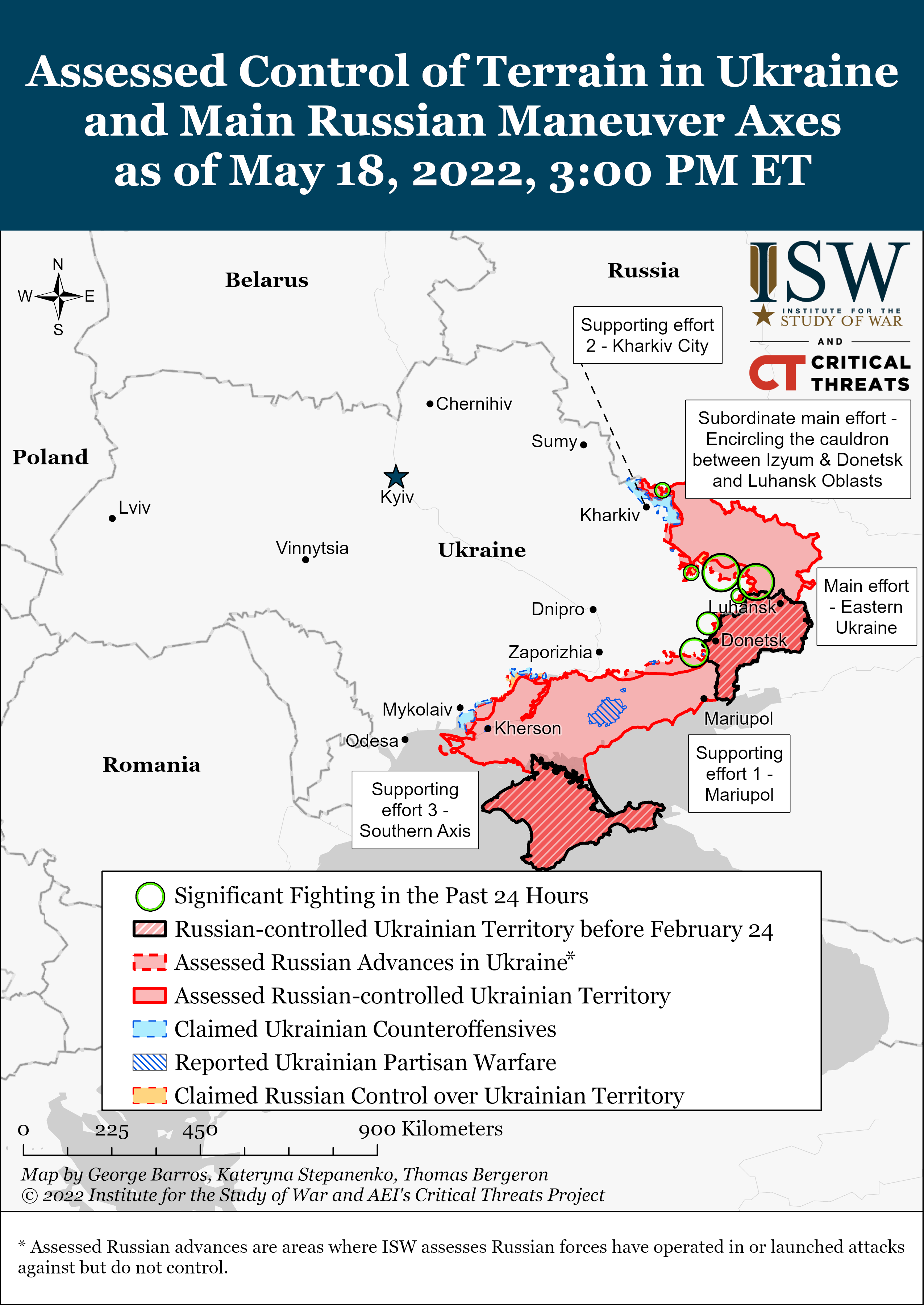

We do not report in detail on Russian war crimes because those activities are well-covered in Western media and do not directly affect the military operations we are assessing and forecasting. We will continue to evaluate and report on the effects of these criminal activities on the Ukrainian military and population and specifically on combat in Ukrainian urban areas. We utterly condemn these Russian violations of the laws of armed conflict, Geneva Conventions, and humanity even though we do not describe them in these reports.


ISW has updated its assessment of the four primary efforts Russian forces are engaged in at this time. We have stopped coverage of supporting effort 4, “Sumy and northeastern Ukraine,” because it is no longer an active effort.


  • Main effort—Eastern Ukraine (comprised of one subordinate and three supporting efforts);
  • Subordinate main effort- Encirclement of Ukrainian troops in the cauldron between Izyum and Donetsk and Luhansk Oblasts
  • Supporting effort 1—Mariupol; 
  • Supporting effort 2—Kharkiv City;
  • Supporting effort 3—Southern axis.

Main effort—Eastern Ukraine

Subordinate Main Effort—Southern Kharkiv, Donetsk, Luhansk Oblasts (Russian objective: Encircle Ukrainian forces in Eastern Ukraine and capture the entirety of Donetsk and Luhansk Oblasts, the claimed territory of Russia’s proxies in Donbas)

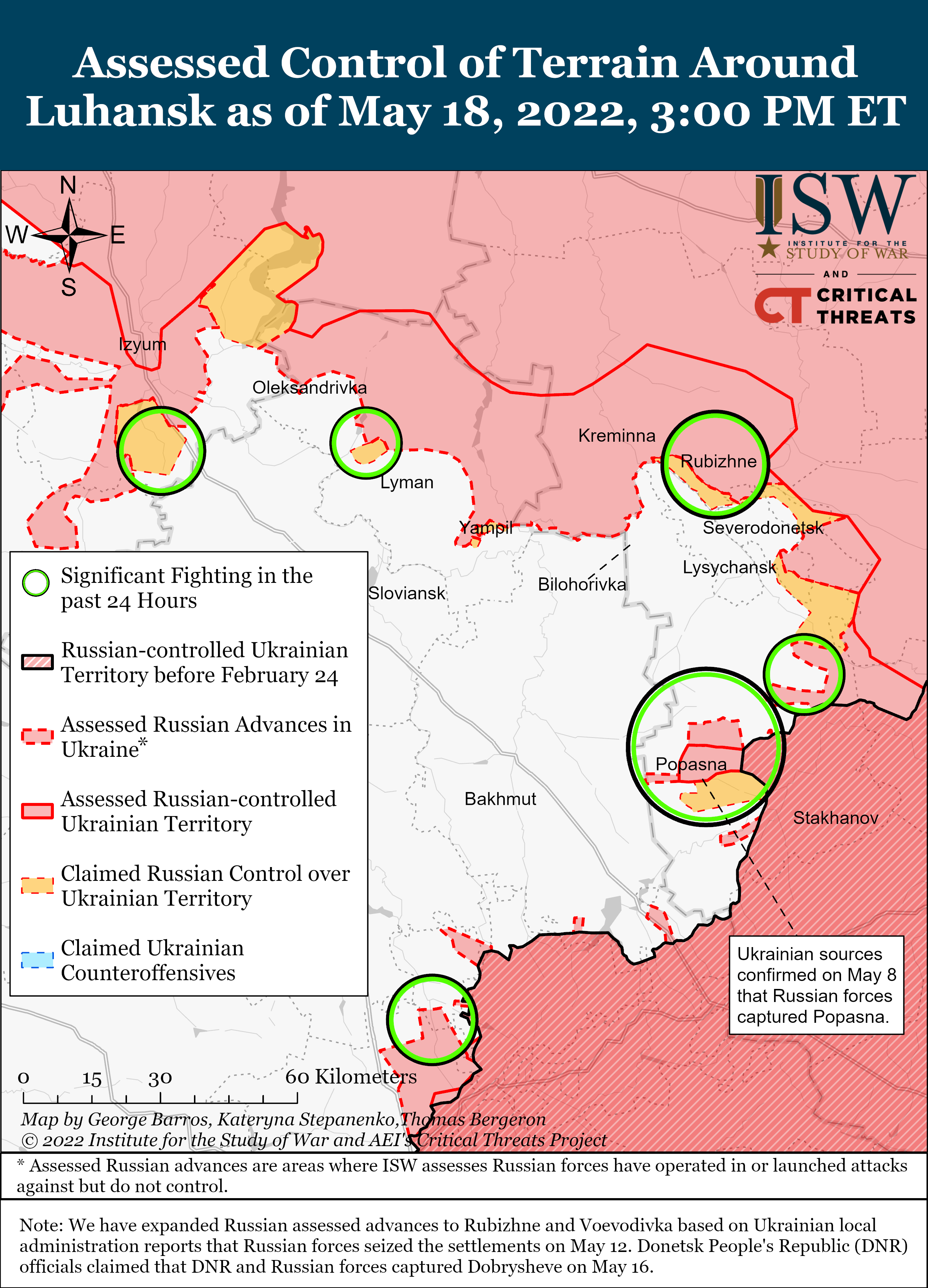
Russian forces did not advance south of Izyum on May 18. The Ukrainian General Staff reported that Russian forces used drones, rockets, and artillery units to support an unsuccessful offensive on Dovhenke - a settlement approximately 30 kilometers south of Izyum.[9] Russian forces are likely aiming to secure access to the Izyum-Slovyansk highway east of the settlement to resume the offensive on Donbas. A satellite image from May 12 released yesterday showed a sunken Russian pontoon bridge approximately seven kilometers southwest of Izyum, which had been previously used by Russian forces to transport heavy artillery in April.[10] Ukrainian forces could have damaged the pontoon bridge given that they had previously destroyed two bridges in the same location on March 27.[11] Damage to the bridge may be hindering Russian drives on Barvinkove southwest of Izyum, although Russian possession of the major highways in the area might be sufficient to support their current level of operations. Russian forces intensified offensive operations in the area of Lyman, likely to gain foothold west of the Siverskyi Donets river.[12]

Russian forces intensified shelling and conducted unsuccessful offensive operations near Popasna in preparation for the Battle of Severodonetsk.[13] The Ukrainian General Staff reported that Russian forces attempted to advance southwest and north of Popasna, but could not seize access to highways to Bahmut and Lysychansk.[14] Luhansk Oblast Administration Head Serhiy Haidai said that Russian forces are increasing aviation support for ground troops in Luhansk Oblast.[15]


Russian forces continued a line of unsuccessful ground assaults in an effort to advance to Slovyansk and Zaporizhia City.[16] Russian forces and artillery were the most active in the settlements east of Avdiivka, but did not secure any territorial gains.[17] Russian military Telegram channels criticized the functioning of the Russian reconnaissance-strike complex (used to identify and attack targets), on the grounds that its centralized approval system hinders Russian artillery from striking Ukrainian positions in time because of delays in securing approval to fire from higher command echelons.[18]


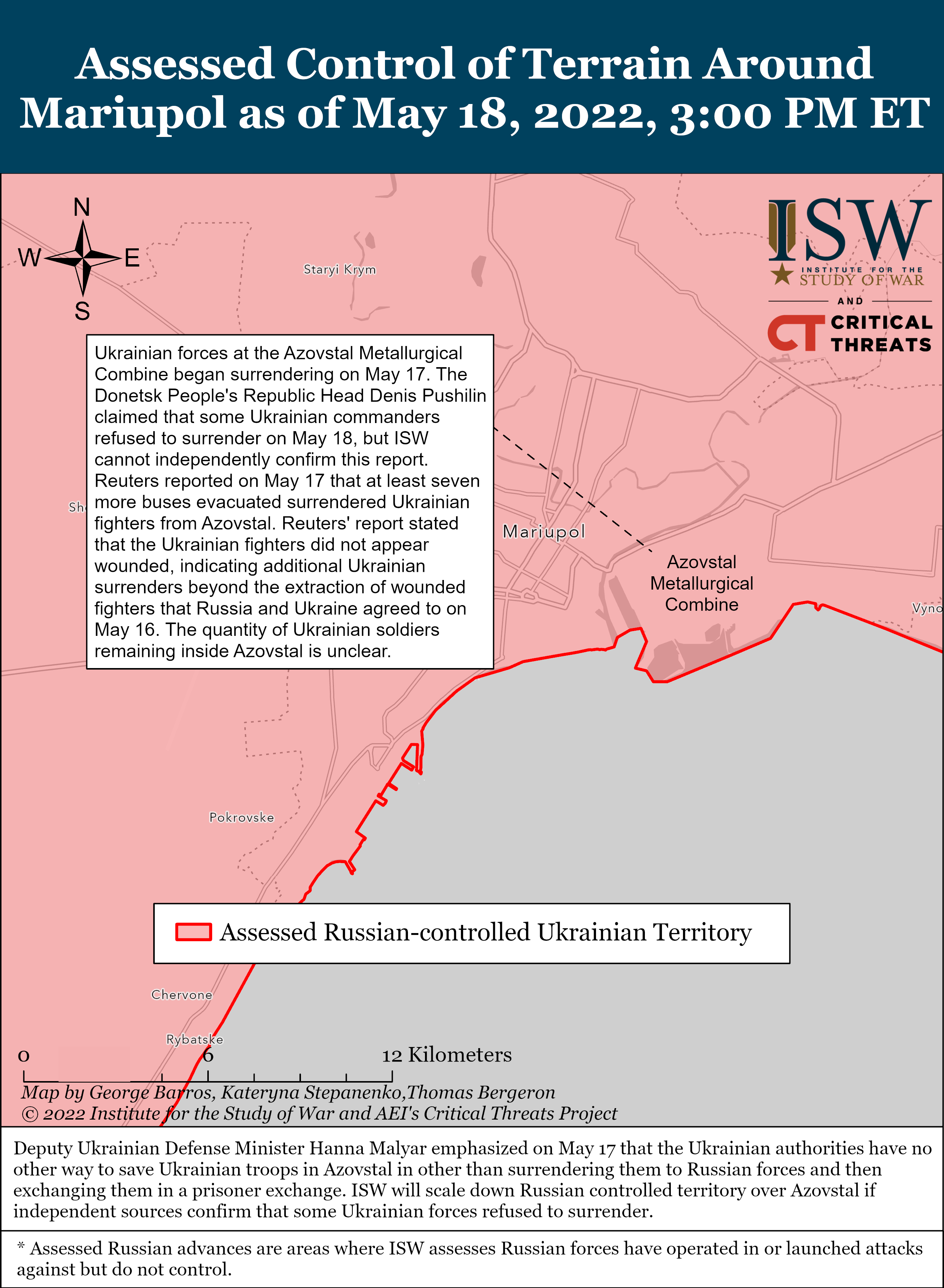
Supporting Effort #1—Mariupol (Russian objective: Capture Mariupol and reduce the Ukrainian defenders)

Russian forces continued to conduct air and artillery strikes against the remaining Ukrainian defenders in the Azovstal Steel Plant on May 18.[19] The Russian Ministry of Defense stated that 694 Ukrainian servicemen surrendered to Russian forces between May 17 to 18 and claimed that nearly 1,000 had surrendered in all since evacuations began.[20] Leader of the Donetsk People’s Republic (DNR) Denis Pushilin claimed that all the high-ranking Ukrainian commanders have not yet left the plant. ISW cannot independently confirm that Ukrainian servicemen remain in Azovstal, but continued Russian air and artillery strikes make it highly likely that there are still some Ukrainian troops in the plant.[21]

Russian authorities continued occupation activities in Mariupol. DNR head Pushilin held a press tour in Mariupol and stated that the DNR intends to fully restore Mariupol and turn it into a “resort town.”[22]  The Mariupol City Council notably stated that DNR authorities are planning to destroy the Azovstal Plant.[23] Occupation authorities also hosted a “high delegation” from Chechnya and promised close cooperation with the Chechen Republic, possibly in recognition of the role Chechen forces played in seizing the city since there is no other obvious reason why Mariupol should cooperate closely with Chechnya.[24] Port authorities continued to prepare the Port of Mariupol for grain, metal, and clay exports under the supervision of a former head of the Russian Yeisk seaport, indicating an administrative focus on continued integration into the Russian economy of such portions of the Mariupol economy as Russia has not yet completely destroyed or announced its intention of destroying.[25]


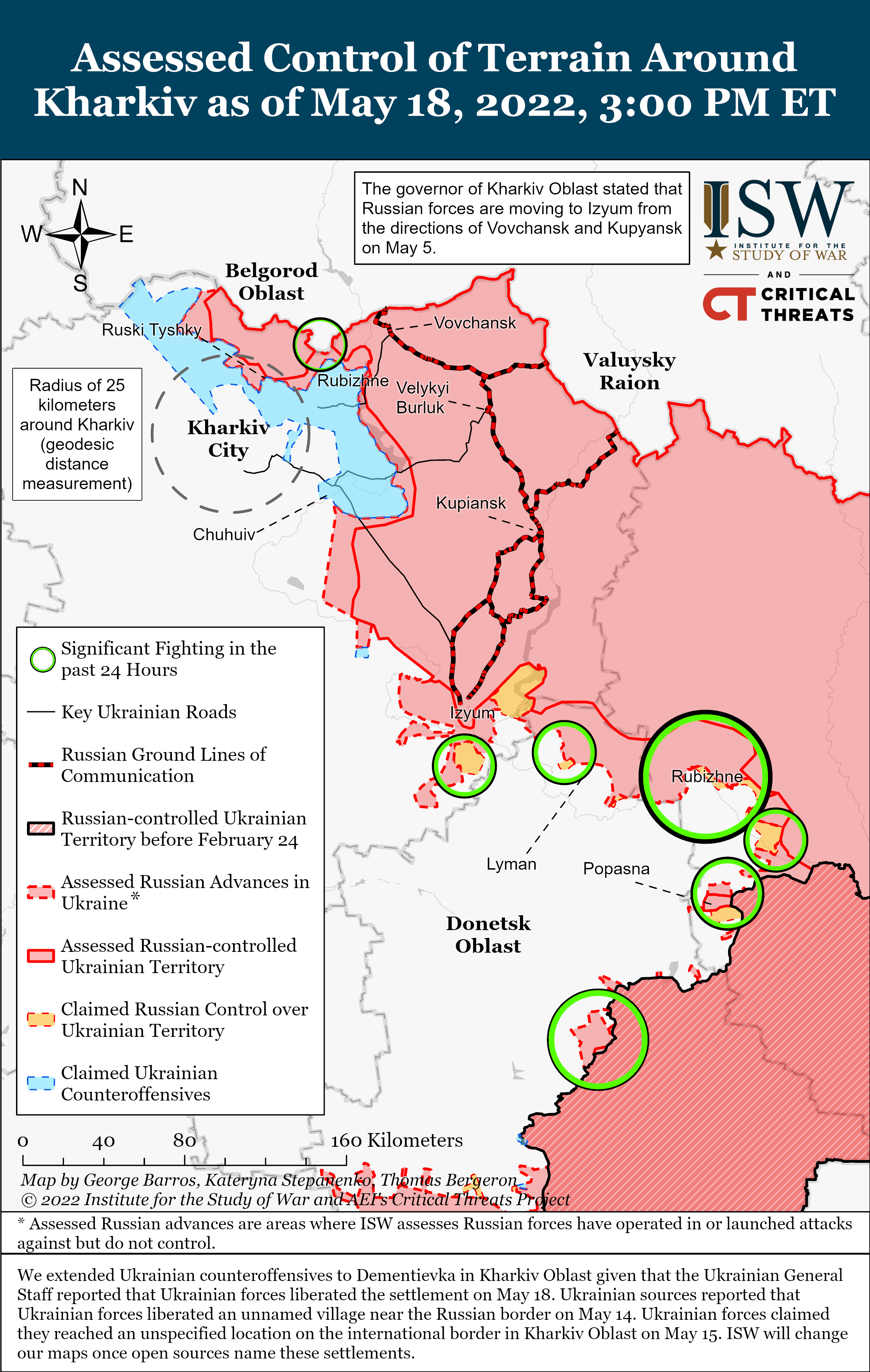
Supporting Effort #2—Kharkiv City (Russian objective: Withdraw forces to the north and defend ground lines of communication (GLOCs) to Izyum)

Russian forces continued efforts to prevent a further northward advance of the on-going Ukrainian counteroffensive around Kharkiv City on May 18. The Ukrainian General Staff stated that Ukrainian troops took control of Dementievka, about 10 kilometers south of Russian border, and that Russian forces are fighting in Ternova, 5 kilometers south of the Russian border.[26] Russian forces additionally shelled the northern part of Kharkiv City, indicating that they still have control of the highway to Belgorod in a manner that allows them to inflict artillery damage on the northern suburbs of Kharkiv despite pressure generated by the Ukrainian counteroffensive.[27] Russian troops north of Kharkiv City will likely continue to prioritize holding positions in Ukraine away from the international border at the expense of deploying additional reinforcements to Donbas.

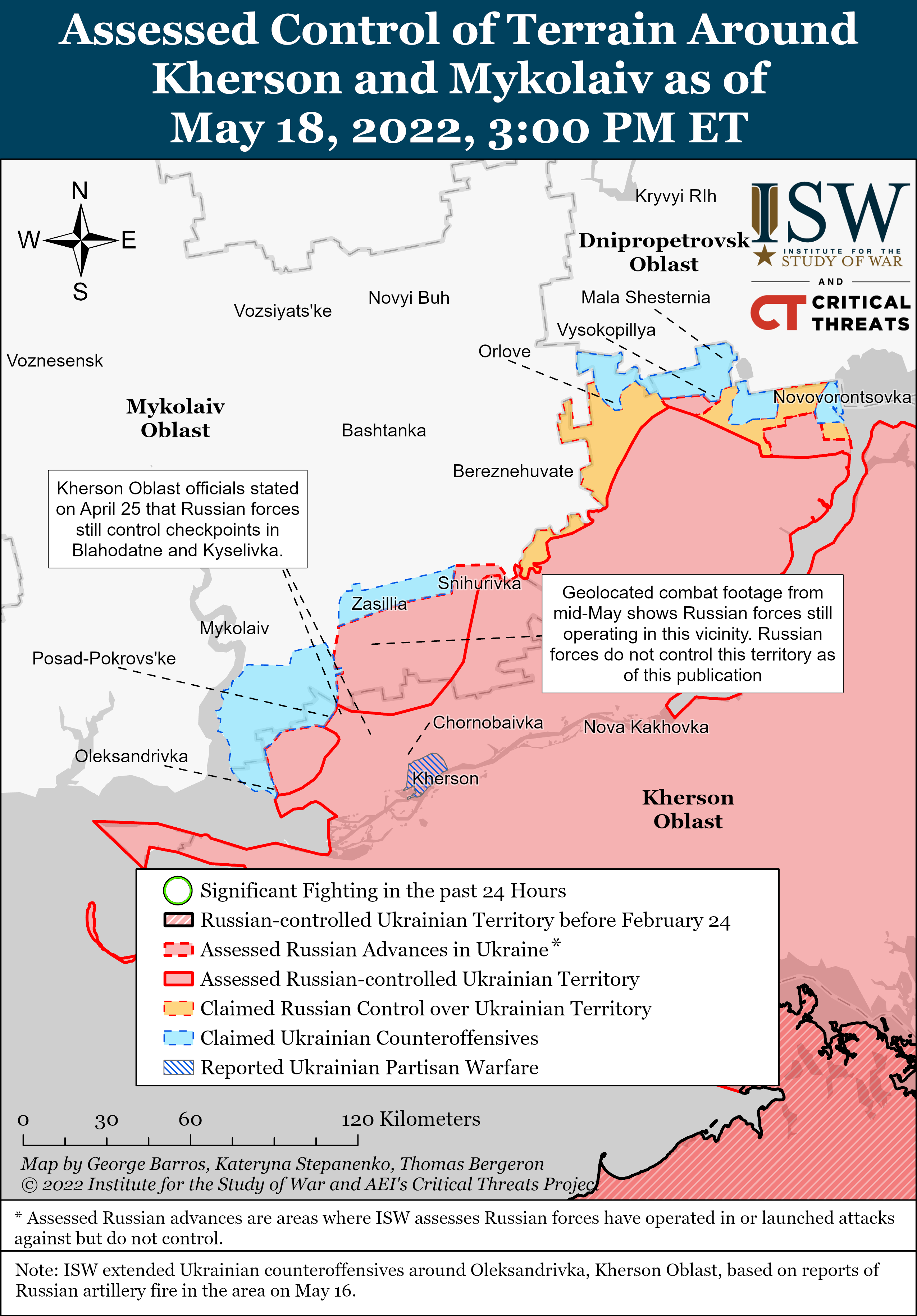
Supporting Effort #3—Southern Axis (Objective: Defend Kherson against Ukrainian counterattacks)

Russian forces did not conduct any ground assaults in southern Ukraine and carried out shelling and reconnaissance of Ukrainian positions.[28] The Zaporizhia Oblast Military Administration noted that Russian forces began reinforcing troops for an offensive from the southeast on Orikhiv—a settlement approximately 80 kilometers from Zaporizhia City.[29] The Ukrainian Southern Operational Command reported that Russian forces are fortifying in-depth in Kherson and Mykolaiv Oblasts.[30] Ukrainian forces reportedly destroyed two Russian ammunition depots in northern Kherson Oblast on May 17, including one near Chornobaivka just north of Kherson City, according to the Ukrainian Southern Operational Command.[31] Russian forces launched missile strikes on Odesa and Mykolaiv Oblasts on May 18.[32] The situation in Transnistria did not change.[33]

Immediate items to watch

  • Russian forces will likely complete their withdrawal from the vicinity of Kharkiv City but attempt to hold a line west of Vovchansk to defend their GLOCs from Belgorod to Izyum. It is unclear if they will succeed.
  • The Russians will continue efforts to encircle Severodonetsk and Lysychansk at least from the south, possibly by focusing on cutting off the last highway connecting Severodonetsk-Lysychansk with the rest of Ukraine.
  • Russia might attempt to annex part of Zaporizhia Oblast to profit off the Zaporizhia Nuclear Power Plant.
  • The Russians will continue to launch artillery and missile strikes on the Azovstal Steel Plant to target Mariupol defenders that refused to surrender.


References:


[1] https://t.me/mariupolrada/9661; 

https://t.me/mariupolnow/10753; 

https://twitter.com/KyivIndependent/status/1526905532904259584

[2] https://t.me/mariupolrada/9661

[3] https://t.me/mariupolnow/10753;

 https://t.me/stranaua/42763%20;

[4] https://m dot business-gazeta.ru/news/550416;

 https://t.me/voenkorKotenok/36486

[5] https://understandingwar.org/backgrounder/russian-offensive-campaign-ass...

[6] https://t.me/zoda_gov_ua/7929

[7] https://www.facebook.com/DefenceIntelligenceofUkraine/posts/314715004173260

[8] https://understandingwar.org/backgrounder/russian-offensive-campaign-ass...;

 https://t.me/andriyshTime/905

[9] https://www.facebook.com/GeneralStaff.ua/posts/319806796999072;

 https://twitter.com/GeoConfirmed/status/1526645451847524353

[10] https://twitter.com/GeoConfirmed/status/1526653244776251392; 

https://twitter.com/GeoConfirmed/status/1526653246642741250

https://twitter.com/GeoConfirmed/status/1526653256759394308

[11] https://twitter.com/GeoConfirmed/status/1526653246642741250

[12] https://www.facebook.com/GeneralStaff.ua/posts/3198067969990;

 https://www.facebook.com/GeneralStaff.ua/posts/319447660368319;

 https://twitter.com/GirkinGirkin/status/1526804475956043779; 

https://twitter.com/GirkinGirkin/status/1526898421306736641

[13] https://t.me/luhanskaVTSA/2692

[14] https://www.facebook.com/GeneralStaff.ua/posts/319806796999072

[15] https://www.facebook.com/GeneralStaff.ua/posts/319447660368319

https://t.me/luhanskaVTSA/2695

[16] https://www.facebook.com/GeneralStaff.ua/posts/3198067969990;

[17] https://t.me/pavlokyrylenko_donoda/3426; 

https://twitter.com/666_mancer/status/1526650111773888514;

 https://www.facebook.com/dshv25opdbr/videos/687887745800691/;

 https://twitter.com/a_vikulin/status/1526657985002491908;

[18] https://t.me/vysokygovorit/7866

[19] https://www.facebook.com/GeneralStaff.ua/posts/319447660368319

[20] https://t.me/mod_russia/15837;

 https://t.me/rlz_the_kraken/50000; 

https://www.reuters.com/world/europe/fears-mariupol-defenders-after-surr...;

 https://www.nytimes.com/live/2022/05/18/world/russia-ukraine-war-news/ru...

[21] https://t.me/stranaua/42835

[22] https://t.me/andriyshTime/939;

 https://t.me/andriyshTime/941;

 https://ria dot ru/20220518/mariupol-1789214329.html?utm_source=yxnews&utm_medium=desktop;

 https://t.me/stranaua/42763 ;

 https://t.me/voenkorKotenok/36472

[23] https://t.me/mariupolrada/9661;

 https://t.me/mariupolnow/10753

[24] https://t.me/mariupolrada/9652; 

https://t.me/RKadyrov_95/2124

[25] https://t.me/mariupolrada/9662

[26] https://www.facebook.com/GeneralStaff.ua/posts/319806796999072

[27] https://t.me/synegubov/3203;

 https://t.me/stranaua/42726;

 https://t.me/stranaua/42783;

 https://www.facebook.com/GeneralStaff.ua/posts/319447660368319;

 https://t.me/synegubov/3203

[28] https://www.facebook.com/GeneralStaff.ua/posts/319806796999072;

 https://www.facebook.com/GeneralStaff.ua/posts/319447660368319

[29] https://t.me/zoda_gov_ua/7929; 

https://www.facebook.com/GeneralStaff.ua/posts/319447660368319

[30] https://www.facebook.com/okPivden/videos/385216160312064/

[31] https://www.facebook.com/okPivden/videos/358851849563562/

[32] https://www.facebook.com/okPivden/videos/385216160312064/;

 https://www.facebook.com/DSNSMYKOL/posts/311152281193603;

 https://www.facebook.com/okPivden/videos/385216160312064/

https://www.facebook.com/okPivden/posts/2059155807588995

[33] https://www.facebook.com/GeneralStaff.ua/posts/319447660368319


Tags


 Ukraine Project

 File Attachments: 

Wednesday, May 18, 2022

War Reparations for Ukraine: Key Issues

 SOURCE: (A) https://www.justsecurity.org/81341/war-reparations-for-ukraine-key-issues/


War Reparations for Ukraine: Key Issues

                                 by


May 2, 2022

In early March, Ukrainian President Volodymyr Zelenskyy declared that Russia would have to “learn the words ‘reparations’ and ‘contributions.’” Russia has committed blatant aggression against Ukraine, and reports show overwhelming evidence of Russian war crimes and crimes against humanity, with disturbing markers of potential genocide demanding further inquiry as well. Investigations of such crimes by the International Criminal Court (ICC) and others are essential for holding individuals criminally responsible for their perpetration of and participation in such crimes. Such accountability is critical to avoid and forestall impunity for grave atrocities. Beyond individual criminal accountability, however, it is equally important to highlight Russia’s state responsibility and establish mechanisms to transfer and disperse the vast sums of money necessary to rebuild Ukraine, and to compensate Ukraine and individual Ukrainians for the horrific attacks, grievous loss of life, and extensive destruction the Russian war has wrought.

War reparations are payments by one state to another (or, sometimes, in modern practice, to individuals) at the end of a conflict, intended to compensate for the damage and injury inflicted during the war. Also once called war indemnities, such payments have a long history and were the primary or only mechanism for compensation in the aftermath of armed conflict until the 20th century. At the end of the First and Second Punic Wars, for example, Rome imposed large war indemnities on Carthage. In the 19th century, the 1871 Treaty of Frankfurt imposed war indemnities amounting to five billion gold francs on France at the end of the Franco-Prussian War, and Greece had to pay four million pounds in war reparations to Turkey at the end of the Greco-Turkish War of 1897. Most infamous, of course, were the war reparations imposed on Germany in the Treaty of Versailles at the end of World War I, together with the “war guilt clause” – considered one factor in the rise of the Third Reich – and Germany’s debt arising from those reparations was finally paid in full in 2010, 92 years after the end of World War I.

The Allied powers imposed extensive reparations obligations on Germany after World War II. In the post-war period, however, reparations have featured prominently in only four or five interstate conflicts at most — including Iraq’s invasion of Kuwait, the 1998-2000 Ethiopia-Eritrea war, and Uganda’s intervention in the Democratic Republic of Congo. As a result, the international community’s “muscle memory” for interstate reparations is somewhat weak.

With reparations for Ukraine now under preliminary discussion, the moment is ripe to explore the myriad of legal and policy issues the idea raises. As a matter of law, the obligation for states to make reparations for breaches of international law is a fundamental tenet of international law, as the Permanent Court of International Justice set forth in the Chorzow Factory case, and as international courts continue to recognize today. How that obligation could or should play out at the end of the current war, however, is open to many questions – particularly in the absence of consistent and substantial interstate war reparations practice in the past several decades. This post thus identifies a series of potential decision points for further exploration and discussion.

Establishing a Reparations Process

Historically, victorious state-imposed reparation or war indemnity payments on its defeated adversary as part of a peace treaty or settlement at the end of a war. Such reparations could be lump sum payments or payments over time, and the core purpose was to recompense the victor for the costs of the war. After World War II, many reparations agreements provided transfer of property, including industrial assets, rather than monetary payments, given the still recent memory of the unsuccessful reparations scheme after World War I.

Notably, until World War II, war reparations were paid by one state to another state; the individual was merely a passive actor but played no direct role in any process of reparation or restitution. Over the course of negotiations and plans for a reparations regime after World War II, the use of reparations to compensate individuals for their suffering during the war began to emerge. As a result, the reparations scheme included both extensive interstate reparations paid by Germany and other Axis states to numerous states, and a variety of agreements and mechanisms for German payments directly to survivors and their families for harms including forced labor, extermination, and other atrocities.

Reparations established through a peace agreement or settlement are an option — however unlikely at present — at some point in the Russia-Ukraine war – to the extent that a negotiated settlement is possible at all in the coming weeks or months. The likelihood of and options for such reparations will depend on the nature of those negotiations, the relative strength of the two parties’ negotiating positions, and a host of other factors that can arise in any such negotiation. As a legal matter, reparations provided for in a treaty are binding on the state parties to that treaty and any failure to abide by the terms of that reparations agreement will be an independent breach of international law.

Another avenue for reparations could be a multilateral commission or mechanism to manage a reparations process, such as the United Nations Compensation Commission (UNCC) established to determine and dispense reparations after Iraq’s invasion of Kuwait in 1990 and the Persian Gulf War in early 1991. The United Nations Security Council established the UNCC as a subsidiary organ of the UNSC in Resolution 687 “to pay compensation for claims” for losses, damage, and injury to foreign governments, individuals and corporations “as a result of Iraq’s unlawful invasion and occupation of Kuwait.”

A reparations commission created by the U.N. Security Council under Chapter VII of the U.N. Charter would have extensive authority — but Russia’s veto power as a permanent member of the U.N. Security Council makes it a non-starter for the current war. Although the international community could establish a reparations commission through other means, whether under the purview of the U.N. General Assembly or a multilateral agreement, in the absence of either Russian consent or a means to mandate Russian participation under binding international legal authority, such a mechanism would face core challenges to its ability to amass the necessary resources and enforce any required payments.

Finally, reparations can be mandated as part of international or national judicial processes, whether an interstate case at the ICJ, a claims commission established by the parties in question, a criminal case at the ICC or domestic criminal court, or an individual suit for damages in the national court. In addition, a tribunal established under either international auspices or Ukrainian jurisdiction to prosecute Russian atrocities could include a dedicated reparations mechanism.

Sourcing the Funds for Reparations

Under international law, reparations usually take one or more of five forms: monetary compensation, restitution, rehabilitation, satisfaction, or guarantees of non-repetition. In the interstate war context, financial or in-kind compensation is the primary means of reparation, with restitution a possible option where appropriate as well. Any system of monetary reparations depends, of course, on financial resources to make such payments.

For reparations established in peace agreements, the state in question is obligated to pay the negotiated amount – the means by which it raises or secures the necessary funds is a domestic matter for that state to resolve. For most reparations scenarios, particularly those in which the process is imposed on an unwilling state participant, however, the existence of a dedicated fund for compensation and the means by which those funds are secured may well be the most important questions. A reparations process without reparations payments is, of course, reparations in name only. For example, the Ethiopia-Eritrea Claims Commission issued final judgments awarding damages to both sides in the conflict, but with the amounts nearly canceling each other out, the victims are ultimately left with almost no compensation actually being paid. From the reparations and individual victim’s perspectives, therefore the process ended on an unsatisfactory note.

The UNCC funded compensation claims through a portion of the proceeds from Iraq’s oil sales, a process established under the UNSC’s binding Chapter VII authority – and an option not feasible in the current scenario, of course. Other options for funding a reparations process include the use of frozen or seized assets, such as provided for in the Algiers Declaration establishing the Iran-U.S. Claims Tribunal after the Iran hostage crisis in 1979. In the agreement, Iran agreed to a $1 billion dollar security fund created from Iran’s assets in the United States and for the purpose of paying out awards issued by the Tribunal (see here for a deep dive into the structure of the Tribunal).

In the context of the Ukraine-Russia war, such options are more complicated, however. The United States and other nations have frozen Russia’s assets and have seized yachts and other assets of Russian officials and oligarchs. As Andrew Boyle and Paul Stephan have each noted, however, freezing assets does not automatically mean that those assets can be seized and put towards a reparations scheme in the absence of a state of armed conflict between the United States and Russia at least as a matter of current domestic law. Both U.S. constitutional and statutory law and international law could also present significant obstacles to a unilateral U.S. decision to confiscate Russia’s frozen assets to create a reparations fund for Ukraine and Ukrainians.

Reparations to Whom?

Although reparations before World War II were paid solely to the state, the aftermath of World War II and the Holocaust launched a steady evolution towards a parallel focus on reparations directly to individuals for harm suffered and greater involvement for individuals and civil society in the negotiation and implementation process. Jewish community leaders participated in negotiations for the 1952 German-Israeli Reparations Agreement, and funds were disbursed both to the State of Israel and directly to victims. Through negotiated settlements with the Conference on Jewish Material Claims Against Germany (Claims Conference), a nonprofit founded in 1951 by major international Jewish organizations, Germany has paid approximately $90 billion in compensation to individuals harmed during the Holocaust. Similarly, the UNCC paid claims directly to individuals suffering losses as a result of Iraq’s invasion and occupation of Kuwait, paying the last of $52.4 billion in total claims in January 2022.

Given both the development of a strong focus on the individual in international law over the past century and the tidal wave of information about Russian atrocities and Ukrainian victims, any reparations process that sidesteps the individual and limits compensation to state-to-state payments will face stiff obstacles as a matter of morality and legitimacy. The scale of Russia’s atrocities in Ukraine suggests that a lump-sum payment might appear to be “too easy” by not requiring any reckoning with the crimes and the victims and thus failing to contribute to justice and accountability. Ultimately, however, the people and the government of Ukraine will be the arbiters of whether a reparations process or settlement is legitimate. To meet these considerations, any process – whether established by treaty, by multilateral institution, or in concert with an accountability process – must begin with a careful examination and delineation of who is eligible to submit claims and to receive compensation, including individuals, community organizations, and local and national governments.

Reparations for What?

The overwhelming array of atrocities reported from Ukraine demands a sweeping effort to compensate victims for loss, harm, and injury, and Ukraine for gross violations of international law, and to help fund the massive reconstruction efforts that will be necessary once the guns finally go silent. The international discourse already includes extensive commentary on the types of atrocities being committed and the possible options for accountability — but reparations require a look at crimes and evidence not only for purposes of holding perpetrators accountable but equally important for compensating victims and pursuing justice through the provision of reparations. In the transitional justice arena, reparations are a uniquely victim-centered mechanism, and a focus on victims in an interstate reparations process will bring much-needed justice and assistance directly to the victims in Ukraine.

The first question is how to address jus ad bellum violations in the reparations context. Russia is committing aggression and in clear violation of the United Nations Charter. Aggression raises two questions in particular with respect to reparations: who is or are the victim(s) of the aggression – Ukraine or individual Ukrainians – and for what harms must an aggressor provide compensation – the invasion itself as the grievous violation of international law, or all harms committed in the course of that aggression? Recent developments offer guidance in this regard. The traditional conception of the State alone as the victim of aggression has begun to give way to a more all-encompassing framework looking at the harm to individuals and communities as well. Most notably, the U.N. Human Rights Committee’s General Comment 36 asserts that aggression violates the right to life, suggesting that both civilians and combatants in the victim State merit consideration as victims for compensation. Some individual claims, therefore, may flow from the traditionally state-based concept of aggression.

The ICJ’s recent decision on reparations in the Armed Activities case suggests that this relationship between the international law violation of aggression and the actual harm to victims remains at least somewhat unclear. Although the ICJ ordered Uganda to pay “full” reparations for its invasion and occupation of Ituri province in the eastern Democratic Republic of Congo, it ultimately ordered specific amounts in reparations for killing of civilians, environmental harm, use of child soldiers, sexual violence, and other violations, suggesting that quantifying aggression may remain somewhat elusive. Although a tribunal or reparations mechanism can surely tally all loss of life and property destruction in a war of aggression and reach a resulting reparations judgment, quantifying the harm to the state itself at its core — in terms of violations of sovereignty, territorial integrity, political independence and more — could be more challenging. That said, jus ad bellum reparations do not pose an insurmountable challenge; rather, the lack of international practice merely means that any such reparations resulting from Russia’s aggression in Ukraine will be helping to build a body of precedent (one that hopefully will not demand frequent reference, however!).

For violations of the jus in bello, or law of armed conflict, Russia’s conduct in Ukraine tragically presents a long list for inclusion in any reparations process. The main categories of war crimes include deliberate and indiscriminate attacks on civilians and civilian objects; attacks on medical facilities and personnel; attacks on cultural property; sexual violence; forced deportation of civilians, including tens of thousands of children; attacks on and execution of prisoners of war; crimes against protected persons in occupied territory; torture and inhuman and degrading treatment; attacks on nuclear facilities – and the list goes on. Russia’s atrocities appear to more than satisfy the definition of crimes against humanity as well and raise serious questions about potential genocide or attempted genocide. Furthermore, based on the ICJ’s recent reparations ruling in the Armed Activities case, in which the court ordered Uganda to pay reparations for violations committed by non-state actors in occupied territory, crimes committed by mercenaries and Russian-backed separatists in eastern Ukraine and other Russian-occupied areas should be included as well.

In considering how to manage the breadth and number of crimes suitable for reparation, it is important to remember that the monetary or other compensation is only one aspect of reparations. Equally consequential is the role of reparations in acknowledging the harm caused and the violations committed – and that acknowledgement is a critical piece of the accountability and justice so necessary in the aftermath of conflict and atrocities. For this reason, any reparations process created for Ukraine should be as inclusive as possible in determining what types of violations to include in the process.

Finally, the discussion of victims, crimes, and perpetrators highlights the need for cooperation, collaboration, and integration between the ongoing documentation efforts, nascent, and future accountability processes, and any future reparations mechanism. There remains (understandable) skepticism about the ability of legal processes to deliver full accountability, but even where legal remedies are incomplete, reparations can help to fill the gaps, providing an additional measure of substantive justice. And the same documentation efforts that are being used to build legal cases against Russia and Russian officials can support a fair and full accounting in any reparations process. Justice and accountability cannot occur in separate silos – decades of transitional justice have shown the need for holistic and integrated solutions to the challenges of conflict and post-conflict situations. In the same manner, any reparations process should include careful thought about not only how to develop such cooperation with these other efforts, but also how to assess and use the information gathered in the course of varied documentation efforts.

Reparations will be a critical piece of any resolution of and rebuilding after the conflict in Ukraine. Thinking through the “whos,” the “hows,” and the “whats” can help to ensure that the “whys” are clear and achievable: compensation, restitution, acknowledgement, justice, and accountability.

The author thanks Adrienne Alderman for her outstanding research contributions on this project.

Photo credit: A destroyed apartment building on April 9, 2022 in Borodianka, Ukraine. The Russian retreat from towns near Kyiv has revealed scores of civilian deaths and the full extent of devastation from Russia’s attempt to seize the Ukrainian capital. (Alexey Furman/Getty Images)