Friday, May 27, 2022

RUSSIAN OFFENSIVE CAMPAIGN ASSESSMENT, MAY 26,2022

  SOURCE:


(P) TOM COOPER UKRAINE WAR:  

    (k)  https://medium.com/@x_TomCooper_x/ukraine-war-26-may-2022-425b9ff2dac9

     (j)  https://medium.com/@x_TomCooper_x/ukraine-war-25-may-2022-5cac8f105cb6

   ( i )  https://medium.com/@x_TomCooper_x/ukraine-war-24-may-2022-dce696ec139b

   (h) https://medium.com/@x_TomCooper_x/ukraine-war-21-22-23-may-2022-585dddf58bf1

   (g)  https://medium.com/@x_TomCooper_x/ukraine-war-19-20-may-2022-58432b03f40 

  (f) https://medium.com/@x_TomCooper_x/ukraine-war-17-18-may-2022-a30378cfbd32

  (e)  https://medium.com/@x_TomCooper_x/ukraine-war-16-and-17-may-2022-2a79fc72e730
  (d) https://medium.com/@x_TomCooper_x/ukraine-war-14-and-15-may-2022-9e9a89f694be
  (c) https://medium.com/@x_TomCooper_x/ukraine-12-may-2020-6fe4a31959b9
  (b) https://medium.com/@x_TomCooper_x/ukraine-war-10-11-12-may-2022-cfd65b518a4d 

(Q) RUSSIA & UKRAINE'S PROGRESSIVE DISPOSITIONS:  

https://upload.wikimedia.org/wikipedia/commons/4/4f/2022_Russian_invasion_of_Ukraine.svg


(R)    WAR ACTIVE ZONES LIVE ON MAP: 

          https://t.co/63fVbMXIWl 

                                                              https://youtu.be/e3cRIOncXRw


ASSESSMENT

RUSSIAN OFFENSIVE CAMPAIGN, MAY 26,2022

Karolina Hird, Mason Clark, and George Barros

May 26, 6:30pm ET

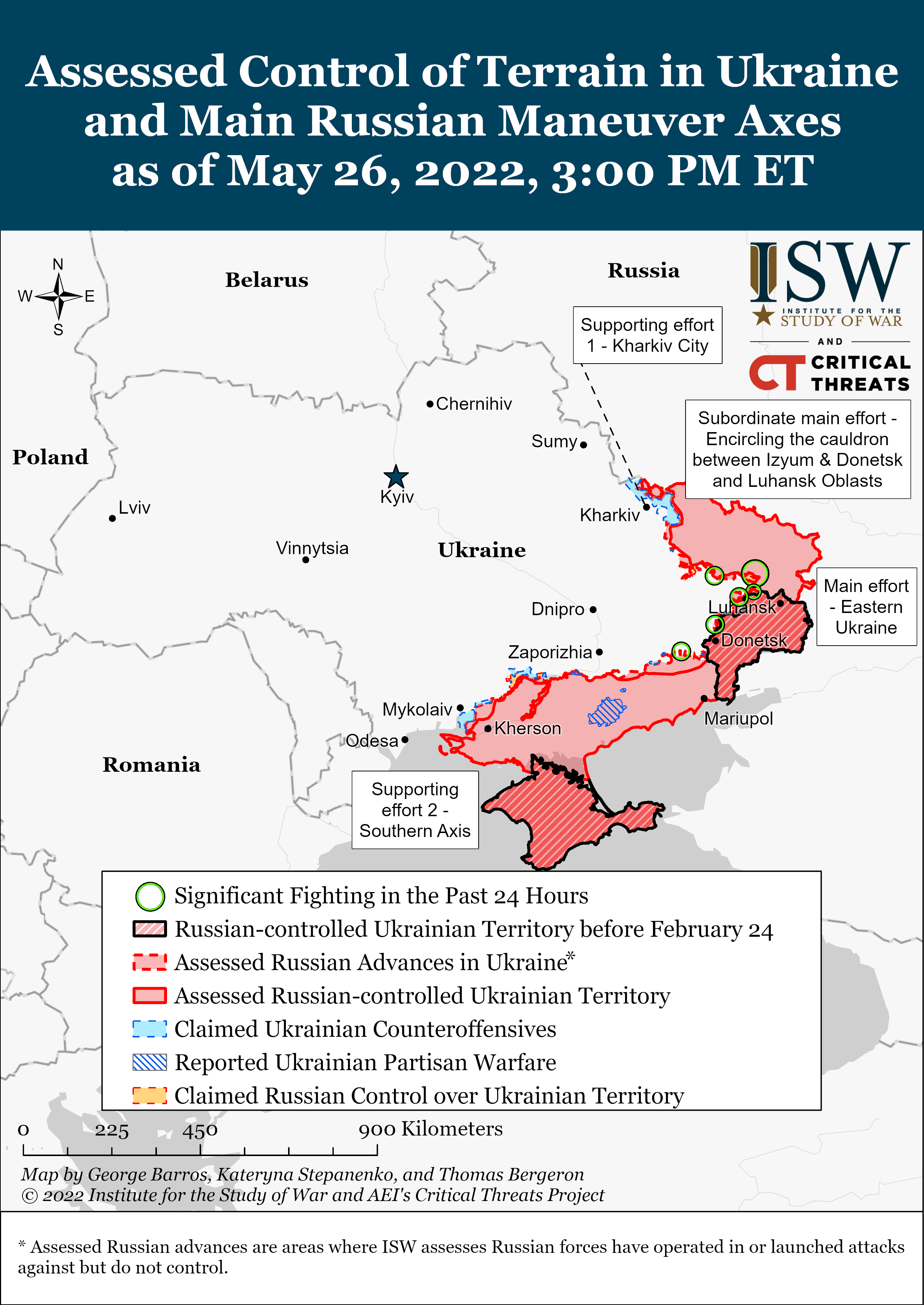
Russian forces have made steady, incremental gains in heavy fighting in eastern Ukraine in the past several days, though Ukrainian defenses remain effective overall. Deputy Ukrainian Defense Minister Hanna Malyar stated that the fighting is currently at its "maximum intensity” compared to previous Russian assaults and will likely continue to escalate.[1] Spokesperson for the Ukrainian Defense Ministry Oleksandr Motuzyanyk characterized Russian gains as “temporary success” and stated that Ukrainian forces are using a maneuver defense to put pressure on Russian advances in key areas.[2] Russian forces have now taken control of over 95% of Luhansk Oblast and will likely continue efforts to complete the capture of Severodonetsk in the coming days.[3] Russian forces have made several gains in the past week, but their offensive operations remain slow. Russian forces are heavily degraded and will struggle to replace further losses.

Key Takeaways

  • Russian forces unsuccessfully attempted to advance southeast of Izyum near the Kharkiv-Donetsk Oblast border.
  • Russian forces continued steady advances around Severodonetsk and likely seek to completely encircle the Severodonetsk-Lysychansk area in the coming days.
  • Russian forces continued to make persistent advances south and west of Popasna toward Bakhmut, but the Russian pace of advance will likely slow as they approach the town itself.
  • Russian forces in occupied areas of the Southern Axis are reportedly preparing a “third line of defense” to consolidate long-term control over the region and in preparation to repel likely future Ukrainian counteroffensives.
We do not report in detail on Russian war crimes because those activities are well-covered in Western media and do not directly affect the military operations we are assessing and forecasting. We will continue to evaluate and report on the effects of these criminal activities on the Ukrainian military and population and specifically on combat in Ukrainian urban areas. We utterly condemn these Russian violations of the laws of armed conflict, Geneva Conventions, and humanity even though we do not describe them in these reports.

ISW has updated its assessment of the four primary efforts Russian forces are engaged in at this time. We have stopped coverage of Mariupol as a separate effort since the city’s fall. We have added a new section on activities in Russian-occupied areas:

  • Main effort—Eastern Ukraine (comprised of one subordinate and three supporting efforts);
  • Subordinate main effort—Encirclement of Ukrainian troops in the cauldron between Izyum and Donetsk and Luhansk Oblasts
  • Supporting effort 1—Kharkiv City
  • Supporting effort 2—Southern axis
  • Activities in Russian-occupied areas

Main Effort—Eastern Ukraine

Subordinate Main Effort—Southern Kharkiv, Donetsk, Luhansk Oblasts (Russian objective: Encircle Ukrainian forces in eastern Ukraine and capture the entirety of Donetsk and Luhansk oblasts, the claimed territory of Russia’s proxies in Donbas)

Russian forces continued to attempt advances southeast of Izyum toward Slovyansk on May 26. The Ukrainian General Staff reported that Russian troops attempted to attack Bohorodychne, about 30 km southeast of Izyum.[4] Russian forces additionally conducted artillery, rocket, mortar, and tank attacks against Chepil, Dovehenke, Kurulka, and Studenok, all settlements to the southeast of Izyum in the direction of Slovyansk.[5] Such offensive actions indicate that Russian troops hope to continue their advance toward the borders of Donetsk Oblast and merge with operations around Lyman, which Russian forces fully captured on May 26.[6]

Russian forces continued efforts to encircle Severodonetsk on May 26. Russian forces reportedly attempted to take control of Ustynivka, about 15 km southeast of Severodonetsk.[7] Russian sources additionally reported that Russian troops are approaching Severodonetsk from Vojevodivka and Schedryshcheve (northeast of Severodonetsk) and that the northeast portion of the city is under Russian control.[8] A Russian military reporter claimed that as many as 10,000 people may be trapped in the Severodonetsk-Lysychansk cauldron.[9] Ukrainian troops have reportedly fortified their positions in the Zolote-Orikhiv area, where Russian troops have encircled them.[10]

Russian forces continued persistent advances in Donetsk Oblast south and west of Popasna on May 26. Troops from the Donetsk and Luhansk People’s Republics (DNR and LNR) claimed to have taken full control of Svitlodarsk and Midna Ruda, settlements off the M03 highway and within 30 km southeast of Bakhmut.[11] Russian troops are reportedly fighting around Komyshuvakha, Nirkove, Berestove, Belohorivka, Pokrovske, Klynove, Lypove, and Nahirne and using these areas to advance toward Bakhmut.[12] Russian forces conducted unsuccessful operations around Donetsk City in the vicinity of Avdiivka and continued to shell north and northwest of Avdiivka.[13]

Supporting Effort #1—Kharkiv City (Russian objective: Withdraw forces to the north and defend ground lines of communication (GLOCs) to Izyum)

Russian forces focused on maintaining their positions around Kharkiv City on May 26. The Ukrainian General Staff stated that Russian troops north of Kharkiv City reconnoitered and fired on Ukrainian positions to prevent any further Ukrainian advances in this area.[14] Russian forces shelled the center of Kharkiv City and surrounding settlements.[15]

Supporting Effort #2—Southern Axis (Objective: Defend Kherson against Ukrainian counterattacks)

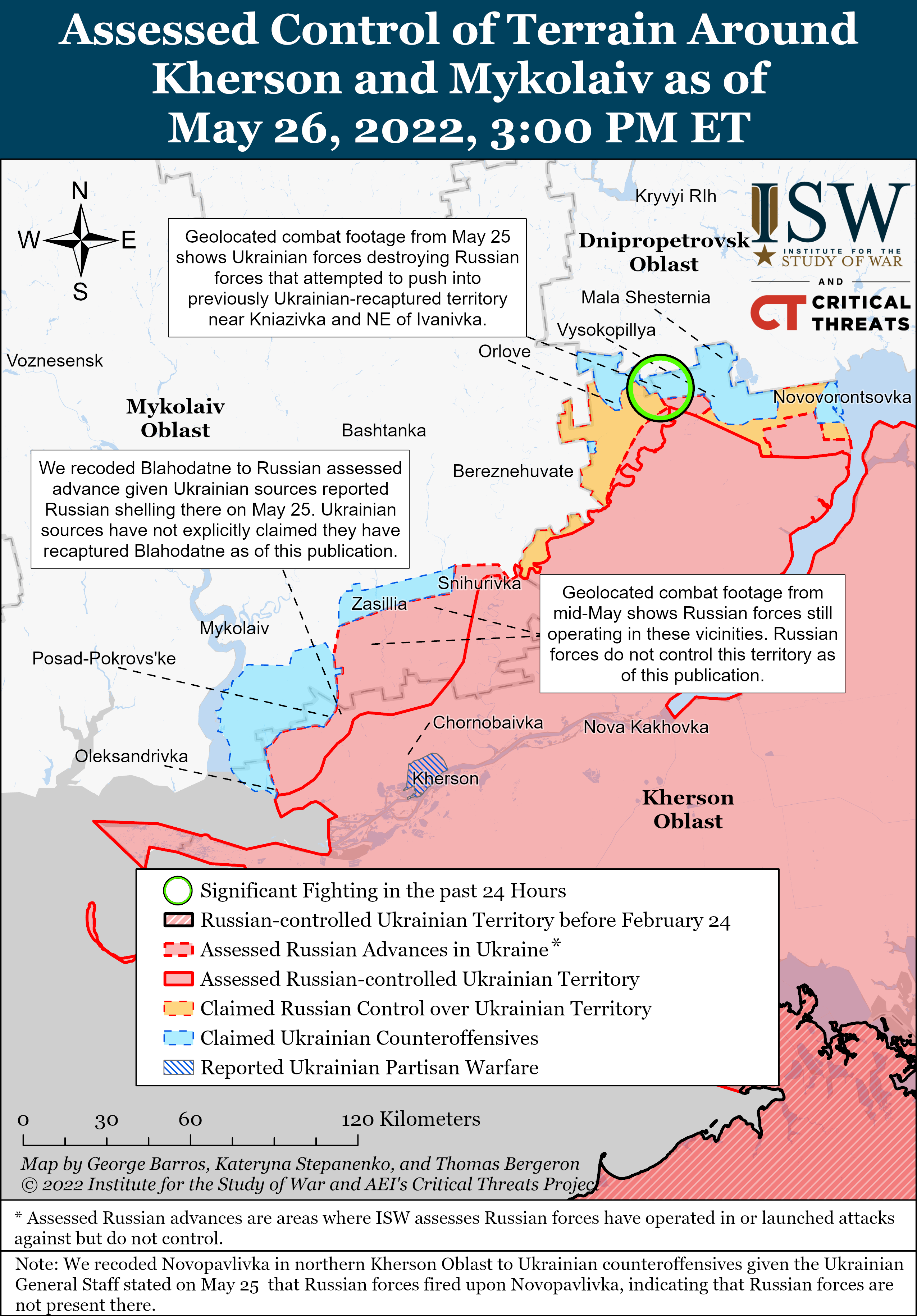
Russian forces focused on improving their tactical positions and strengthening defensive lines on the southern axis on May 26.[16] Ukraine’s Southern Operational Command stated that Russian forces are creating a “third line of defense” in occupied Kherson Oblast, indicating they are preparing for protracted conflict in this area and digging in to repel likely anticipated Ukrainian counteroffensives.[17] This assessment is consistent with statements made by the Ukrainian Main Intelligence Directorate (GUR) that Russian forces are strengthening their defenses in occupied areas in order to hold those territories over the long term.[18]

Russian forces are reportedly attempting to advance to the Mykolaiv-Kherson administrative border and conducted unsuccessful assault operations around Tavriyske and Mykolaivka on May 26.[19] Russian forces heavily shelled areas of Zaporizhia Oblast and strengthened their grouping of forces around Vasylivka and Polohy to renew offensives in the directions of Kamyanske, Orikhiv, and Huliapole.[20] The Ukrainian General Staff noted that the Russian grouping in Zaporizhia, specifically around Melitopol, has been reinforced by a battalion using outdated T-62 tanks, confirming earlier Ukrainian reports that Russian forces are cobbling together battalions with obsolete T-62 tanks to compensate for equipment losses.[21]
Activity in Russian-occupied areas (Russian objective: consolidate administrative control of occupied areas; set conditions for potential annexation into the Russian Federation or some other future political arrangement of Moscow’s choosing)

Russian occupation authorities continued actions to strengthen their administrative control of occupied areas on May 26. Russia’s Ministry of Emergency Situations deployed three broadcast trucks to Mariupol to transmit state-controlled programming to residents of the city.[22] Advisor to the Mayor of Mariupol Petro Andryushchenko claimed that occupation elements are taking control of schools in Mariupol and have extended the school year through September in order to ensure children spend the summer learning according to strictly Russian curricula.[23] Russian-backed occupation authorities in Kherson stated that Russian mobile phone operators will be available in occupied areas and that pensions will be paid in rubles starting in June.[24] Residents of Kherson and Zaporizhia will additionally be able to obtain Russian passports at newly established passport points in accordance with Russian President Vladimir Putin’s May 25 decree simplifying the process to obtain Russian passports in these occupied areas.[25]

Immediate items to watch

  • Russian forces are likely reinforcing their grouping north of Kharkiv City to prevent further advances of the Ukrainian counteroffensive toward the Russian border. Russan forces may commit elements of the 1st Tank Army to Northern Kharkiv in the near future.
  • Russian forces are prioritizing cutting off two major highways to Severodonetsk but may start to storm the city before they successfully cut GLOCs.
  • Occupation forces in Mariupol will continue to strengthen administrative control of the city but are likely unsure of what the ultimate annexation policy will be.
  • Russian forces are likely preparing for Ukrainian counteroffensives and settling in for protracted operations in Southern Ukraine.

Refereences:

[1] https://t.me/stranaua/44113

[2] https://t.me/spravdi/9131

[3] https://regnum dot ru/news/polit/3602011.html; 

https://www.facebook.com/watch/?v=595922954918641

[4] https://www.facebook.com/GeneralStaff.ua/posts/325726553073763

[5] https://www.facebook.com/GeneralStaff.ua/posts/325370633109355

https://t.me/synegubov/3287;

 https://twitter.com/GeoConfirmed/status/1529839934739296256

[6] https://www.youtube.com/watch?v=4CssCrrOI-I

https://t.me/sashakots/33093

https://twitter.com/andreyboss77/status/1529722736767029249;

 https://twitter.com/bradyafr/status/1529809588417085440;

 https://twitter.com/andreyboss77/status/1529506282398527495; 

https://t.me/vladlentatarsky/13875

[7] https://www.facebook.com/GeneralStaff.ua/posts/325726553073763

https://www.facebook.com/GeneralStaff.ua/posts/325370633109355; 

https://t.me/luhanskaVTSA/2916; 

https://t.me/luhanskaVTSA/2910

[8] https://t.me/swodki/103842; 

https://t.me/swodki/103941

[9] https://t.me/epoddubny/10912

https://t.me/epoddubny/10902

[10] https://t.me/strelkovii/2599

[11] https://t.me/nm_dnr/8078; ttps://t.me/nm_dnr/8081; https://t.me/milinfolive/83980; ttps://www.facebook.com/GeneralStaff.ua/posts/325726553073763

[12] https://www.facebook.com/GeneralStaff.ua/posts/325726553073763;

 https://www.facebook.com/GeneralStaff.ua/posts/325370633109355

[13] https://www.facebook.com/GeneralStaff.ua/posts/325726553073763

https://twitter.com/GirkinGirkin/status/1529755943109525504; 

https://t.me/strelkovii/2599

[14] https://www.facebook.com/GeneralStaff.ua/posts/325726553073763

https://www.facebook.com/GeneralStaff.ua/posts/325370633109355

[15] https://t.me/synegubov/3287; 

https://t.me/synegubov/3293

[16] https://www.facebook.com/GeneralStaff.ua/posts/325726553073763

https://www.facebook.com/GeneralStaff.ua/posts/325370633109355; 

https://www.radiosvoboda.org/a/news-rosia-tretia-linia-oborony-pivden-uk...

[17] https://www.facebook.com/watch/?v=550938303251904

[18] https://www.facebook.com/watch/?v=550938303251904

https://www.radiosvoboda.org/a/news-rosia-tretia-linia-oborony-pivden-uk...

[19] https://www.facebook.com/GeneralStaff.ua/posts/325370633109355

[20] https://www.facebook.com/GeneralStaff.ua/posts/325370633109355; 

https://t.me/zoda_gov_ua/8258

[21] https://www.facebook.com/GeneralStaff.ua/posts/325726553073763;

 https://t.me/zoda_gov_ua/8252; 

https://twitter.com/Militarylandnet/status/1529494956796219395;

 https://twitter.com/200_zoka/status/1529479186720628736

https://www.facebook.com/GeneralStaff.ua/posts/323137383332680 

[22] https://t.me/tass_agency/137036; 

https://t.me/andriyshTime/1073;

 https://www.facebook.com/GeneralStaff.ua/posts/325726553073763

[23] https://t.me/andriyshTime/1072

[24] https://ria dot ru/20220526/zarplata-1790768207.html; 

https://t.me/swodki/103743

[25] https://t.me/stranaua/44056; https://t.me/zoda_gov_ua/8278;

 https://t.me/zoda_gov_ua/8280;

 https://ria dot ru/20220525/grazhdanstvo-1790612394.html;

 https://hromadske dot ua/posts/v-op-vidpovili-na-sproshennya-vidachi-pasportiv-rf-dlya-zhiteliv-hersonskoyi-ta-zaporizkoyi-oblastej


China-India Border Crisis Has Quietly Resulted In Victory For Beijing

SOURCE:

 (A) https://www.thedrive.com/the-war-zone/china-india-border-crisis-has-quietly-resulted-in-victory-for-beijing


China-India Border Crisis Has Quietly Resulted In Victory For Beijing

Since the China-India border crisis last erupted, Beijing has secured its territorial claim by installing massive military infrastructure.


Two years have passed since the height of the most recent flare-up in the border crisis between China and India that started in May 2020. The event saw lethal melee combat over Aksai Chin, which the Chinese claim as a part of Xinjiang and India claims as a part of Ladakh, Jammu and Kashmir. Both India and China reported casualties as a result of a June 2020 altercation in this region's Galwan Valley. The crisis itself ended through a number of limited withdrawals of frontline positions on both sides. But now, two years later, the overall strategic picture is one of remarkable Chinese military buildup and encroachment. 

Being one of the largest disputed areas between India and China, Aksai Chin sits adjacent to the Kashmir region, another turbulent border for India due to its overlapping claim on the region with Pakistan. Sitting at 38,000 square kilometers, Aksai Chin is a cold, arid, and largely uninhabited desert just a little bigger than MarylandThe area has been long disputed between the two with China extending its first military grab over the region after the Sino-Indo war of 1962. Four decades passed with both countries regularly entering into minor scuffles in the region, but 2020 witnessed a complete change in tempo, pushing two nuclear-armed neighbors into a rapid escalation. Some reports have suggested that China’s aggression came as a result of a new road – the Darbuk–Shyok–Daulat Beg Oldi Road, or DSDBO – that India was building in the region. Another possible catalyst linked to the conflict was a move by India to change the status of Jammu & Kashmir, redrawing maps and borders which included the disputed area — a move China has regularly voiced opposition to.

As the crisis dropped from the headlines following the initial de-escalation, no further progress was made in negotiations. Chinese and Indian troops remain just kilometers apart while steadily increasing their military capacity. Through the crisis, China managed to effectively take control of Aksai Chin — in a practical military sense, this is a departure from its previous disputed status — and has heavily militarized the entire region around it.


During the border crisis in 2020, China established improvised positions at key locations along the edges of its own territorial claim in the region. Chinese forces established tent camps in the Galwan Valley, occupied critical patrol points, sent forces to camp atop mountain ranges along high altitude lakes and set up new bases in open plains. Negotiations during the crisis itself led China to abandon a small minority of these improvised frontline positions, but over the next two years, the vast majority of them developed into permanent all-weather military encampments. 

The strength that China has rapidly developed along these borders will severely constrain India’s ability to ever recover access to the Aksai Chin region. Despite the public appearance of the crisis being settled in a Chinese withdrawal, this withdrawal has remained negligible compared to the scale of the territory that China has militarized. As such, China has achieved a form of territorial expansion by bringing Aksai Chin from a disputed status to a de facto militarily occupied status.

India has, of course, not been entirely passive throughout the course of the crisis and the two years that have followed. Initially, its stern response to Chinese expansions into the Galwan Valley quite literally pushed back the Chinese efforts to establish new positions, but its risk-averse approach did eventually allow the Chinese military to dig in at Aksai Chin.


The main Indian response has come outside of Aksai Chin itself, within the undisputed bordering territories of India, and has focused on building up a capacity for aerial combat and reconnaissance along with the redistribution of forces along its northern border. While China built up its military capacity within Aksai Chin, India has been upgrading and adding to its air bases outside of, but near Aksai Chin. New armaments have also made it into the Indian inventory, such as the French-made Rafale multi-role fighter aircraft, as well as the possible acquisition of U.S.-made MQ-9B Reaper unmanned aerial vehicles that would enhance India’s ability to monitor Chinese activities in Aksai Chin, and if needed to strike against them if a conflict were to break out.

Abhijit Iyer-Mitra, a Senior Fellow (Nuclear Security Program) at the Institute of Peace and Conflict Studies, a New Delhi-based think tank focusing on South Asian affairs, notes that there has been a massive drive to improve infrastructure and better interconnectivity within disputed Aksai Chin, by China.

“This sort of development would have been a land warfare planner’s nightmare, but it offers India a unique advantage now, in the form of a target-rich environment for the Indian Air Force, the same air force that has, in the course of the last few years, replaced the army as the primary response to serious cross border threats,” according to Iyer-Mitra. “Unfortunately, the progress on the Chinese side, in his opinion, solidifies the fluid line of actual control into an actual border, one that will be more prone to friction. But on the bright side, this semi-formally ends the 'salami-slicing' the Chinese resorted to till around 2013.”


Salami-slicing refers to a well-known Chinese strategy for territorial expansion, where, with the use of small provocations and challenges separated over time, China tries to achieve a much larger snowballing goal.

Choosing a path of stability and de-escalation has also allowed India to nurture close relationships with strategic partners in the developed world to help balance against or contain Chinese power on a global level. The Quadrilateral Security Dialogue, known commonly as “the Quad,” that brings India together with the United States, Australia, and Japan (as well as possibly South Korea and Vietnam’s role as part of the so-called “Quad Plus”) is one of the main ways in which India tries to build such a diplomatic alliance. Coordinating with countries that all share concerns over Chinese power projection may allow India to be part of a higher-level strategic effort to counterbalance China. Still, that doesn’t mean these burgeoning alliances will directly impact the situation in Akai Chin.


The most critical manner in which China has in fact managed to establish its undisputed control over the Aksai Chin region is evidenced by the evolution of China’s frontline positions. While initially composed of small outposts and then joined by temporary tent camps during the 2020 face-off, these positions have now evolved into permanent bases with cold-weather shelters.


At the Depsang Plains for example, at the northern end of the disputed Aksai Chin region, China used to maintain an observational presence. Today, this area boasts a large military position composed of infantry shelters and ammunition storage facilities, as well as tanks and artillery systems. The Chinese presence at the Depsang Plains evolved from a limited mission to a permanent deployment of a large combat-capable force that would present serious challenges for India to dislodge from its positions.

At Galwan Valley and Hot Springs, Chinese troops were in fact forced to withdraw following skirmishes with Indian troops and ensuing negotiations in 2020. Even at these locations of the so-called “mutual withdrawals” just a single kilometer removed from their initial positions, Chinese forces have established large permanent bases supported by solar panels to provide them with energy and modern roads to resupply them.


China does maintain some rather rudimentary temporary positions in the Spanggur Lake area (just south of Pangong Lake), but even these positions are directly supported by permanent military positions that China developed at Pangong Lake and the even larger military support positions deeper into China at Rutog.


China’s ability to claim undisputed control over Aksai Chin is not based solely on its ability to establish permanent military positions on the border of the disputed territory. Perhaps even more important is the vast network of large logistical nodes and support bases that China established within the disputed region, and the tremendous effort it has gone through to connect these and its frontline positions by building new roads. Where China in the past maintained a logistics network that could support the presence of several hundred Chinese troops on the frontlines of its territorial claims in Aksai Chin, this upgraded infrastructure and support network now allows it to reinforce many thousands of troops simultaneously.

This effort may seem easier than it really is, but in order to effectively connect all these positions and support bases to China’s existing military lines of communication, it has had to effectively tame the geography of Aksai Chin. 

This means, for example, taming the riverbed in the many valleys between mountain ranges, to guarantee year-round mobility even when the rivers are in spate. By constructing this brand new road network, interspaced with large arterial support bases behind the frontline, China effectively turned what used to be a long five-hour journey into just a one or two-hour trip. 


China has also not limited its logistical expansion into Aksai Chin to ground transport and has expanded its logistics into the third dimension by constructing a number of large heliports inside and nearby Aksai Chin. Prior to the 2020 crisis, small Chinese observation posts would sometimes have a small helipad nearby, but the new disposition includes the permanent deployment of entire helicopter squadrons at key logistical nodes to facilitate the rapid movement of troops or supplies when needed. The redevelopment and expansion of airpower on China’s western border are not only limited to Aksai Chin, the pattern has been observed across the Tibetan Plateau indicative of a larger vertical lift network that is rapidly taking shape. You can read all about this reality and our analysis of it in past features linked here and here.

The expansion of China’s forward deployments and logistical support even expands beyond the Aksai Chin region itself. Since the beginning of the 2020 crisis, China has erected veritable military cities from the empty desert. These immense bases directly support China’s ability to maintain troop presence within Aksai Chin, and offer it the ability to rapidly surge its military presence in the area during future crises. 

At Pangong Lake, for example, new roads – and a bridge across the lake just outside of India’s territorial claim – reach all the way around the lake to the town of Rutog where large military facilities now dominate the landscape.


These facilities provide for a permanent deployment of Chinese forces, as well as frequent rotations of training exercises that allow Chinese military units to even better prepare for potential conflict in this region and especially at extreme altitudes that are a staple of it. The same is true for other regions, where in the North, the logistical connections draw all the way to China’s Hotan Air Base, and in the south, Chinese forward positions at Demchok are supported by connections to military facilities in Gar County and the Ngari Gunsa air bases. 

Vikram J. Singh, Senior Advisor for Asia at the US Institute For Peace, says enhancing India’s situational awareness and deterrent posture will be critical to maintaining stability.

“In Aksai Chin, China has largely replicated its success of gaining de facto control of disputed territory in the waters of the South China Sea,” Singh says. “Getting the best intelligence, surveillance and reconnaissance capabilities possible and investing in its military to deter further Chinese provocations is vital.”

“Beijing’s success with coercion and militarisation of disputed territory below the threshold of conflict can easily lead to miscalculation about what will provoke a forceful response from a neighbor and risk escalation.”

As India turns to self-reliance, Singh says, it should leverage its "willing partners, the United States, as well as Europe and Israel, can provide technology India needs right now to stay on top of the challenge from China and contribute to self-sufficiency.”

The intensity of China’s military buildup in and around Aksai Chin, which has continued effortlessly after the limited withdrawals in 2020, effectively puts it in a position where its ability to project military power into the disputed region is relatively uncontestable. Negotiations have not led to any breakthroughs for India to improve its position or access within the disputed territory.

In essence, time has been on China’s side and India now faces a (quite literal) uphill battle to restore even a semblance of control over its territorial claims in this area while it simultaneously faces similar challenges at other locations of its shared border farther East.

Detresfa_ is an open-source and image intelligence analyst and contributor for The War Zone. Sim Tack is the co-founder and military analyst at Force Analysis and also a contributor for The War Zone.

Contact the editor: Tyler@thedrive.com