ASSESSMENT
RUSSIAN OFFENSIVE CAMPAIGN, DECEMBER 16,2022.
Kateryna Stepanenko, George Barros, Riley Bailey, Katherine Lawlor, Layne Phillipson, and Frederick W. Kagan
December 16, 6:00 pm ET
Click here to see ISW’s interactive map of the Russian invasion of Ukraine. This map is updated daily alongside the static maps present in this report.
Russian forces conducted their ninth large-scale missile campaign against critical Ukrainian energy infrastructure on December 16 and carried out one of the largest missile attacks on Kyiv to date. Ukrainian Commander-in-Chief General Valery Zaluzhny stated that Ukrainian air defenses shot down 60 of 76 Russian missiles, of which 72 were cruise missiles of the Kh-101, Kalibr, and Kh-22 types, and four guided missiles of the Kh-59 and Kh-31P types.[1] The Kyiv City Military Administration reported that Ukrainian forces destroyed 37 of 40 missiles targeting Kyiv.[2] Ukrainian officials also reported that Russian missiles struck nine energy infrastructure facilities and some residential buildings in Zhytomyr, Kyiv, Kharkiv, Dnipropetrovsk, and Zaporizhia oblasts.[3] Ukrainian military officials noted that Russian forces launched most of their missiles from the Black and Caspian seas and the Engels airfield in Saratov Oblast.[4] Russian forces are likely to intensify their strikes on Kyiv to stir up societal discontent in the capital, but these missile attacks are unlikely to break Ukrainian will.
Russian strikes continue to pose a significant threat to Ukrainian civilians but are not improving the ability of Russian forces to conduct offensive operations in Ukraine. Ukraine’s state electricity transmission system operator Ukrenergo stated that restoration of electricity may be delayed by the December 16 strikes and announced a state of emergency aimed at electricity market suppliers.[5] Ukrenergo added that Ukraine’s United Energy System had to cut more than 50% of energy consumption as a result of the strikes.[6]
Russian National Security Council Deputy Chairman Dmitry Medvedev made inflammatory but irrelevant comments in support of ongoing information operations that aim to weaken Western support for Ukraine. Medvedev published on December 16 a list of what he described as legitimate military targets, which included "the armed forces of other countries that have officially entered the war" in Ukraine.[7] Medvedev rhetorically questioned whether Western military aid to Ukraine means that NATO members have entered the war against Russia.[8] Medvedev did not explicitly state that the armed forces of NATO members are legitimate military targets nor that he was stating an official Russian position on legitimate targets in the war in Ukraine.[9] Medvedev likely made the comments in coordination with the large-scale Russian missile strikes in an attempt to weaken Western support for Ukraine by stoking fears of an escalation between the West and Russia. Medvedev has previously made purposefully inflammatory comments in support of other information operations with the same aims.[10] Medvedev's past and current inflammatory rhetoric continues to be out of touch with actual Kremlin positions regarding the war in Ukraine. Russian forces have and will likely continue to target Western military equipment that Ukrainian forces have deployed in Ukraine, of course, but there is nothing surprising or remarkable in that fact.
Russian President Vladimir Putin will likely pressure Belarusian President Alexander Lukashenko for Russian-Belarusian integration concessions at an upcoming December 19 meeting in Minsk—Putin’s first meeting with Lukashenko in Minsk since 2019.[11] Lukashenko and Putin reportedly will discuss Russian-Belarusian integration issues, unspecified military-political issues, and implementing Union State programs.[12] The Union State is a supranational agreement from 1997 with the stated goal of the federal integration of Russia and Belarus under a joint structure. The Kremlin seeks to use the Union State to establish Russian suzerainty (control) over Belarus.[13]
Lukashenko is already setting information conditions to deflect Russian integration demands as he has done for decades.[14] Lukashenko stressed that "nobody but us is ruling Belarus," and that Belarus is ready to build relations with Russia but that their ties "should always proceed from the premise that we are a sovereign and independent state."[15] It is unclear whether Putin will be successful in extracting his desired concessions from Lukashenko. Lukashenko has so far largely resisted intensified Russian integration demands and has refused to commit Belarusian forces to join Russia's invasion of Ukraine.
Putin’s visit to Minsk could indicate that Putin is trying to set conditions for the newly assessed most dangerous course of action (MDCOA) that ISW reported on December 15: a renewed offensive against Ukraine—possibly against northern Ukraine or Kyiv—in winter 2023.[16] Russian Defense Minister Sergei Shoigu and Belarusian Defense Minister Viktor Khrenin signed an unspecified document to further strengthen bilateral security ties—likely in the context of the Russian-Belarusian Union State—and increase Russian pressure on Belarus to further support the Russian invasion of Ukraine, in Minsk on December 3.[17] ISW’s December 15 MDCOA warning forecast about a potential Russian offensive against northern Ukraine in winter 2023 remains a worst-case scenario within the forecast cone. ISW currently assesses a Russian invasion of Ukraine from Belarus as low, but possible. Belarusian forces remain extremely unlikely to invade Ukraine without a Russian strike force. It is far from clear that Lukashenko would commit Belarusian forces to fight in Ukraine even alongside Russian troops. There are still no indicators that Russian forces are forming a strike force in Belarus.[18]
Putin and Lukashenko’s meeting will—at a minimum—advance a separate Russian information operation that seeks to break Ukrainian will and Western willingness to support Ukraine, however. This meeting will reinforce the Russian information operation designed to convince Ukrainians and Westerners that Russia may attack Ukraine from Belarus. Russia’s continued strikes against Kyiv, constant troop deployments to Belarus, and continued bellicose rhetoric are part of (and mutually reinforce) this information operation. The Kremlin is unlikely to break the Ukrainian will to fight. The Kremlin likely seeks to convince the West to accept a false fait accompli that Ukraine cannot materially alter the current front lines and that the war is effectively stalemated. ISW assesses that such a conclusion is inaccurate and that Ukraine stands a good chance of regaining considerable critical terrain in the coming months.
Russian President Vladimir Putin reportedly ignored warnings about worst-case economic scenario assessments from senior Kremlin financial advisors prior to launching his full-scale invasion of Ukraine in February 2022. Unnamed sources told the Financial Times (FT) that the head of the Russian Central Bank, Elvira Nabiullina, and the head of Sberbank, German Gref, briefed a 39-page assessment to Putin outlining the long-term damage to the Russian economy if Russia recognized the independence of proxy republics in Donetsk and Luhansk oblasts a month prior to the full-scale invasion.[19] FT sources noted that both Nabiullina and Gref spoke to Putin of their own initiative but were not brave enough to tell Putin that Russia risked a geopolitical disaster when he interrupted the brief to ask how Russia can prevent a worst-case scenario. Nabiullina and Gref specifically warned Putin that Western sanctions would set the Russian economy back by decades and negatively impact the Russian quality of life. Both Nabiullina and Gref reportedly were shocked when Putin launched the invasion on February 24 and indirectly expressed some discontent to their inner circles, despite implementing provisions to mitigate some negative impacts of sanctions during the first weeks of the war.
The report, if true, indicates that Putin had received some prognosis of the war’s risks and costs but decided to ignore them in favor of his maximalist goal of seizing Ukraine. It is unclear if Putin received and subsequently ignored similar reports from the Russian Ministry of Defense (MoD) or the Ministry of Foreign Affairs (MFA), but his engagement with Nabiullina and Gref shows that he had some awareness of the potential long-term risks of the war. Nabiullina's and Gref's reported hesitance to dissuade Putin also demonstrates the unbalanced power dynamic that may have prompted some Russian officials to play along with Putin’s bad decisions rather than remonstrating with him.
Russia is continuing to endure some economic challenges as a direct result of Putin’s war in Ukraine. FT reported that Nabiullina was able to protect the Russian economy from the worst-case scenario by undertaking provisions such as regulation of the exchange control during the first day of the war, but some war costs are likely catching up to the Kremlin. Russia’s Central Bank announced on December 16 that mobilization had sparked increasing manpower shortages across several industries in Russia.[20] The Central Bank report added that Russia has limited possibilities to expand its production as a result of shortages in the state labor market and noted that "unemployment hit a historic low." The costs of Putin’s war, including the human and labor cost of his force generation efforts, will continue to have a long-term effect on Russia’s economy, as ISW has previously assessed.[21]
Key Takeaways
- Russian forces conducted another set of large-scale missile strikes throughout Ukraine and one of the largest missile attacks against Kyiv to date.
- Russian strikes continue to pose a significant threat to Ukrainian civilians despite generating no improvement in the Russian ability to conduct offensive operations.
- Dmitry Medvedev made inflammatory but irrelevant comments in support of ongoing information operations that aim to weaken Western support for Ukraine.
- Russian President Vladimir Putin will likely pressure Belarusian President Alexander Lukashenko to support the Russian war in Ukraine further at a December 19 meeting in Minsk.
- Lukashenko is already setting information conditions to deflect Russian integration demands.
- Putin’s upcoming visit to Minsk could indicate that he is setting conditions for a new offensive from Belarusian territory.
- Putin and Lukashenko’s meeting will likely advance a separate Russian information operation that seeks to break Ukrainian will and Western willingness to support Ukraine.
- Russian President Vladimir Putin reportedly ignored worst-case scenario assessments of potential damage to the Russian economy prior to launching his full-scale invasion of Ukraine.
- Russia is continuing to face economic challenges as a direct result of the war in Ukraine.
- Russian forces conducted counterattacks in the Svatove and Kreminna areas.
- Russian forces continued offensive operations in the Bakhmut and Avdiivka-Donetsk City areas.
- Russian forces continued to undertake defensive measures on the left (east) bank of the Dnipro River.
- Russian officials will likely struggle to recruit additional contract servicemembers despite ongoing efforts to do so.
- Russian occupation authorities continued seizing civilian infrastructure to treat wounded Russian servicemen and aid Russian forces operating in occupied territories.
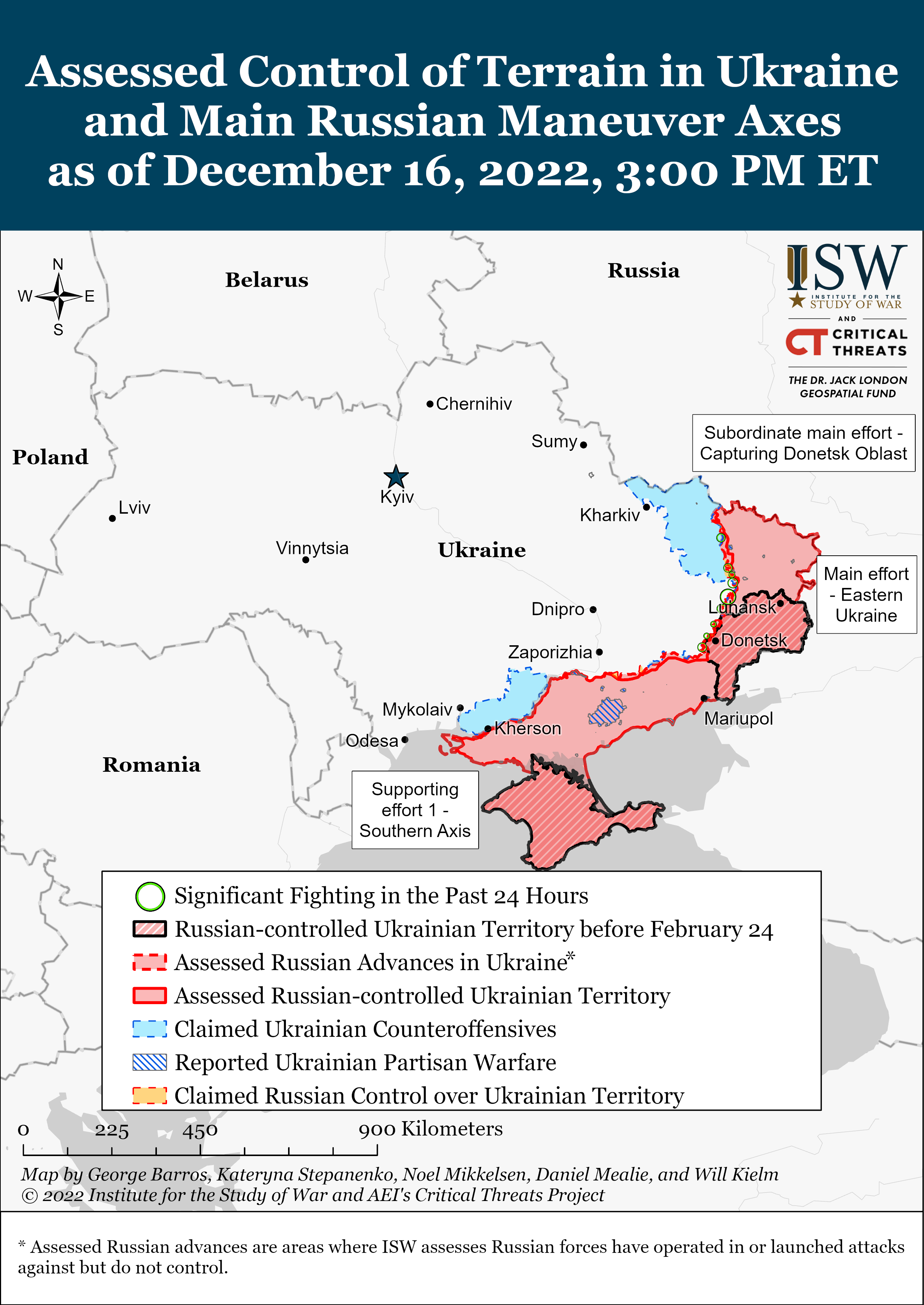
We do not report in detail on Russian war crimes because those activities are well-covered in Western media and do not directly affect the military operations we are assessing and forecasting. We will continue to evaluate and report on the effects of these criminal activities on the Ukrainian military and population and specifically on combat in Ukrainian urban areas. We utterly condemn these Russian violations of the laws of armed conflict, Geneva Conventions, and humanity even though we do not describe them in these reports.
- Ukrainian Counteroffensives—Eastern Ukraine
- Russian Main Effort—Eastern Ukraine (comprised of one subordinate and one supporting effort);
- Russian Subordinate Main Effort—Capture the entirety of Donetsk Oblast
- Russian Supporting Effort—Southern Axis
- Russian Mobilization and Force Generation Efforts
- Activities in Russian-occupied Areas
Ukrainian Counteroffensives (Ukrainian efforts to liberate Russian-occupied territories)
Eastern Ukraine: (Eastern Kharkiv Oblast-Western Luhansk Oblast)
Russian forces conducted counterattacks in the Svatove and Kreminna areas on December 16. The Ukrainian General Staff reported that Ukrainian forces repelled Russian assaults near Novoselivske (14km northwest of Svatove) and Stelmakhivka (16km northwest of Svatove).[22] The Ukrainian General Staff also reported that Ukrainian forces repelled Russian assaults within 17km north of Kreminna near Ploshchanka and Chervonopopivka and within 12km south of Kreminna near Bilohorivka, Luhansk Oblast.[23] A Russian milblogger claimed that Ukrainian and Russian forces continued fighting in positional battles on the western outskirts of Bilohorivka.[24] The Russian Ministry of Defense (MoD) claimed that Russian forces also destroyed Ukrainian sabotage and reconnaissance groups southwest of Kreminna near Terny, Donetsk Oblast, and Dibrova, Luhansk Oblast.[25] ISW previously assessed that Russian forces are likely conducting spoiling counterattacks in eastern Kharkiv and western Luhansk oblasts to preempt Ukrainian forces from increasing the pace of their eastern counteroffensive as conditions become more conducive for mechanized maneuver warfare in the winter.[26]
Russian forces continue to build defensive fortifications along the Svatove-Kreminna line as of December 16. The United Kingdom Ministry of Defense (UK MoD) reported on December 16 that Russian forces have continued to construct extensive defensive lines along the front line in eastern Ukraine, particularly around Svatove.[27] The UK MoD reported that the Russian defensive lines follow traditional entrenchment methods, which are likely to be vulnerable to modern, precision indirect strikes.[28]
Ukrainian forces continue to strike Russian rear areas in Luhansk Oblast. Russian and social media sources claimed that Ukrainian forces struck Russian rear areas in Kadiivka, Lantrativka, and Amino in Luhansk Oblast on December 15 and 16.[29] A social media source claimed that there was an explosion at a weapons depot in Kadiivka.[30] A Russian mil blogger claimed that Ukrainian forces struck a Russian ammunition depot in Irmino.[31]

Russian Main Effort—Eastern Ukraine
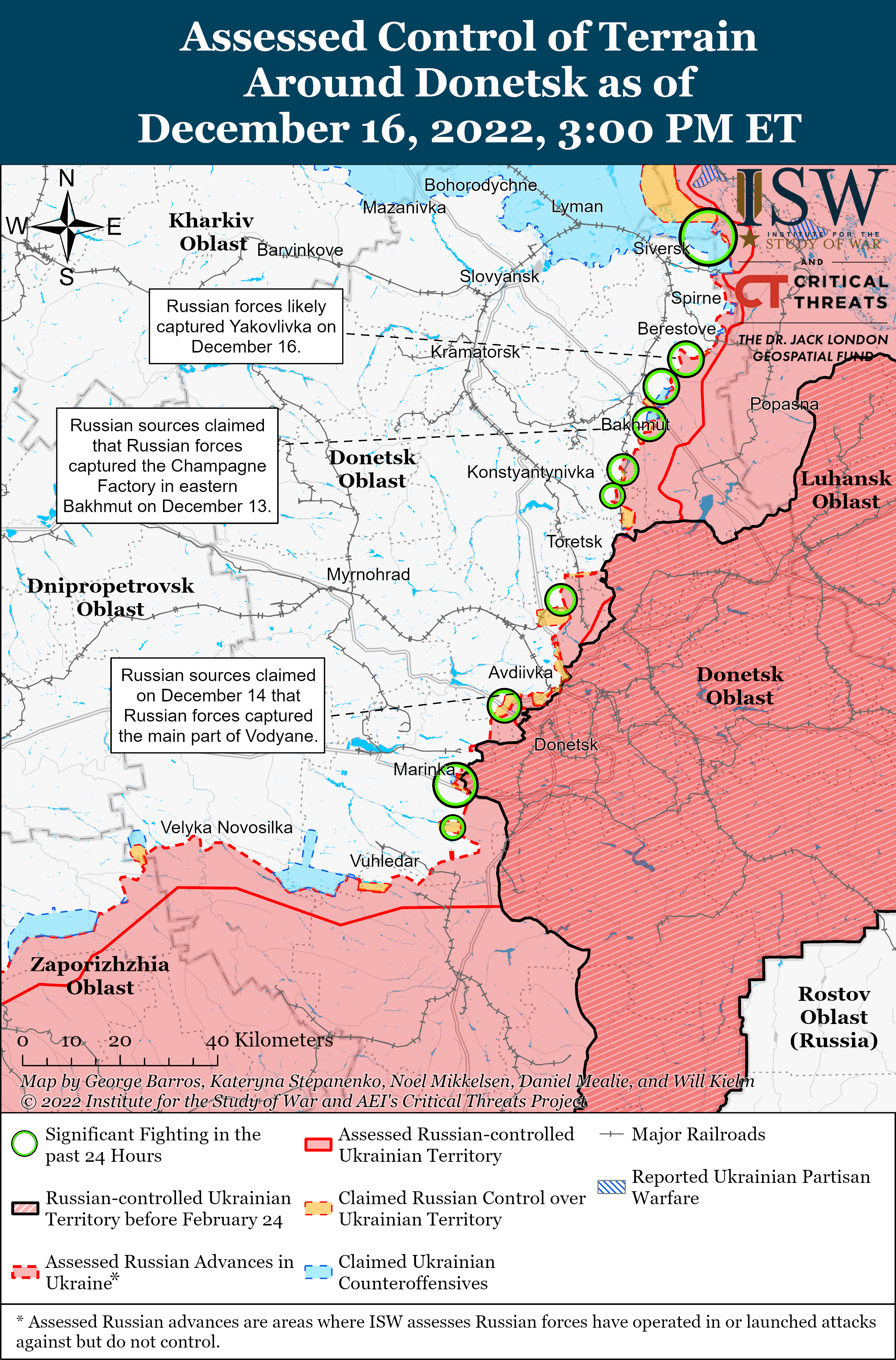
Russian Subordinate Main Effort—Donetsk Oblast (Russian objective: Capture the entirety of Donetsk Oblast, the claimed territory of Russia’s proxies in Donbas)
Russian forces continued offensive operations around Bakhmut on December 16. The Ukrainian General Staff reported that Ukrainian forces repelled Russian assaults near Bakhmut; within 26km northeast of Bakhmut near Vyimka, Yakovlivka , Soledar, and Bakhmutske; and within 21km south of Bakhmut near Klishchiivka, Andriivka, Kurdyumivka, Opytne, Ozarianivka, and Druzhba.[32] A Russian milblogger claimed that Russian forces completely cleared Yakovlivka, which will help Russian forces to conduct assaults in the direction of Soledar.[33] Geolocated footage posted on December 16 shows Wagner Group units operating in central Yakovlivka, supporting this Russian claim.[34] A Russian milblogger claimed that Ukrainian forces consider holding Bakhmut a priority task over fears that losing the settlement would damage the current image of Ukrainian forces.[35] Geolocated footage posted on December 16 shows that Russian forces have made marginal advances west of Ozaranivka.[36]
Russian forces continued offensive operations in the Avdiivka-Donetsk City area on December 16. The Ukrainian General Staff reported that Ukrainian forces repelled Russian assaults within 17km north of Avdiivka near Novobakhmutivka and Oleksandropil, and within 37km south of Avdiivka near Nevelske, Marinka, Pobieda, and Novomykhailiivka.[37] A Russian milblogger claimed that Russian forces conducted an assault near Vesele intending to cut a section of the N-20 highway.[38] Another Russian milblogger claimed that the Donetsk People’s Republic (DNR) Peoples Militia's "Somali" and "Sparta" battalions and the 11th Regiment of the 1st Army Corps conducted assaults southwest of Avdiivka in the direction of Nataylove and Karlivka.[39] A Russian milblogger claimed that Russian forces are focusing their efforts on capturing Ukrainian-held territory around Marinka.[40]
Russian forces reportedly continued defensive operations in western Donetsk Oblast on December 16. The Russian Ministry of Defense (MoD) reported that Russian forces repelled a Ukrainian assault near Solodke, Donetsk Oblast (33km southwest of Donetsk City), and destroyed Ukrainian sabotage and reconnaissance groups near Novomayorske and Shevchenko in western Donetsk oblast.[41] The Ukrainian General Staff reported that Russian forces continued routine indirect fire along the line of contact in Donetsk and eastern Zaporizhia oblasts.[42]
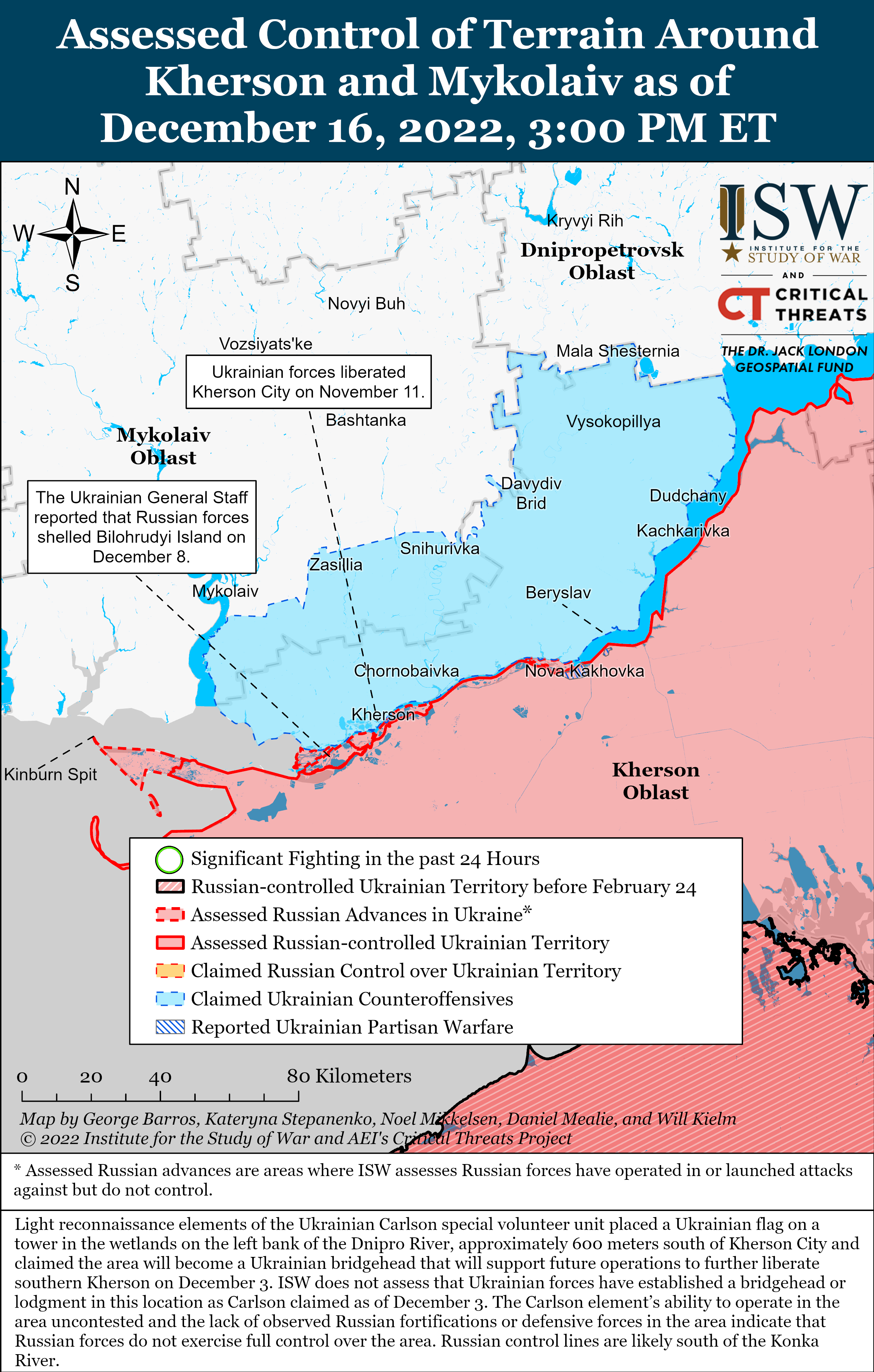
Supporting Effort—Southern Axis (Russian objective: Maintain frontline positions and secure rear areas against Ukrainian strikes)
Russian forces continued to undertake defensive measures on the left (east) bank of the Dnipro River. The Ukrainian General Staff reported that Russian forces deployed personnel from Krasnodar Krai to strengthen defensive lines and security for water supply facilities in Kherson Oblast and Crimea, such as the North Crimean Canal.[43] Sentinel-1 imagery also showed that Russian forces have accumulated a large amount of military equipment in Medvedivka in northeastern Crimea.[44] The Donetsk People’s Republic (DNR) Militia claimed to hold defensive positions in the area of the Kakhovka reservoir in Zaporizhia Oblast.[45]
Russian forces continued to shell Kherson, Dnipropetrovsk, and Zaporizhia oblasts.[46] Social media footage showed the aftermath of Russian artillery fire on residential buildings in Kherson City, and geolocated footage showed Russian forces mistakenly striking their former air-defense positions near the T2207 highway that Ukrainian forces previously destroyed in August.[47] Zaporizhia Oblast Office of General Prosecutor reported that Russian forces launched 21 missiles from S-300 air-defense systems at Zaporizhzhia City and surrounding settlements, which damaged the premises of an unspecified piece of critical infrastructure.[48]
Ukrainian forces continued to target Russian logistics in Kherson and Zaporizhia oblasts. The Ukrainian General Staff reported that Ukrainian strikes on December 14 wounded about 180 servicemen and destroyed up to 10 pieces of equipment in Tokmak, Zaporizhia Oblast.[49] The Ukrainian General Staff noted that Russian forces are operating mobile crematoria in Tokmak and that Ukrainian forces eliminated up to 30 Russian servicemen in Lazurne on the left bank of the Dnipro River.[50] Geolocated footage published on December 16 also reportedly showed the aftermath of a Ukrainian strike on Skadovsk.[51]
Note: ISW will report on activities in Kherson Oblast as part of the Southern Axis in this and subsequent updates. Ukraine’s counteroffensive in right-bank Kherson Oblast has accomplished its stated objectives, so ISW will not present a Southern Ukraine counteroffensive section until Ukrainian forces resume counteroffensives in southern Ukraine.
Mobilization and Force Generation Efforts (Russian objective: Expand combat power without conducting general mobilization)
Russian officials will likely struggle to recruit additional contract service members despite ongoing efforts and will likely continue to rely largely on conscripted and mobilized personnel. The Ukrainian General Staff reported on December 16 that Russian forces are continuing recruitment campaigns for contract servicemembers, particularly to fill positions in the once-elite 1st Guards Tank Army.[52] The 1st Guards Tank Army has been heavily degraded during the war and likely can no longer function in the elite strike force role that it once played in the Russian military; all maneuver elements of the 1st Guards Tank Army have taken heavy losses near Kharkiv, Sumy, and eastern Kyiv Oblast since February 2022.
Russian mobilized forces in Ukraine are likely showing an increased interest in surrendering to Ukrainian forces as they face winter weather without winter equipment. Russian opposition outlet Verstka reported on December 14 that searches in the Russian search engine Yandex related to surrender have increased dramatically since mid-November.[53] Verstka reported that users searched for phrases relating to surrender more than 121,000 times between November 14 and December 4, a period that coincides with reports of large-scale Russian losses and the arrival of additional mobilized personnel to the frontlines. By comparison, Yandex recorded around 19,000 surrender-related searches from October 24 to November 13.
St. Petersburg officials reportedly refused to allow the burial of Wagner Group servicemembers in cemeteries designated for Russian servicemembers, highlighting the disparities in the treatment of unofficial military formations in Russia. Wagner financier Yevgeniy Prigozhin commented on the burial scandal, noting that a deceased Wagner servicemember, Dmitry Menshikov, fought for his motherland as a volunteer in Donbas while St. Petersburg officials were "cowardly" hiding in their offices.[54] Chairman of the State Duma Committee on Defense Andrey Kartapolov also commented on the incident, noting that Wagner fighters are full-fledged participants of the "special military operation" and urging anyone debating this topic to "come to their senses."[55] Kartapolov’s statement may reflect some internal pushes in the Kremlin to officially legalize Wagner, given that Russian law prohibits private military companies in Russia.
Activity in Russian-occupied Areas (Russian objective: consolidate administrative control of and annexed areas; forcibly integrate Ukrainian civilians into Russian sociocultural, economic, military, and governance systems)
Ukrainian sources reported on December 16 that Russian forces and occupation officials continued to seize and redirect civilian infrastructure to support Russian forces. The Ukrainian Resistance Center reported on December 16 that Russian occupation officials in the occupied Donetsk Oblast have allocated all utility equipment and resources to the Russian military, leaving civilians without electricity and water.[56] The Ukrainian Resistance Center added that a hospital in Kreminna, Luhansk Oblast, has fully transitioned to only treating wounded Russian servicemen and that the Luhansk City Multidisciplinary Hospital No. 15 refuses to accept civilian patients, planning to fully transition to a military hospital by the end of December 2022.[57]
Russian-backed Zaporizhia Oblast officials announced measures designed to eliminate Ukrainian cultural heritage on December 16. The head of the Zaporizhia Oblast occupation administration, Yevheny Balitsky, stated on December 16 that Russian occupation authorities will rename all streets, alleys, and parks in occupied Zaporizhia Oblast by the end of the year. Balitsky also stated that Russian-backed Zaporizhia Oblast authorities will restore more than 100 monuments dedicated to Russia’s "Great Heroes" that Ukrainian officials removed from 2014-2022.[58] Mariupol mayoral advisor Petro Andryushenko stated on December 16 that Russian occupation authorities have conducted a "diagnostic examination" in Mariupol schools to assess how well Mariupol students have learned the Russian language, the history of Moscow, general knowledge of Russia, and mathematics in the Russian language.[59]
Russian occupation authorities are continuing to intensify filtration measures to eliminate alleged political dissidents from occupied territories. Ukrainian publication Graty reported on December 16 that Russian occupation authorities are forcibly transferring Ukrainian political prisoners from Crimea to penal colonies in Russia.[60] Graty noted that Russian occupation officials are transferring Ukrainian activists and seven members of the "Crimean Solidarity" movement to prisons in the Republics of Dagestan and Mordovia, and Tambov, Tula, Novgorod, Ryazan, and Kostroma oblasts.
Ukrainian partisans continued to undermine the Russian occupation by helping Ukrainian forces destroy valuable Russian targets. The Ukrainian Resistance Center reported on December 16 that Ukrainian partisans helped to correct indirect fire (IDF) to destroy an unspecified Russian military base in occupied Luhansk Oblast, killing 20 Russian servicemembers and destroying eight pieces of Russian military equipment on December 13.[61]
Note: ISW does not receive any classified material from any source, uses only publicly available information, and draws extensively on Russian, Ukrainian, and Western reporting and social media as well as commercially available satellite imagery and other geospatial data as the basis for these reports. References to all sources used are provided in the endnotes of each update.
References
[1] https://t.me/CinCAFU/331; https://t.me/boris_rozhin/72872 ; https://t.me/stranaua/80843; https://www.facebook.com/GeneralStaff.ua/p...
[3] https://www.facebook.com/GeneralStaff.ua/posts/pfbid02SEbDVNTxnqhiQB1XSQ... https://t.me/energoatom_ua/11136; https://t.me/energoatom_ua/11135; https://t.me/energoatom_ua/11133; https://suspilne dot media/339628-rf-moze-gotuvati-novij-nastup-es-pogodiv-devatij-paket-sankcij-proti-rosii-296-den-vijni-onlajn/; https://suspilne dot media/339628-rf-moze-gotuvati-novij-nastup-es-pogodiv-devatij-paket-sankcij-proti-rosii-296-den-vijni-onlajn/
[4] https://t.me/kpszsu/2215; https://t.me/CinCAFU/331’; https://t.me/boris_rozhin/72872 ; https://t.me/stranaua/80843
[5] https://suspilne dot media/339628-rf-moze-gotuvati-novij-nastup-es-pogodiv-devatij-paket-sankcij-proti-rosii-296-den-vijni-onlajn/
[6] https://suspilne dot media/339628-rf-moze-gotuvati-novij-nastup-es-pogodiv-devatij-paket-sankcij-proti-rosii-296-den-vijni-onlajn/
[7] https://t.me/medvedev_telegram/232
[8] https://t.me/medvedev_telegram/232
[9] https://t.me/medvedev_telegram/232
[10] https://isw.pub/UkrWar110622 ; https://t.me/medvedev_telegram/181 ; ...
[11] https://sputnik dot by/20190701/S-utra-i-do-samoy-nochi-kak-proshel-dolgozhdannyy-vizit-Putina-v-Minsk-1041838366.html; https://president.gov dot by/ru/events/aleksandr-lukashenko-19-dekabrya-provedet-peregovory-s-prezidentom-rossiyskoy-federacii-vladimirom-putinym
[12] https://president.gov dot by/ru/events/aleksandr-lukashenko-19-dekabrya-provedet-peregovory-s-prezidentom-rossiyskoy-federacii-vladimirom-putinym; https://news.zerkalo dot io/economics/28479.html
[13] https://www.understandingwar.org/backgrounder/russian-offensive-campaign...
[14] https://www.understandingwar.org/backgrounder/russia-review-belarus-upda...
[15] https://tass dot com/world/1551691; http://www.business-gazeta dot ru/news/576390; https://www.belta dot by/president/view/lukashenko-suverenitet-i-nezavisimost-nezyblemy-a-belarus-nikogda-ne-budet-vragom-rossii-540411-2022/
[16] https://www.understandingwar.org/backgrounder/russian-offensive-campaign...
[17] https://understandingwar.org/backgrounder/russian-offensive-campaign-ass...
[18] https://understandingwar.org/backgrounder/russian-offensive-campaign-ass...
[19] https://meduza dot io/feature/2022/12/16/oni-byli-dostatochno-hrabrymi-chtoby-poprosit-nachalnika-o-vstreche-no-im-vse-ravno-ne-udalos-otgovorit-ego; https://www.ft.com/content/fe5fe0ed-e5d4-474e-bb5a-10c9657285d2
[20] https://cbr dot ru/press/pr/?file=16122022_133000Key.htm
[21] https://www.understandingwar.org/backgrounder/russian-offensive-campaign...
[22] https://www.facebook.com/GeneralStaff.ua/posts/pfbid0AHUPDo1G12uxySvaVa8...
[23] https://www.facebook.com/GeneralStaff.ua/posts/pfbid0AHUPDo1G12uxySvaVa8...
[25] https://t.me/mod_russia/22696
[26] https://www.understandingwar.org/backgrounder/russian-offensive-campaign...
[27] https://twitter.com/DefenceHQ/status/1603637770450309121
[28] https://twitter.com/DefenceHQ/status/1603637770450309121
[29] https://t.me/kommunist/14236 ; https://t.me/miroshnik_r/9873 ; https...
[30] https://twitter.com/samotniyskhid/status/1603636903886159874
[32] https://www.facebook.com/GeneralStaff.ua/posts/pfbid0AHUPDo1G12uxySvaVa8...
[34] https://t.me/yaremshooter/565 ; https://twitter.com/neonhandrail/statu...
[36] https://twitter.com/GeoConfirmed/status/1603768244929699841?s=20&t=SwBNQ...
[37] https://www.facebook.com/GeneralStaff.ua/posts/pfbid0AHUPDo1G12uxySvaVa8...
[38] https://t.me/wargonzo/9834
[39] https://t.me/Sladkov_plus/6856
[40] https://t.me/wargonzo/9834
[41] https://t.me/mod_russia/22696
[42] https://www.facebook.com/GeneralStaff.ua/posts/pfbid02SEbDVNTxnqhiQB1XSQ...
[43] https://www.facebook.com/GeneralStaff.ua/posts/pfbid02SEbDVNTxnqhiQB1XSQ...
[44] https://twitter.com/The_Lookout_N/status/1603502941314359301?s=20&t=3ILh...
[46] https://www.facebook.com/GeneralStaff.ua/posts/pfbid02SEbDVNTxnqhiQB1XSQ...
[47] https://twitter.com/GeoConfirmed/status/1603776561030766593;
[48] https://t.me/pgo_gov_ua/8204
[49] https://www.facebook.com/GeneralStaff.ua/posts/pfbid0AHUPDo1G12uxySvaVa8...
[50] https://www.facebook.com/GeneralStaff.ua/posts/pfbid0AHUPDo1G12uxySvaVa8...
[51] https://twitter.com/GeoConfirmed/status/1603777444040908802
[52] https://www.facebook.com/GeneralStaff.ua/posts/pfbid0AHUPDo1G12uxySvaVa8...
[53] https://t.me/svobodnieslova/1056
[54] https://t.me/concordgroup_official/138
[55] https://t.me/pravda_oborona/2331
[56] https://sprotyv.mod.gov dot ua/2022/12/16/na-donechchyni-gumanitarna-kryza-okupanty-napravlyayut-vsi-resursy-na-zabezpechennya-rosijskyh-vijskovyh/
[57] https://sprotyv.mod.gov dot ua/2022/12/16/okupanty-perevodyat-usi-likarni-luganshhyny-na-obslugovuvannya-vijskovyh-rf/
[58] https://t.me/BalitskyEV/609; https://t.me/boris_rozhin/72904
[59] https://t.me/andriyshTime/5071
[60] https://meduza dot io/news/2022/12/16/grati-osuzhdennyh-zhiteley-kryma-etapiruyut-za-predely-poluostrova;
[61] https://sprotyv.mod.gov dot ua/2022/12/16/pidpillya-dopomoglo-znyzyty-bazu-okupantiv-na-luganshhyni/


