SOURCE:
(a) https://economictimes.indiatimes.com/wealth/plan/supporting-kids-parents-6-smart-ways-to-protect-your-retirement-corpus/dont-forget-to-spend-on-what-matters/slideshow/133339471.cms
SOURCE:
(a) https://economictimes.indiatimes.com/wealth/plan/supporting-kids-parents-6-smart-ways-to-protect-your-retirement-corpus/dont-forget-to-spend-on-what-matters/slideshow/133339471.cms
Middle-aged people often have to juggle several major financial responsibilities at once -funding children’s higher education, supporting their ageing parents and building their own retirement corpus. Add EMIs, healthcare costs and other household expenses, and finances can feel really stretched. The key is to set clear priorities, safeguard non-negotiable goals and stagger other financial commitments rather than trying to fund everything at the same time.
There is no loan for retirement, so your children should not become your retirement plan.
Continue at least the minimum baseline contribution towards retirement through instruments such as:
● Provident Fund
● National Pension System (NPS)
● Mutual fund SIPs
Pausing retirement investments for several years may make it difficult to recover the compounding that was lost.
Maintain an emergency fund covering around 6–12 months of household expenses. It should cover both:
● Income shocks, such as temporary job loss
● Expense shocks, including unexpected or uninsured costs
The family, including ageing parents, should have adequate health insurance with reasonable top-ups. If parents cannot get sufficient health insurance, a dedicated medical contingency fund may be necessary. A large term life insurance cover is also important
Parents naturally want to fund their children's higher education, but trying to pay 100% of the cost at the expense of retirement may not be sustainable. A more balanced approach could be to save a meaningful share of the education cost and use an education loan for the remaining requirement. At the same time, families can increase education savings by cutting unnecessary expenses or increasing income wherever possible.
Parents are a responsibility, but if they already have savings, investments, pensions or rental income, trying to fund everything yourself may not always be financially prudent. The priority should be ensuring that elders have:
● Adequate health insurance
● A dedicated medical contingency fund, where required
● Financial support for genuine needs
If your finances are tight, trying to save simultaneously for every goal could leave none of them adequately funded. A possible priority sequence is:
Emergency fund → Health insurance → Minimum retirement contributions → Essential parental support → Children's education funding. Lower-priority goals can receive more money once the higher-priority goals have reached their minimum required level.
The sandwich-generation phase is not a permanent one. Children grow up, loans get repaid, and people can enter their peak earning years as they move towards their 50s. As cash flow improves, redirect money that was previously going towards college fees or loan repayments towards retirement savings. This can help accelerate retirement contributions during the later years of your working life.
Managing multiple financial responsibilities can make every rupee feel like a problem to solve. But life cannot be only about meeting financial obligations.
Once essential goals are being funded, allow room for family trips, celebrations and meaningful experiences. Occasional, guilt-free spending on things that genuinely matter is not necessarily financial irresponsibility; it can make a long period of financial discipline more sustainable.
Nobody wakes up expecting a diagnosis, an accident, or a sudden decline. But when something like that happens, the families who cope best aren't the luckiest, they're the ones who already had their paperwork in order. Getting your affairs organized now, while you're healthy and thinking clearly, isn't about expecting the worst. It's about making sure the people you love aren't left guessing, searching, or fighting over what you would have wanted.
A will decides who gets your property, money, and belongings when you die, and if you skip it, your state's laws decide for you, not your family. A durable power of attorney for finances names someone to manage your money the moment you're unable to, whether that's temporary or permanent. A living trust goes a step further, naming a trustee to hold and distribute your assets on your behalf. Without these three pieces in place, even simple financial decisions can get stuck in legal limbo exactly when your family needs speed, not delays.
This is where advance directives come in, legal documents that only activate if you can't communicate your own medical wishes. A Living Will spells out exactly which treatments you want and which you don't, so doctors and family aren't left guessing during a crisis. A durable power of attorney for healthcare names a proxy, someone who knows your values well enough to make the call for you. Together, these documents turn an impossible decision for your loved ones into something you've already decided for them.
Your proxy isn't just a name on a form, it's the person who will stand in a hospital hallway and make life-altering decisions in your voice. The best choice isn't always your closest relative. It's whoever actually knows your values, stays calm under pressure, and will fight to honor your wishes even if other family members disagree. Naming a proxy is one of the few end-of-life decisions where getting the "who" right matters just as much as getting the paperwork right.
All the planning in the world doesn't help if nobody can find the documents when it matters. A simple file, a labeled drawer, or a notebook listing where everything is kept can work just fine, the key is consolidation, not complexity. A fireproof, waterproof safe adds extra protection for originals. And if anything sits in a bank safe deposit box, keep copies at home too, because those boxes aren't always instantly accessible in an emergency.
A perfectly organized file does nothing if it's a secret. You don't need to share every personal detail, but at least one trusted person, a relative, a close friend, or a lawyer, should know exactly where to find your paperwork if something happens to you. This single step, often skipped, is the difference between a family that finds what they need in minutes and one that spends weeks searching drawers and calling banks.
Beyond legal documents, there's a long list of practical details your family will need: your full legal name, Social Security number, birth and marriage certificates, employment history, and contacts for your doctors, lawyer, and financial advisor. It sounds tedious to compile, but every item on this list is something a grieving or overwhelmed family member would otherwise have to hunt down from scratch, often while also handling a funeral.
Financial clarity is just as critical as legal paperwork: account numbers for every bank and investment account, insurance policies with agent contacts, a copy of your most recent tax return, and a clear list of debts and when they're due. Without this, loved ones can miss payments, lose track of assets, or simply not know an account exists at all. A single organized list turns a financial scavenger hunt into a straightforward handoff.
Talking through advance care planning with your doctor isn't just wise, it's often free. Medicare covers this conversation during your annual wellness visit, and many private insurance plans do too. Your doctor can walk you through the medical decisions you're likely to face and help you understand what your choices would actually mean in practice. Then, sharing that conversation with your family removes the guesswork and prevents painful disagreements later.
Getting your affairs in order isn't a one-time task you check off and forget. A divorce, a move, a new grandchild, or a major health change can all make an existing plan obsolete overnight. The people who stay truly prepared review their documents at least once a year and update them after any major life event. It takes far less effort to update a plan than to live with the consequences of an outdated one.
Naval Fighters
INDIA’S QUEST FOR AN INDIGENOUS NAVAL FIGHTER
Cdr Sandeep Dhawan (Retd)
Mon, 20 Jan 2025

The first Indian naval air station, INS Garuda, was commissioned in May 1953. However, it wasn’t until 1959 that naval aviation received its first fighter, the Hawker Sea Hawk. This was followed by the formation of INAS 300, the White Tigers, which consisted of 36 Sea Hawks. The Sea Hawks saw action during the Goa Liberation in 1961 and the Bangladesh Liberation in 1971, operating from India’s first aircraft carrier, INS Vikrant.
The Sea Hawks were decommissioned in 1983, and the Indian Navy had to wait five years before inducting the BAe Sea Harriers in 1988, which gained fame during the Falklands War. A total of 30 Sea Harriers were integrated into INAS 300. As the Sea Harriers neared the end of their operational life, the Indian Navy began receiving MiG-29K fighters in 2009, acquiring a total of 45 jets, including MiG-29KUB trainers. However, due to unsatisfactory performance with the MiG-29Ks, the Indian Navy has decided to procure 26 Rafale Marine jets and is expected to finalise these orders in the coming months.
The Quest for Indigenous Fighter
The Indian Navy faced resource constraints that hindered the development of an indigenous fighter jet, making it more practical to rely on imported deck-based fighters while receiving support from the Indian Air Force from shore. The Jamnagar-based No. 6 Jaguar Squadron and the Thanjavur-based No. 222 Su-30MKI Squadron are at the forefront of maritime operations.
Meanwhile, the Navy continued its pursuit of an indigenous fighter. In 1983, the Defence Research and Development Organisation (DRDO) initiated work on India’s second indigenous fighter program, the Light Combat Aircraft (LCA). The LCA prototype completed its first flight test in 2001 and received operational clearance in 2011. The Indian Navy became involved with the program early on. The NP-1 prototype was rolled out in 2010, and its first flight occurred in 2012. The NP-2 took to the skies in 2015.
The Indian Navy planned to acquire 50 deck-based aircraft for the aircraft carriers INS Vikramaditya and the under-construction Vikrant. Additionally, the Navy invested $22.4 million in six naval Tejas aircraft. Unfortunately, the underpowered Tejas did not meet the stringent requirements for a deck-based fighter, leading the Indian Navy to withdraw from the program.
Birth of a Twin-Engine Deck-Based Fighter
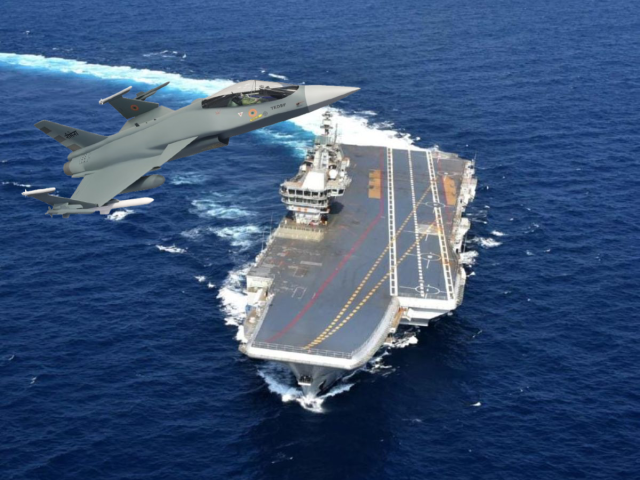
In response to the unsatisfactory performance of the Naval Tejas in 2020, the Indian Navy initiated the design of a dedicated naval fighter known as the Twin Engine Deck Based Fighter (TEDBF). The Aeronautical Development Agency (ADA), based in Bengaluru, has been entrusted with the design of this fighter.
While the project has received clearance from the Ministry of Defence (MoD), it still awaits critical approval from the Cabinet Committee on Security (CCS). The TEDBF is scheduled to undergo a Critical Design Review (CDR) by mid-2025. Upon successful completion of the CDR, the project will be presented to the CCS for funding approval. The ADA is seeking funding ranging from ₹13000 to ₹15000 crore for this initiative.
The ADA has classified the TEDBF as a 5-minus-generation fighter. It features a canard delta wing design, is semi-stealthy, and is built as a twin-engine fighter jet capable of achieving air superiority. Its intended roles include anti-ship operations, electronic warfare, and anti-access/area denial (A2/AD) missions, as well as support missions. The advancements in the Indian Air Force’s Advanced Medium Combat Aircraft (AMCA) program have also helped the TEDBF programme in many ways.
The TEDBF features advanced stealth capabilities essential for operational effectiveness in hostile environments. Its design includes radar-absorbent materials and blended surfaces to reduce radar cross-section (RCS). Twin engines minimize infrared (IR) emissions, enhancing protection against detection by heat-seeking missiles.
A key innovation is the diverterless supersonic inlet (DSI), which automatically adjusts for optimal engine performance, increasing thrust and fuel efficiency, especially at high speeds. Innovative serpentine air intakes improve stealth by concealing engine fan blades and optimising airflow, contributing to lower RCS. These intakes also enhance performance across varying altitudes and speeds.
Additionally, the TEDBF is equipped with advanced electronic warfare (EW) systems that jam and deceive enemy radar and communication, enhancing survivability in contested environments. Overall, the TEDBF showcases cutting-edge aerospace technology, positioning the Indian Navy at the forefront of modern naval aviation.
Commercial Viability
When evaluating the feasibility of a fighter jet programme, three key terms should be considered: Program Unit Cost (PUC), Unit Procurement Cost (UPC), and Operational Cost. PUC is calculated by dividing the total program cost by the total number of aircraft produced. In contrast, UPC is determined by dividing the cost of the most recent production contract by the number of aircraft included in that contract, which typically excludes most research and development (R&D) and support costs.
A comparison of various fighter jet programs:
| Aircraft Type | UPC (Million USD) | PUC (Million USD) | Program Cost/Units |
| F/A-18 | 78.4 (2007) | 95.3 (2005) | 44.03 Bn, 462 |
| Rafale-M | 67.8 (2005) | 145.7 (2005) | 8.72 Bn, 60 |
| AMCA | 80-100 (estimated) | 60 (estimated) | ~6 Bn, 125-200 |
| LCA Tejas Mk1 & 1A | 40, 79 | 30, 23 | 1.2 (40)1.9 Bn (180) |
| Tejas Mk2 | NA | NA | 1.2 Bn, 120-250 |
| TEDBF | NA | NA | Expected 2 Bn, 100 |
In the long run, the cost per flight hour can significantly impact the viability of a programme. The estimated cost per flight hour for the F/A-18 Super Hornet ranges from $10,000 to $24,000. This range is influenced by factors such as mission complexity, maintenance requirements, fuel consumption, spare parts, and support infrastructure. In comparison, the cost for the Rafale-M is estimated to be between $16,500 and $19,000 per hour. The cost per flight hour for the F-35, however, is considerably higher, ranging from $38,000 to $50,000 depending on the aircraft variant. Currently, there is no data available regarding the cost per flight hour for the TEDBF or AMCA.
Getting back to the advantages of local production, we can consider the example of the indigenous production of the Su-30MKI. Many people compare the Su-30MKI produced in India by Hindustan Aeronautics Limited (HAL) with those produced in Russia. While the Su-30MKI in India may have higher initial costs, it provides long-term benefits such as self-reliance, local job creation, and potential export opportunities. On the other hand, acquiring the Su-30 directly from Russia may seem more cost-effective initially, but it does not offer the same strategic and economic advantages as domestic production.
When examining the production and operation patterns of various fighter programmes, several facts emerge. Firstly, aircraft designed by a single country are not necessarily more expensive than those developed through international cooperation. Additionally, single-nation development does not guarantee lower costs, as evidenced by the fact that U.S. fighters like the F-35 and F-22 are significantly more expensive than European fighters such as the Rafale-M and Gripen. Furthermore, long production runs do not always result in less expensive aircraft. Thus, maintaining continuity in development is the best way to avoid cost overruns. Finally, development costs are influenced more by the management and development history than by the aircraft’s actual capabilities.
The Challenges
India faces a significant challenge in achieving self-reliance in defense manufacturing, particularly in developing advanced aero engines, which are crucial for the performance and reliability of fighter aircraft. The Kaveri engine, developed by the Gas Turbine Research Establishment (GTRE) since the 1980s for the LCA, has encountered numerous technical issues and has not met performance standards, leading the Tejas to depend on an American-supplied GE engine.
To address this, the DRDO has sought partnerships with international firms like France’s Safran and the U.S. General Electric to expedite indigenous engine development. However, India has already faced two years delays with the GE F404-IN20 engine for the Tejas Mk1, anticipating similar issues for the Tejas Mk2 and AMCA programmes.
The Way Forward

The TEDBF, which focuses on indigenous development, aims to provide cost-effective solutions while integrating advanced technologies from the AMCA program. While the Indian Navy has supported the Tejas program, it is now time for the Indian Air Force to reciprocate by backing the TEDBF program, particularly through its involvement in the Omni-Roll Combat Aircraft (ORCA) programme, a land-based variant of the TEDBF.
However, it is unlikely that the IAF will support the ORCA program. Nonetheless, this does not diminish the importance of naval aviation in supporting India’s rise. According to estimates from the Centre for Economics and Business Research in London, China is projected to be the world’s largest economy for 21 years by 2036, with the United States expected to reclaim its position by 2057. Ultimately, India is anticipated to surpass the US around 2081.
To achieve these economic goals and maintain its global status, India will require a strong navy with worldwide reach. This ambition can only be realised if the momentum of the ‘Atmanirbhar Bharat’ initiative is sustained. The TEDBF is one such initiative that could revitalise naval aviation and help India achieve greater heights.
SOURCE :
( ) Russo-Ukraine War - 2024 :https://www.globalsecurity.org/military/world/war/russo-ukraine-2024.htm
( ) Russo-Ukraine War - 2024:Russo-Ukrainian War - 04 February 2024 - Day 710 - https://www.globalsecurity.org/military/world/war/russo-ukraine-2024-maps.htm
A number of claims and counterclaims are being made on the Ukraine-Russia conflict on the ground and online. While GlobalSecurity.org takes utmost care to accurately report this news story, we cannot independently verify the authenticity of all statements, photos and videos.
On 24 February 2022, Ukraine was suddenly and deliberately attacked by land, naval and air forces of Russia, igniting the largest European war since the Great Patriotic War. Russian President Vladimir Putin announced a "special military operation" (SVO - spetsialnaya voennaya operatsiya) in Ukraine. The military buildup in preceeding months makes it obvious that the unprovoked and dastardly Russian attack was deliberately planned long in advance. During the intervening time, the Russian government had deliberately sought to deceive the world by false statements and expressions of hope for continued peace.
"To initiate a war of aggression... is not only an international crime; it is the supreme international crime differing only from other war crimes in that it contains within itself the accumulated evil of the whole." [Judgment of the International Military Tribunal]
"We have heard reports from the Ukrainian government that they have concerns -- from the Ukrainian Ministry of Defense and general staff that they are concerned that they believe that units are not -- do not have the stocks and the stores of ammunition that they require, and that is one of the reasons we have been focusing on the need to answer Congress's questions so that they are able to move forward on a decision to pass the supplemental." Assistant Secretary of Defense International Security Affairs Celeste Wallander said 24 January 2024.
Wallander said "we are able to provide ammunition and interceptors that were contracted for in 2022 and 2023 under USAI, but those levels are not -- are not at the same level when we were able to provide on a regular basis ammunition and interceptors and other capabilities funded both by PDA and by USAI. So without USAI, we're not able to sustain the same levels of provision of capability to Ukraine."
The Biden administration and House Republicans failed to reach a funding deal that would have included an additional $60 billion in security assistance for Ukraine's military effort. In an interview 16 January 2024 with ABC News, Minister of Foreign Affairs of Ukraine Dmytro Kuleba said that this money would potentially allow Ukraine to avoid a direct confrontation between NATO and Russia, in which American troops would be forced to intervene. "Even if we run out of weapons, we will fight with shovels. Because the existence of this nation is at stake for Ukraine," he told ABC News during an interview in Kyiv.
The "prospects for passing any deal on immigration policy and Ukraine aid in the Republican-led House are near zero... House Speaker Mike Johnson, who is beholden to his right wing and to former president Donald Trump.... in a leaked call with GOP members, Johnson went further, saying he wouldn’t accept any Senate deal and that he doesn’t think the border issue can be solved until a Republican becomes president.... Johnson has no political motivation to move against his right wing and defy Trump to support a Senate compromise. Why give President Biden a win on the border going into the general election? Setting extremist standards for immigration reform was part of MAGA’s plan to kill both efforts all along." wrote Josh Rogin in The Washington Post 19 January 2024.
Despite the huge American and Western aid amounting to more than $100 billion during 2023, its counterattack - which was much promoted - ended in great disappointment after Russia repelled it, and the Ukrainian army did not succeed in regaining the territory controlled by Moscow, which is estimated at a fifth of Ukrainian territory. If Kiev receives a large boost of US aid in 2024, as President Biden hoped, it may still have to consolidate its power and absorb the relentless Russian attacks.
The Atlantic Council's Eurasia Center noted that Russia commenced 2024 with the biggest air and drone strikes since the beginning of the full-scale invasion, attacking civilians and infrastructure in cities including Kyiv and Kharkiv, as ammunition for Western-provided air defense ran out and debates continued in Washington on whether to provide more. With deflated expectations on territorial progress by Ukraine, and attention shifted to the Israel-Hamas war, international media has largely deemed the ongoing counter-offensive a failure and the war on Ukraine a stalemate.
However, contrary the expectations of pessimists, Ukrainian strikes into the Black Sea and the Russian navy headquarters in Sevastopol crippled Russian naval efforts in the region and broken the long-standing blockade on Ukrainian trade. As recently as late December 2023, Ukrainian drone and missile strikes hit and destroyed key Russian warships and landing craft in occupied Crimea. Additionally, the Ukrainian military continued to repel Russian forces in cities in the east and south, inflicting possibly unsustainable manpower and equipment attrition on the Russian military.
The dubious framing of the war as a stalemate had become an argument against further Western support for Ukraine and led some to push for negotiations with the Kremlin. Such narratives discount the substantial successes Ukraine enjoyed in the Black Sea and ignored the fact that Russian President Vladimir Putin had shown no real indication of moving away from his maximalist war aims for conquest of Ukraine and imposition of a New Europe. Nor had Putin shown the political will to conscript the army needed to realize such ambitions.
The Atlantic Council's Eurasia Center proposed the key quesitns for the new year - What does Ukraine need to succeed in 2024? How did the media narrative of the failed counteroffensive form, and how can Ukraine’s Western allies best maintain international support for continued aid? What is the true danger of accommodating a continuously aggressive Kremlin?
Minister of Foreign Affairs Dmytro Kuleba stated 25 January 2024 that the gross domestic product of Ukraine and its allies is 21 times higher than that of Russia and its allies. The head of the Ministry of Foreign Affairs reported this in an interview with Foreign Affairs. "If you take the states that militarily support Ukraine and those that militarily support Russia, the combined GDP of our state and allies is 21 times greater than that of the Russian "coalition," Kuleba said. The minister emphasized that, "according to this, the world has enough resources for Ukraine's victory even in a war of attrition."
Kuleba emphasized that even when analyzing the ability to create coalitions, Ukraine exceeds the capabilities of the Russian Federation in this regard. "And it's funny, because Ukraine is not a member of the G7, and yet the G7 is much more united in helping Ukraine protect its interests. Russia is one of the founders of BRICS, but BRICS is much less supportive of the Russian Federation, even though it is supposedly a member of their families," said the minister.