Russian Offensive Campaign Assessment, November 19, 2023
Kateryna Stepanenko, Grace Mappes, Christina Harward, Angelica Evans, and Frederick W. Kagan
November 19, 2023, 6:15pm ET
Click here to see ISW’s interactive map of the Russian invasion of Ukraine. This map is updated daily alongside the static maps present in this report.
Click here to see ISW’s 3D control of terrain topographic map of Ukraine. Use of a computer (not a mobile device) is strongly recommended for using this data-heavy tool.
Click here to access ISW’s archive of interactive time-lapse maps of the Russian invasion of Ukraine. These maps complement the static control-of-terrain map that ISW produces daily by showing a dynamic frontline. ISW will update this time-lapse map archive monthly.
Note: The data cut-off for this product was 2:00 pm ET on November 19. ISW will cover subsequent reports in the November 20 Russian Offensive Campaign Assessment.
Ukrainian and Russian forces are continuing combat operations in eastern and southern Ukraine, although the rainy weather will likely continue to slow the pace of combat operations until winter conditions fully set in. A Russian milblogger claimed that Ukrainian forces continue to defend against a strong group of Russian forces attacking near Avdiivka and that Ukrainian forces maintain the initiative in southern Ukraine.[1] The milblogger added that it is premature to declare any Russian victories to avoid creating any false impressions about the situation on the battlefield. Another Russian milblogger observed that poor weather is impeding the use of armored vehicles in western Zaporizhia Oblast but that Ukrainian forces are still attacking Russian positions with infantry units.[2] The United Kingdon (UK) Ministry of Defense (MoD) assessed on November 18 that neither side has achieved any substantial progress in the Kupyansk and Avdiivka directions, or in east (left) bank Kherson Oblast — where the most intense battles are ongoing.[3] The UK MoD added that there are fewer immediate prospects of major changes on the frontlines as colder winter weather begins to set in. Ukrainian military officials anticipate that Russia will launch a third wave of assaults on Avdiivka.[4] Freezing weather conditions during the winter will likely prompt the resumption of more active combat operations, and ongoing rainy weather is unlikely to halt Ukrainian or Russian attacks.
Russian forces conducted another series of drone strikes primarily targeting Kyiv, Poltava, and Cherkasy oblasts on the night of November 18 to 19. The Ukrainian Air Force reported on November 19 that Ukrainian air defenses destroyed 15 of the 20 Russian Shahed-131/-136 drones.[5] Ukrainian Air Force Spokesperson Colonel Yuriy Ihnat stated the strike series did not result in any casualties or critical damages and that this was an “excellent result.”[6] The Russian Ministry of Defense (MoD) claimed that Russian forces struck Ukrainian ammunition depots in Kirovohrad City, Kirovohrad Oblast and Olshanytsya, Kyiv Oblast and a fuel storage facility at the Kanatove airfield, Kirovohrad Oblast.[7]
Ardent nationalist and former Russian officer Igor Girkin formally announced his intent to run in the 2024 Russian presidential elections despite his imprisonment. Girkin acknowledged that his August 30 post claiming that he is better than Russian President Vladimir Putin aimed to attract attention before formally announcing his intent to run for president as an independent candidate.[8] Girkin claimed that the current Russian government fears his nomination because it would disrupt the Kremlin’s plans to have sham candidates run against Putin, as Putin is the “only winner [of the presidential election] already known in advance.” Girkin acknowledged that running in the Russian presidential election is “like sitting down at a table to play with cheaters” but that bringing like-minded “patriots” together through the election is a defeat for the Russian officials living on the delusional “planet of the pink ponies.” Girkin appealed to the Russian Strelkov (Girkin) Movement (RDS), which has supported Girkin’s defense against his criminal case for allegedly discrediting the Russian military, to help canvas to receive the necessary number of signatures to run as an independent candidate.
Girkin’s presidential announcement indicates a possible rift between the RDS and his wife, Miroslava Reginskaya. Reginskaya has been the first to transcribe Girkin’s prior letters from prison to post on Telegram but did not claim to post Girkin’s presidential campaign announcement on November 19 and has not yet acknowledged Girkin’s presidential announcement on her own Telegram channel.[9] Reginskaya has been a staunch advocate for Girkin’s release since the first day of his imprisonment in July 2023 and appears to maintain ties with Russian veterans who support Girkin’s release, so her silence regarding Girkin’s most recent announcement is notable.[10] Reginskaya and the RDS contradicted each other on November 8 when the RDS called for character witnesses to speak for Girkin at his trial, but Reginskaya stated that witness recruitment on ”other channels and by other persons is not coordinated with the general defense and can be dangerous for Igor [Girkin].”[11] The RDS announced on November 15 that it had found several such witnesses for Girkin, despite Reginskaya’s November 8 statement.[12]
The Russian Ministry of Defense (MoD) may be censoring irregular Russian armed formations as part of its ongoing efforts to formalize Russia’s irregular forces and establish greater control over the Russian information space. The Donetsk People’s Republic (DNR) “Vostok” Battalion claimed on November 19 that the DNR's Internal Affairs Ministry issued a censorship order, prohibiting the battalion from “showing its life and work.”[13] The “Vostok” Battalion is currently serving in the Donetsk-Zaporizhia Oblast border area and provides near-daily updates on the situation in their sector of the front.[14] The DNR Internal Ministry may be administering the censorship order as part of the Russian MoD’s ongoing efforts to formalize the DNR/Luhansk People’s Republic (LNR) People’s Militias into the Russian armed forces, which has previously trigger backlash within the Russian information space.[15] ISW has extensively reported on the Kremlin’s ongoing censorship efforts targeting Russian milbloggers and state media.[16]
Ukrainian officials announced on November 19 that Bohdan Yermokhin, a teenage Ukrainian whom Russian authorities forcibly deported from occupied Mariupol to Russia and attempted to conscript, returned to Ukraine.[17] Ukrainian Presidential Administration Chief of Staff Andriy Yermak stated that Yermokhin’s return occurred within the framework of Ukrainian President Volodymyr Zelensky’s “Bring Kids Back UA” program.[18] Yermak and Ukrainian Ombudsman Dmitry Lubinets stated that Qatar and UNICEF mediated the return, and Lubinets noted that this was the first time UNICEF was involved in efforts to return Ukrainian children back from Russia.[19] Russia dictated that Yermokhin travel to a third country to meet a relative once he turned 18 years old, and Yermokhin turned 18 on November 19 and met his sister in Belarus before returning to Ukraine.[20] Kremlin-appointed Children’s Rights Commissioner Maria Lvova-Belova continued attempts to dispute Russia‘s practice of illegally deporting Ukrainian children to Russia and claimed on November 19 that the Russian military found Yermokhin “neglected” in Mariupol in 2022 and took him to “safety” with a Russian foster family.[21]
A prominent Kremlin-affiliated milblogger expressed anger on November 19 about Armenia’s decisions to distance itself from Russia against the backdrop of recent deteriorating Armenian-Russian relations. Russian sources claimed that Ukrainian forces used a Tochka-U missile to strike Belgorod Oblast on November 19, and a prominent Russian milblogger used the opportunity to allege that Armenia, possibly with assistance from the US, agreed to give Tochka-U launchers and missiles to Ukraine.[22] The milblogger offered no evidence in support of this allegation, and ISW has not observed anything to substantiate it. The milblogger speculated about the number of weapons Armenia could possibly transfer to Ukraine but did not offer any specifics or the sourcing of his information. The milblogger also claimed that the Armenian government has begun to prepare to withdraw from the Russian-led Collective Security Treaty Organization (CSTO). ISW has not observed any confirmation of the milblogger’s claim that Armenia is planning to leave the CSTO, and Armenian Deputy Foreign Minister Vahan Kostanyan told journalists on November 9 that Armenia is not discussing the legal process of leaving the CSTO.[23] Armenian Prime Minister Nikol Pashinyan stated on November 18 that Armenia and Azerbaijan were able to agree on the basic principles for a peace treaty but that the two countries are speaking “different diplomatic languages” and that there is an atmosphere of mistrust.[24]
Key Takeaways:
- Ukrainian and Russian forces are continuing combat operations in eastern and southern Ukraine, although the rainy weather will likely continue to slow the pace of combat operations until winter conditions fully set in.
- Russian forces conducted another series of drone strikes primarily targeting Kyiv, Poltava, and Cherkasy oblasts on the night of November 18 to 19.
- Ardent nationalist and former Russian officer Igor Girkin formally announced his intent to run in the 2024 Russian presidential elections despite his imprisonment.
- The Russian Ministry of Defense (MoD) may be censoring irregular Russian armed formations as part of its ongoing efforts to formalize Russia’s irregular forces and establish greater control over the Russian information space.
- Ukrainian officials announced on November 19 that Bohdan Yermokhin, a teenage Ukrainian whom Russian authorities forcibly deported from occupied Mariupol to Russia and attempted to conscript, returned to Ukraine.
- A prominent Kremlin-affiliated milblogger expressed anger on November 19 about Armenia’s decisions to distance itself from Russia against the backdrop of recent deteriorating Armenian-Russian relations.
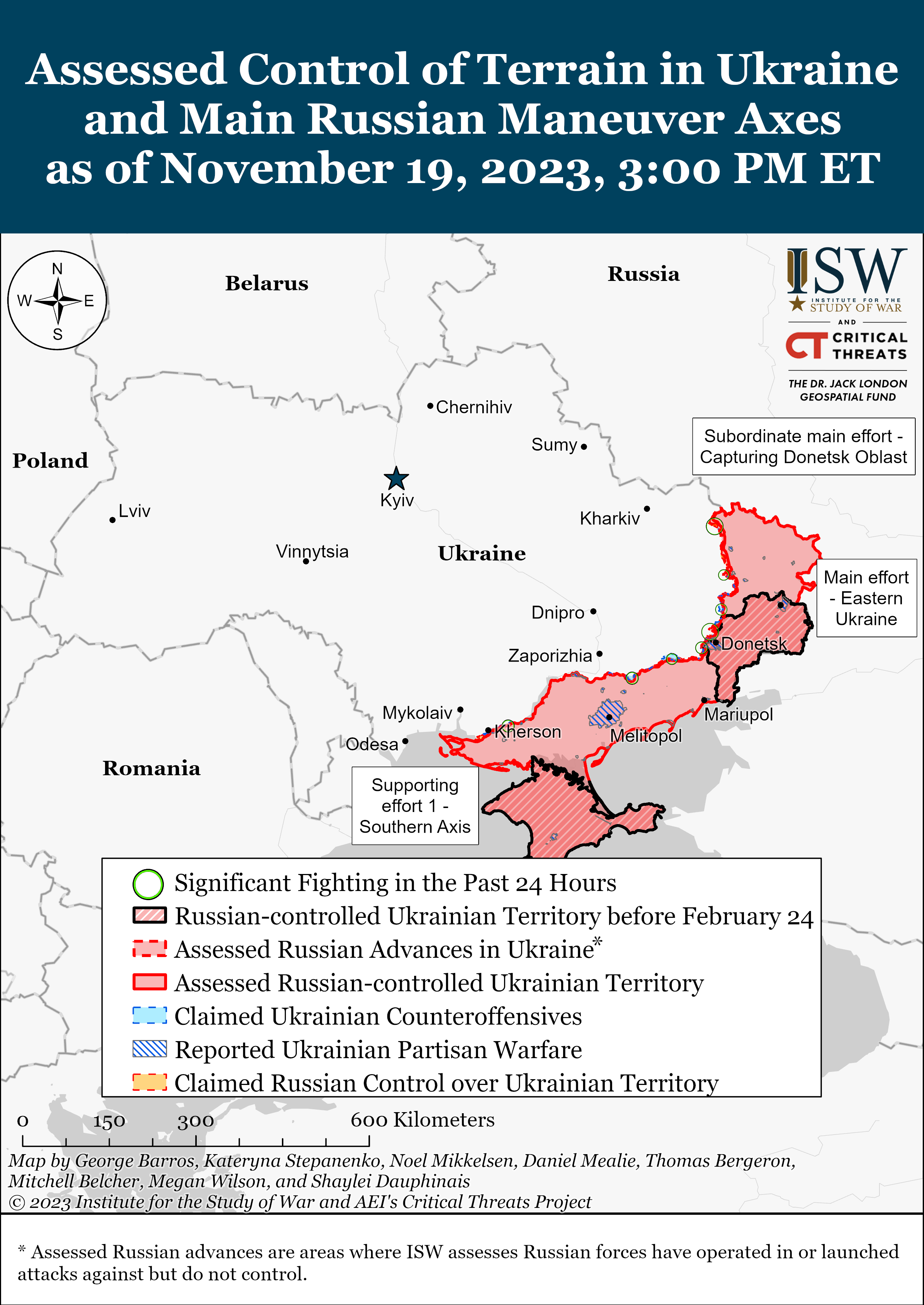
- Russian forces conducted offensive operations along the Kupyansk-Svatove-Kreminna line, near Bakhmut, near Avdiivka, west and southwest of Donetsk City, in the Donetsk-Zaporizhia Oblast border area, and in western Zaporizhia Oblast and reportedly advanced in some areas on November 19.
- Regional Russian officials continue to fear the emergence of localized protests in response to the Russian military’s refusal to return some mobilized personnel from the frontlines.
- Occupation authorities continue efforts to indoctrinate Ukrainian children in occupied Ukraine into Russian national and cultural identities.
We do not report in detail on Russian war crimes because these activities are well-covered in Western media and do not directly affect the military operations we are assessing and forecasting. We will continue to evaluate and report on the effects of these criminal activities on the Ukrainian military and the Ukrainian population and specifically on combat in Ukrainian urban areas. We utterly condemn Russian violations of the laws of armed conflict and the Geneva Conventions and crimes against humanity even though we do not describe them in these reports.
- Russian Main Effort – Eastern Ukraine (comprised of two subordinate main efforts)
- Russian Subordinate Main Effort #1 – Capture the remainder of Luhansk Oblast and push westward into eastern Kharkiv Oblast and encircle northern Donetsk Oblast
- Russian Subordinate Main Effort #2 – Capture the entirety of Donetsk Oblast
- Russian Supporting Effort – Southern Axis
- Russian Mobilization and Force Generation Efforts
- Russian Technological Adaptations
- Activities in Russian-occupied areas
- Russian Information Operations and Narratives
Russian Main Effort – Eastern Ukraine
Russian Subordinate Main Effort #1 – Luhansk Oblast (Russian objective: Capture the remainder of Luhansk Oblast and push westward into eastern Kharkiv Oblast and northern Donetsk Oblast)
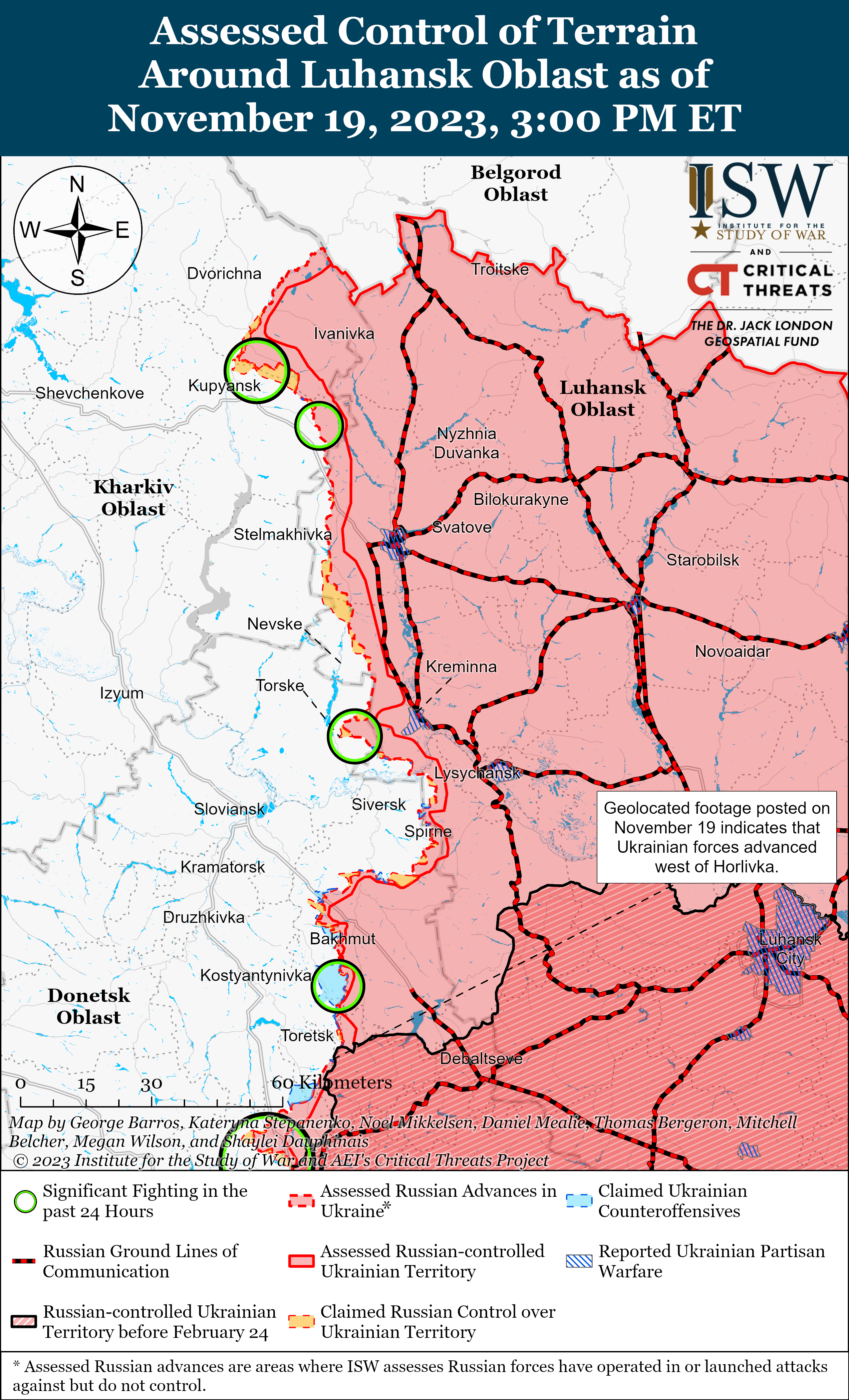
Russian forces continued offensive operations along the Kupyansk-Svatove-Kreminna line on November 19 but did not make any confirmed advances. The Ukrainian General Staff reported that Russian forces conducted unsuccessful attacks in the Kupyansk direction near Synkivka (9km northeast of Kupyansk) and Ivanivka (20km southeast of Kupyansk) and east of Petropavlivka (7km east of Kupyansk); and in the Lyman direction near Torske (15km west of Kreminna).[25] A prominent Russian milblogger claimed that Russian forces achieved unspecified tactical successes near Petropavlivka and Synkivka in the past week.[26] The North Ossetian “Alania” and “Storm Ossetia” volunteer battalions claimed on November 18 that fighting is currently very intense near Kupyansk.[27] A Russian milblogger claimed on November 19 that there were also meeting engagements near the Serebryanske forest area southwest of Kreminna in the past week.[28] Ukrainian military observer Kostyantyn Mashovets stated that elements of the Russian 164th Motorized Rifle Brigade (part of Russia’s newly formed 25th Combined Arms Army [CAA], reportedly under the Eastern Military District) unsuccessfully attacked near Dibrova (7km southwest of Kreminna) and elements of the 228th Motorized Rifle Regiment (90th Tank Division, 41st CAA, Central Military District) attacked near Torske.[29] Mashovets stated that Russian forces are transferring elements of the Russian 7th Motorized Rifle Regiment (11th Army Corps [AC], Baltic Sea Fleet) and the 11th Tank Regiment (18th Motorized Rifle Division, 11th AC, Baltic Fleet) to positions near Pershotravneve in preparation for renewed offensive operations in the Kupyansk direction.[30] Mashovets added that elements of the Russian 283rd Motorized Rifle Regiment (144th Motorized Rifle Division, 20th CAA, WMD) are operating near Holykove (10km north of Kreminna).
The Russian Ministry of Defense (MoD) claimed on November 19 that elements of the Russian Central Grouping of Forces repelled a Ukrainian attack south of Kuzmyne (3km southwest of Kreminna).[31]
Russian Subordinate Main Effort #2 – Donetsk Oblast (Russian objective: Capture the entirety of Donetsk Oblast, the claimed territory of Russia’s proxies in Donbas)
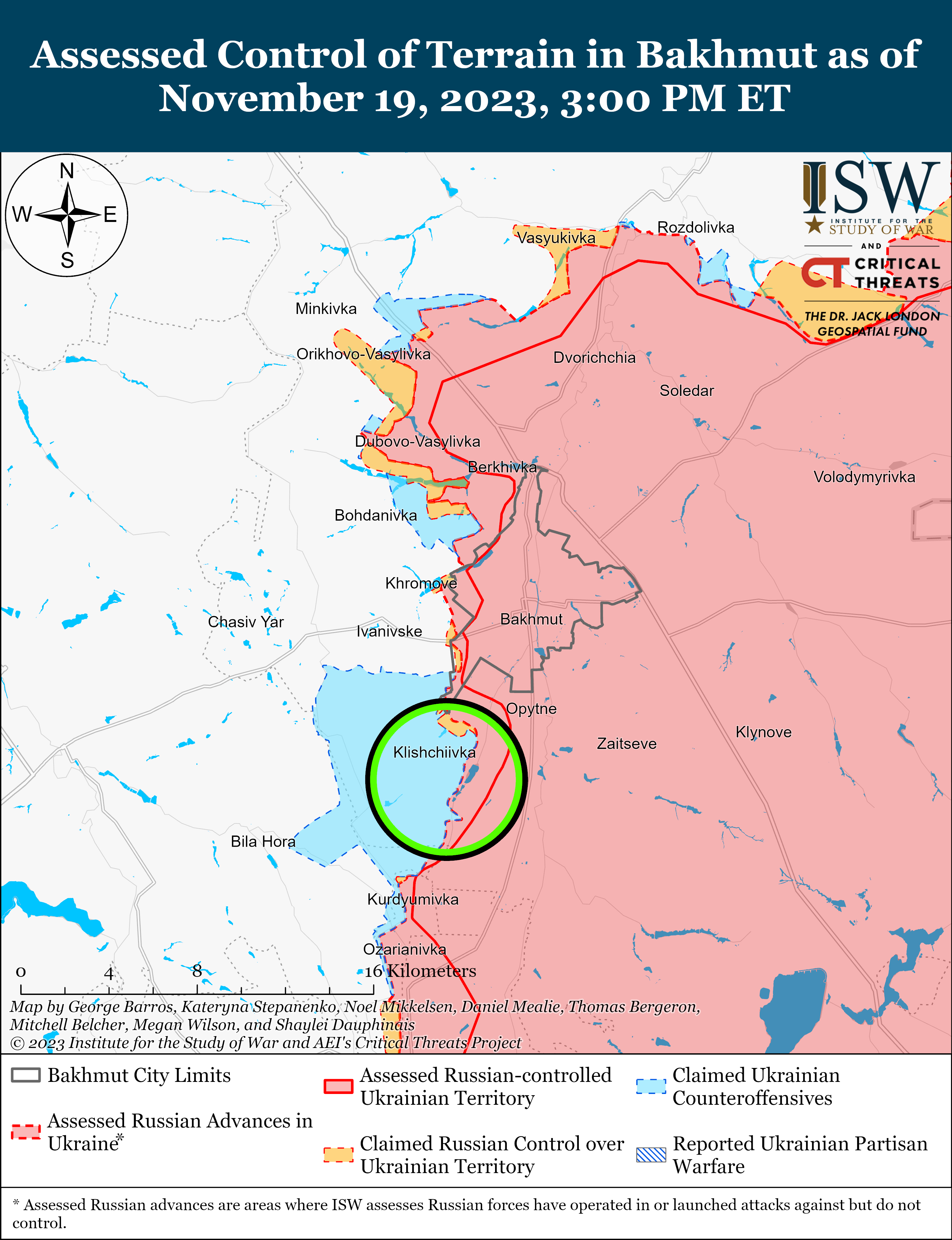
The Russian Ministry of Defense (MoD) claimed that Ukrainian forces unsuccessfully attacked near Bakhmut near Klishchiivka (7km southwest of Bakhmut) on November 19.[32]
Russian forces conducted offensive operations near Bakhmut but did not make any confirmed advances on November 19. A Russian news aggregator claimed that Russian forces made unspecified advances in Andriivka on November 18.[33] The Ukrainian General Staff reported that Russian forces unsuccessfully attacked near Klishchiivka and Andriivka (10km southwest of Bakhmut).[34] Russian sources claimed on November 18 and 19 that Russian forces attacked in the direction of Bohdanivka (6km northwest of Bakhmut) and near Klishchiivka, where Ukrainian forces still hold position on the nearby heights.[35] A Russian milblogger claimed that Russian forces significantly advanced from Yahidne (2m north of Bakhmut) and Berkhivka (2km northwest of Bakhmut) in the direction of Bohdanivka (6km northwest of Bakhmut) and Khromove (immediately west of Bakhmut) and that tactical engagements occurred north of Soledar (9km northeast of Bakhmut) in the past week.[36]
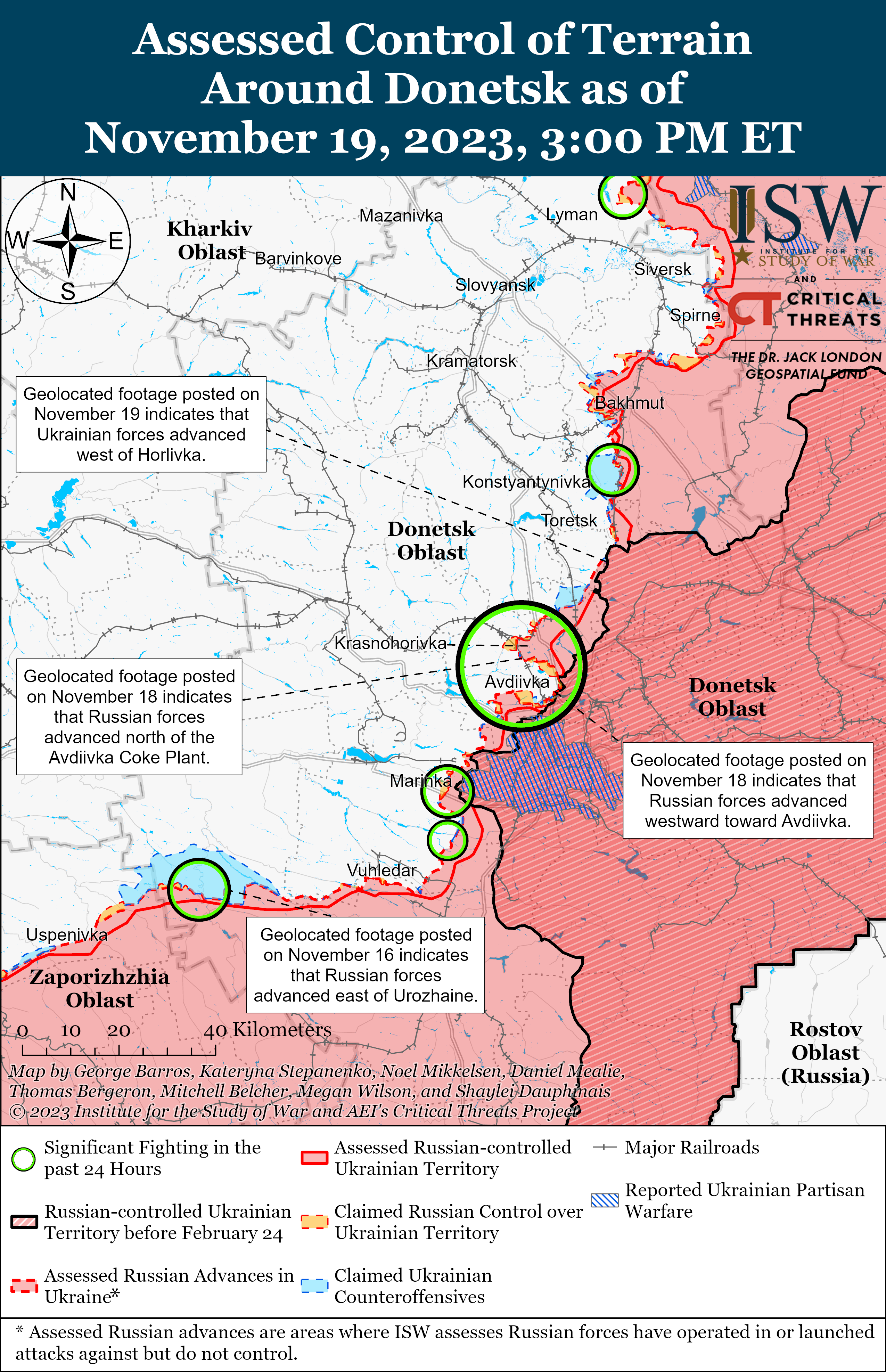
Russian sources claimed that Russian forces repelled Ukrainian attacks and pushed Ukrainian forces out of positions northwest of Horlivka (25km south of Bakhmut) on November 19. Geolocated footage published on November 19 indicates that Ukrainian forces attacked and initially advanced south of Shumy (23km south of Bakhmut and 9km northwest of Horlivka).[37] The Russian MoD claimed that Ukrainian forces unsuccessfully attacked near Shumy.[38] Russian milbloggers claimed that elements of the Russian 3rd Motorized Rifle Battalion (132nd Motorized Rifle Brigade, 1st Donetsk People’s Republic [DNR] Army Corps) pushed Ukrainian forces out of positions on the waste heap near the Gagarin mine northwest of Horlivka after unsuccessful Ukrainian attacks on November 18 and 19.[39] Another Russian milblogger claimed that Russian forces recaptured unspecified positions on the waste heap and that Ukrainian forces hold the area near the western slope.[40] Russian sources claimed that the top of the waste heap is a contested “gray zone.”[41]
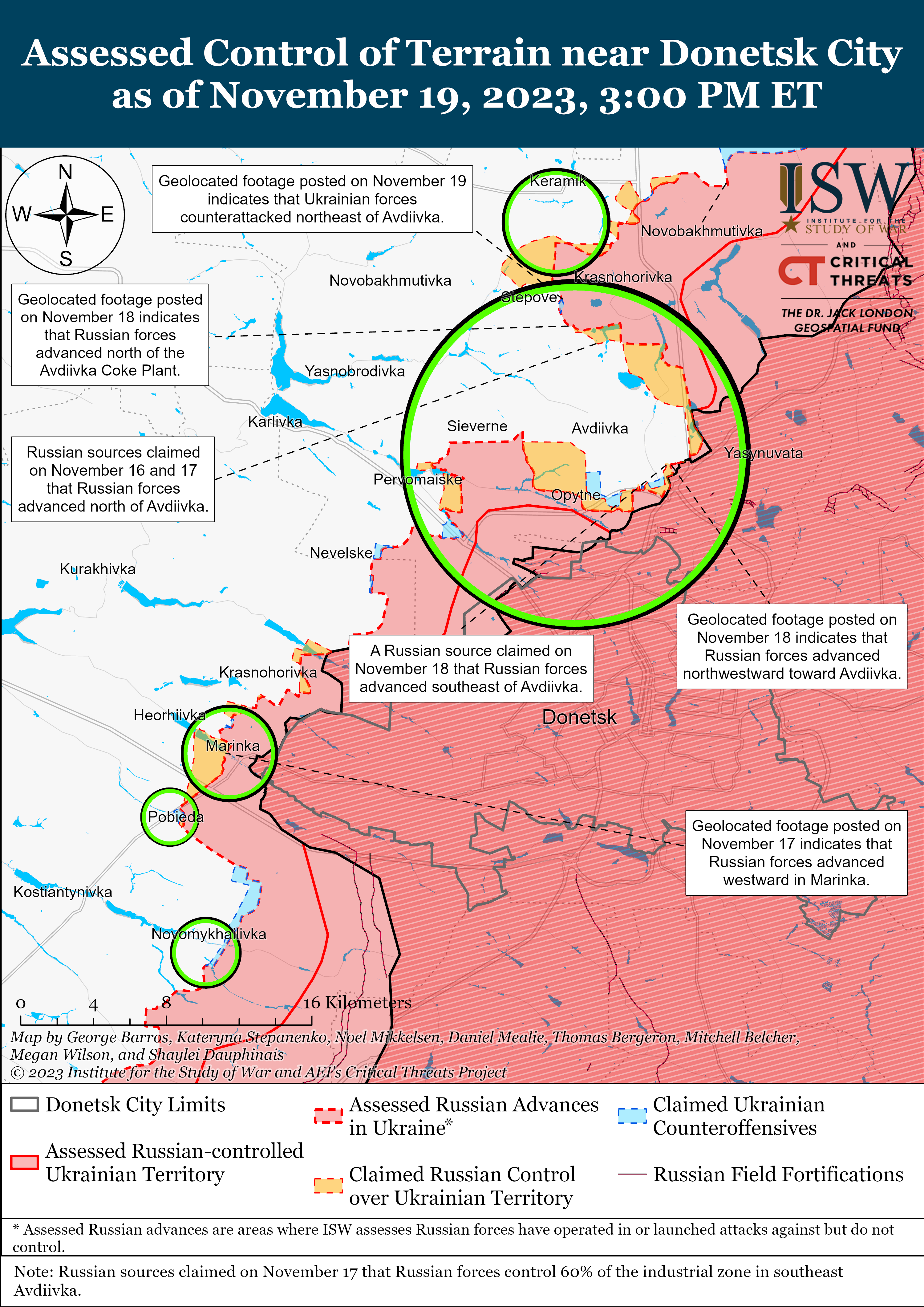
Ukrainian forces counterattacked near Avdiivka and made a confirmed advance on November 19. Geolocated footage published on November 19 indicates that Ukrainian forces advanced near the railway southeast of Stepove (3km northwest of Avdiivka).[42] A Russian milblogger claimed that Ukrainian forces recaptured positions near the railway near Stepove and counterattacked near the Avdiivka Coke Plant.[43]
Russian forces conducted offensive operations near Avdiivka but did not make any confirmed gains on November 19. Russian milbloggers claimed on November 18 and 19 that Russian forces advanced near the industrial zone on Avdiivka’s southeastern outskirts, the Avdiivka Coke Plant, and the railway west and northwest of Krasnohorivka (5km northwest of Avdiivka).[44] A Russian milblogger claimed on November 19 that elements of the Russian 114th Motorized Rifle Brigade (1st DNR Army Corps) and “Storm-Z” units advanced near the “Tsarska Okhota” restaurant south of Avdiivka, but later retracted this claim after other Russian sources refuted this claim.[45] The Ukrainian General Staff reported that Russian forces unsuccessfully attacked south of Novokalynove (13km northeast of Avdiivka), east of Novobakhmutivka (9km northwest of Avdiivka), and near Sieverne (6km west of Avdiivka) and Avdiivka.[46] Russian sources claimed on November 18 and 19 that Russian forces attacked near Pervomaiske (10km southwest of Avdiivka) and Sieverne; west of Krasnohorivka; south of the waste heap northwest of Avdiivka; east of the coke plant; towards Novokalynove; and from the industrial zone southeast of Avdiivka.[47] Russian sources claimed on November 18 and 19 that fighting is ongoing near the industrial zone, the coke plant, and Stepove.[48] Ukrainian Tavriisk Group of Forces Spokesperson Colonel Oleksandr Shtupun stated on November 19 that the numbers of Russian deserters and personnel who refuse to conduct offensive operations are increasing, causing Russian commanders to use physical force and barrier troops to push Russian forces to fight.[49] Shtupun stated that Russian forces have suffered heavy losses near Avdiivka and are forced to use mobilized personnel and penal recruits.[50]
The Russian MoD claimed that Ukrainian forces unsuccessfully attacked west of Donetsk City near Marinka (on the western outskirts of Donetsk City) on November 19.[51]
Russian forces conducted offensive operations west and southwest of Donetsk City but did not make any claimed or confirmed advances on November 19. The Ukrainian General Staff reported that Russian forces unsuccessfully attacked near Marinka, Pobieda (6km southwest of Donetsk City), and Novomykhailivka (10km southwest of Donetsk City).[52] A Russian milblogger claimed that Russian forces unsuccessfully attacked in Marinka and near Nevelske (directly west of Donetsk City).[53] The milblogger claimed that Russian forces improved their tactical positions in Marinka in the past week.[54]
Russian Supporting Effort – Southern Axis (Russian objective: Maintain frontline positions and secure rear areas against Ukrainian strikes)
Russian Eastern Grouping of Forces Spokesperson Oleg Chekhov claimed that Russian forces repelled a Ukrainian ground attack near Staromayorske (9km south of Velyka Novosilka) in the Donetsk-Zaporizhia Oblast border area on November 19.[55]
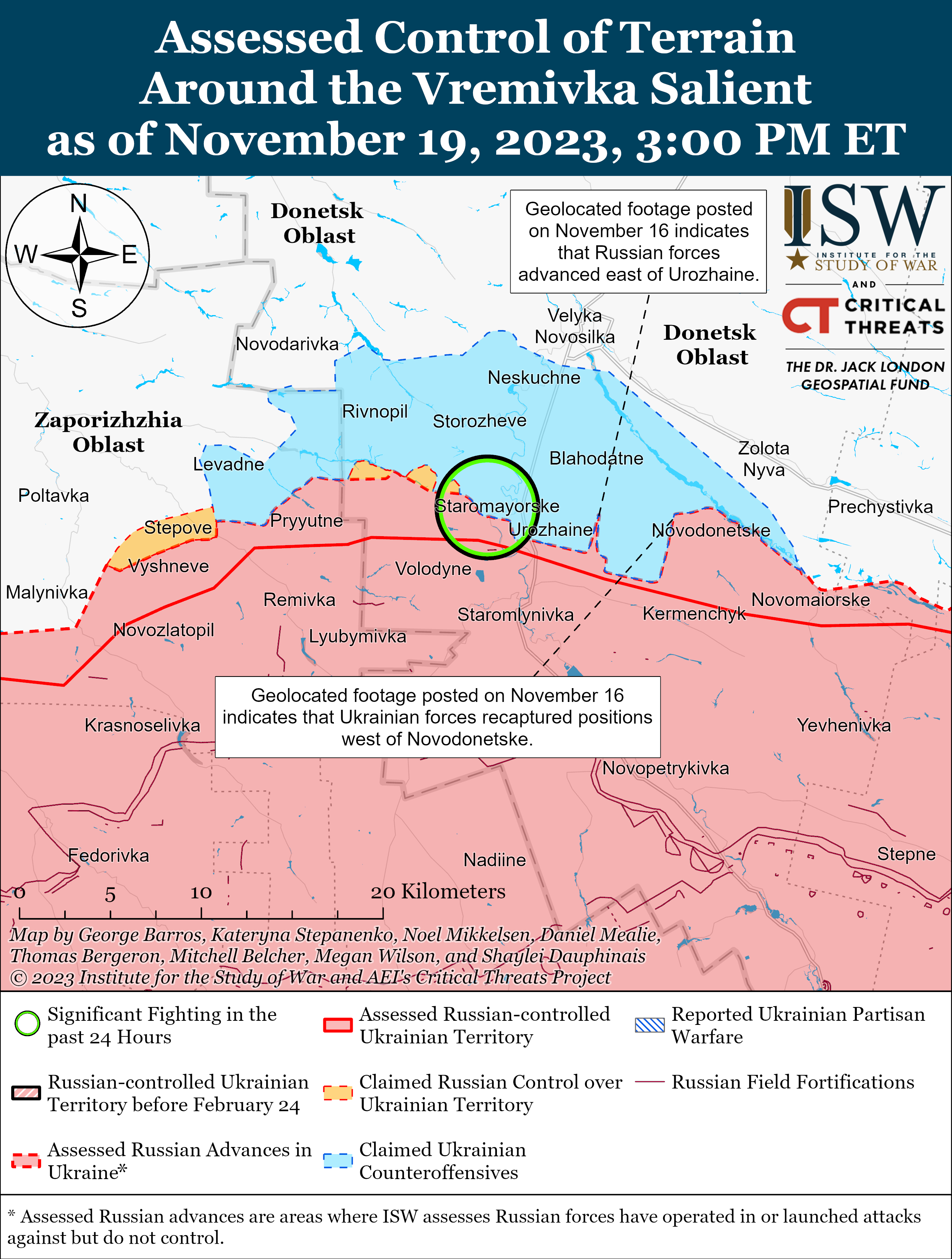
Russian forces continued offensive operations in the Donetsk-Zaporizhia Oblast border area and did not advance on November 19. The Ukrainian General Staff reported that Ukrainian forces repelled Russian ground attacks near Staromayorske.[56] Russian milbloggers claimed that Russian forces conducted a large airstrike with RBK-500 cluster bombs modified to be glide bombs against Ukrainian positions near Staromayorske.[57] The milbloggers claimed that this strike is the first large Russian strike in Ukraine using this weapon with the glide bomb modification.
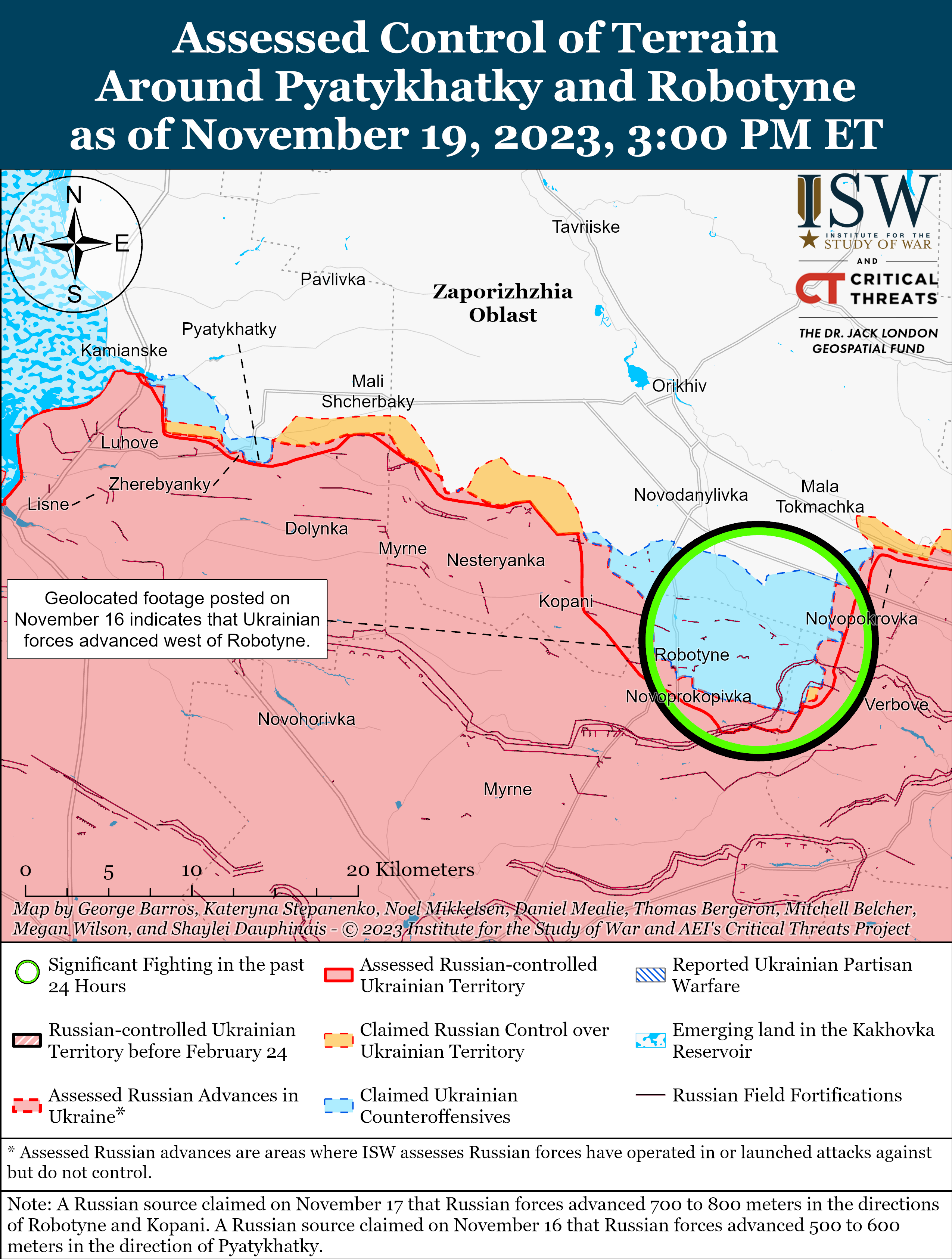
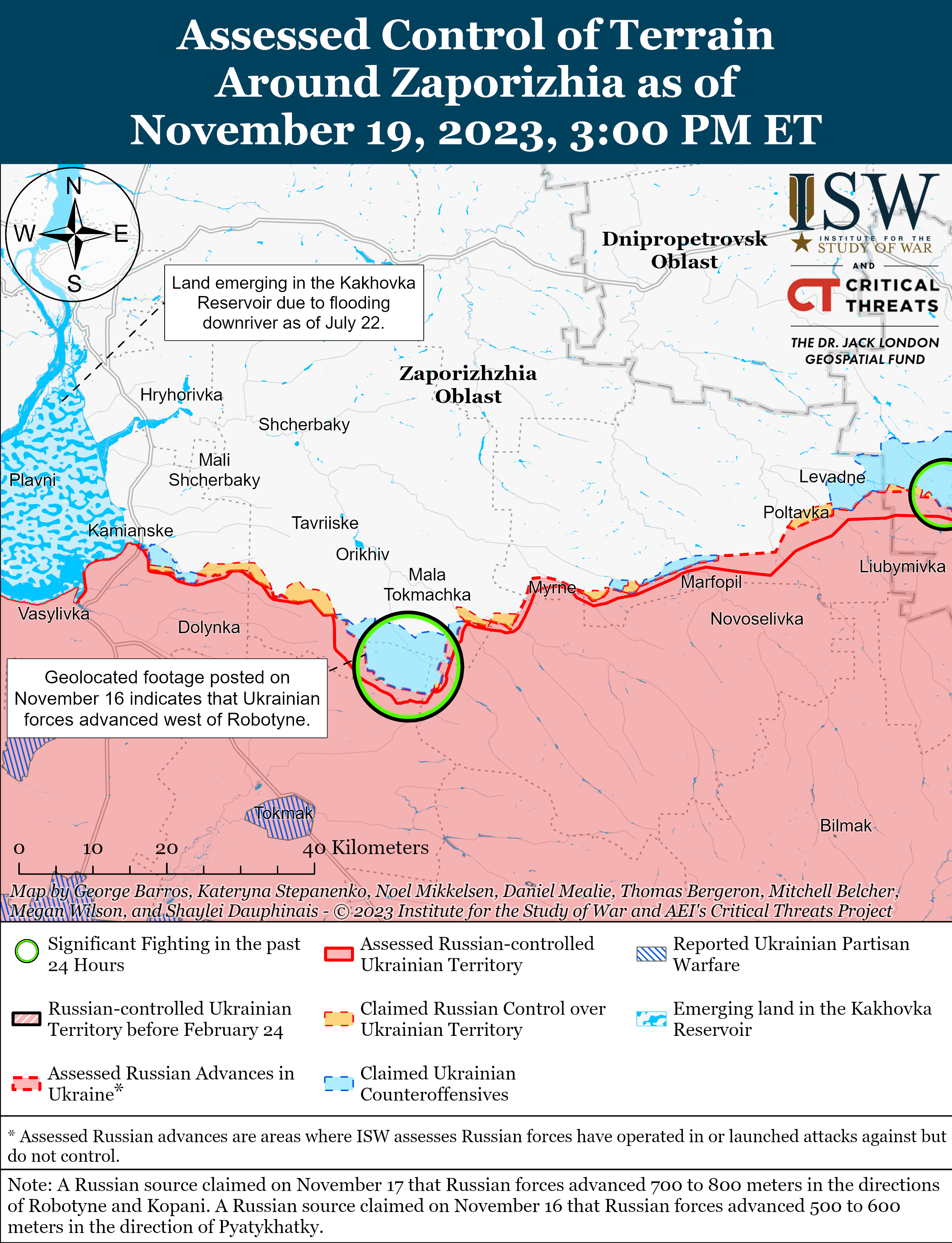
Ukrainian forces continued offensive operations in western Zaporizhia Oblast and reportedly made marginal advances on November 19. Russian milbloggers claimed that Ukrainian forces marginally advanced near Novoprokopivka (3km south of Robotyne) and Rivne (8km west of Robotyne).[58] Russian sources claimed that Ukrainian forces also attacked near Robotyne, Verbove (10km east of Robotyne), and Kopani (5km northwest of Robotyne).[59] Russian milbloggers claimed that poor weather and visibility are impeding offensive operations in western Zaporizhia Oblast.[60]
Russian forces continued offensive operations in western Zaporizhia Oblast on November 19 and reportedly marginally advanced. Russian milbloggers claimed that Russian forces recaptured a section of the N08 Orikhiv-Polohy-Bilmak highway during a counterattack near Novofedorivka (14km northeast of Robotyne), though ISW has not observed confirmation of these claims.[61] The Ukrainian General Staff reported that Russian forces conducted unsuccessful assaults near Robotyne and Novoprokopivka and west of Verbove.[62]
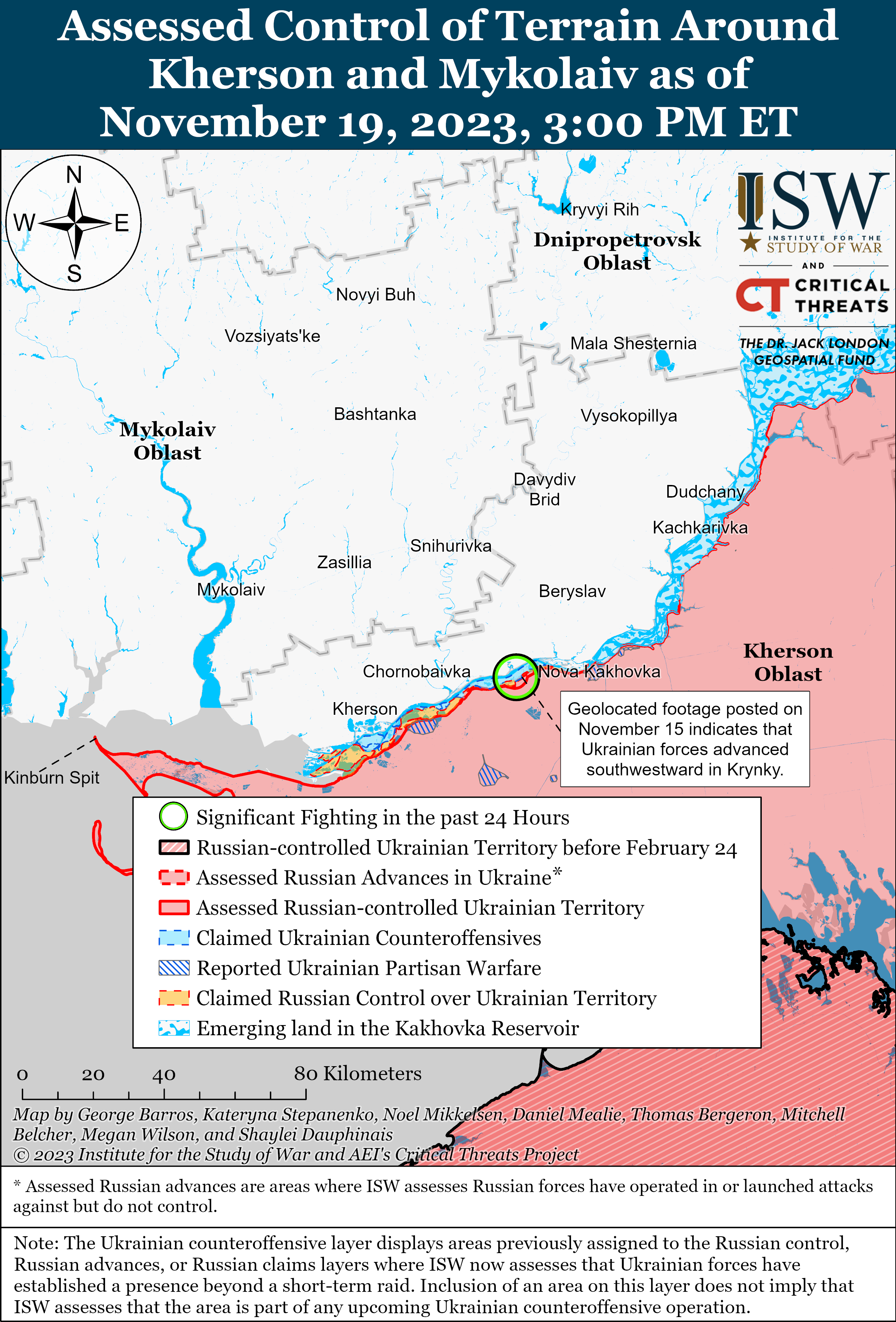
Ukrainian forces continued operations in the east (left) bank of Kherson Oblast on November 19. The Ukrainian General Staff stated that Ukrainian forces maintain positions on the east bank.[63] Russian milbloggers claimed that Ukrainian forces attacked near Poyma (12km east of Kherson City and 4km from the Dnipro River) and Pishchanivka (13km east of Kherson City and 3km from the Dnipro River) while Russian forces counterattacked in Krynky (30km northeast of Kherson City and 2km from the Dnipro River).[64] Russian sources claimed that Russian forces repelled a Ukrainian attempt to land on Velykyi Potemkin Island south of Kherson City.[65] A Russian milblogger claimed that Ukrainian forces are using modified Baba Yaga drones to damage Russian TOS thermobaric artillery systems in the east bank, underscoring the vulnerability of Russian air defenses in the area.[66]
Russian Mobilization and Force Generation Efforts (Russian objective: Expand combat power without conducting general mobilization)
Regional Russian officials continue to fear the emergence of localized protests in response to the Russian military’s refusal to return some mobilized personnel from the frontlines. Russian opposition and local sources reported that Novosibirsk officials refused to approve a rally organized by local families who planned to appeal for the return of their mobilized family members from the frontlines on November 19.[67] Novosibirsk officials later decided to meet with 30 protesters in a closed venue with numerous security requirements including metal detectors and bag checks.[68] One Russian outlet reported that there were many police personnel present during the meeting and that many relatives refused to speak to the media after leaving the meeting out of fear.[69] Local police reportedly prohibited journalists from attending the closed-door meeting.[70]
Russian sources reported that a Russian field military hospital caught fire in Valuyki, Belgorod Oblast, on November 18.[71] Russian sources claimed that faulty wiring started the fire and that there were no casualties.
Russian Investigative Committee Head Alexander Bastrykin instructed the Russian Investigative Committee to open a criminal case against security employees who shot five Russian veterans with a gas pistol and pepper spray in a bar in Yuzhno-Sakhalinsk, Sakhalin Oblast.[72]
Russian Technological Adaptations (Russian objective: Introduce technological innovations to optimize systems for use in Ukraine)
Western sanctions against exporting rechargeable batteries to Russia are reportedly forcing the Russian military to find workarounds to maintain handheld radio communications. A prominent Russian ultranationalist milblogger claimed that Russia has not replaced Western imports for rechargeable batteries and noted that Russian volunteers are purchasing Chinese-made USB rechargeable radio batteries due to Western sanctions.[73] The milblogger claimed that Russian forces are now trying to use 3-D printers to print batteries in an underground military radio factory in occupied Luhansk Oblast. The milblogger observed that Chinese batteries need to be frequently recharged, which forces Russian servicemen to turn off their radios to recharge them.
Kremlin newswire TASS, citing a source in the shipbuilding industry, reported that Russia is building the modernized Project 11711 large landing ship Vladimir Andreev at the Yantar shipyard on the Baltic Sea in Kaliningrad Oblast.[74] The source claimed that the Vladimir Andreev will transfer to the Russian Navy by the end of 2024. A Russian milblogger claimed that Russia is also building the Project 11711 ship Vasiliy Trushin at the Yantar shipyard.[75]
Activities in Russian-occupied areas (Russian objective: Consolidate administrative control of annexed areas; forcibly integrate Ukrainian citizens into Russian sociocultural, economic, military, and governance systems)
Occupation authorities continue efforts to indoctrinate Ukrainian children in occupied Ukraine into Russian national and cultural identities. The Ukrainian Resistance Center reported on November 19 that occupation authorities recently brought 34,000 unspecified Russian-produced textbooks to schools in occupied Kherson Oblast and plan to bring over 100,000 textbooks in total.[76] ISW previously reported that the Russian government recently updated the history textbooks for 11th grade students in Russia and in occupied territories in Ukraine to cover more contemporary topics such as the “reunification of Crimea and Sevastopol,” “the 2014 coup d'état in Ukraine,” and “the causes and course of the ‘special military operation’” in Ukraine.[77] Ukrainian Melitopol Mayor Ivan Fedorov stated that Russian textbooks and teachers have “rewritten history” and are indoctrinating Ukrainian children with propaganda about Russia‘s and the Russian military‘s “role in the world.“[78] Fedorov added that occupation authorities encourage their law enforcement officers to visit schools in occupied Ukraine to detail the possible punishments for various crimes and encourage Ukrainian children to denounce pro-Ukraine friends and relatives.
Russian Information Operations and Narratives
Russian state media continued to report on the surge of migrants trying to cross into Finland from Russia.[79] Russian media focused on denying Finnish border officials’ reports that Russian border guards pushed migrants onto the border barrier and closed the barriers from the Russian side behind them.[80] ISW previously covered the November 2021 migrant border crisis on the Belarusian-Polish border, which was likely an effort to destabilize Poland.[81] The Kremlin may be attempting to recreate similar information space conditions to destabilize NATO states on Russian borders and distract from the war in Ukraine.
Kremlin-affiliated outlets and Russian milbloggers largely responded to US President Joe Biden’s November 18 op-ed in the Washington Post by reiterating the Kremlin’s boilerplate anti-US rhetoric.[82]
Significant activity in Belarus (Russian efforts to increase its military presence in Belarus and further integrate Belarus into Russian-favorable frameworks and Wagner Group activity in Belarus)
Nothing significant to report.
Note: ISW does not receive any classified material from any source, uses only publicly available information, and draws extensively on Russian, Ukrainian, and Western reporting and social media as well as commercially available satellite imagery and other geospatial data as the basis for these reports. References to all sources used are provided in the endnotes of each update.
References
[1] https://t.me/dva_majors/29256
[2] https://t.me/DnevnikDesantnika/4852
[3] https://twitter.com/DefenceHQ/status/1725770500670963717
[4] https://www.understandingwar.org/backgrounder/russian-offensive-campaign...
[5] https://t.me/kpszsu/7673 ; https://www.facebook.com/GeneralStaff.ua/po...
[6] https://armyinform.dot com.ua/2023/11/19/15-zbytyh-shahediv-z-20-cze-chudovyj-rezultat-roboty-nashoyi-ppo-yurij-ignat/
[7] https://t.me/mod_russia/32638
[8] https://t.me/strelkovii/6470 ; https://t.me/RDS_Official_channel/305; https://www.understandingwar.org/backgrounder/russian-offensive-campaign...
[9] https://www.understandingwar.org/backgrounder/russian-offensive-campaign... https://www.understandingwar.org/sites/default/files/Oct%209%20Russian%2...
[10] https://www.understandingwar.org/backgrounder/russian-offensive-campaign... https://t.me/i_strelkov_2023/285
[11] https://t.me/strelkovii/6457; https://t.me/i_strelkov_2023/461 ; https://t.me/RDS_Official_channel/289; https://t.me/RDS_official_smi/1600
[12] https://t.me/RDS_Official_channel/294
[13] https://t.me/batalyon_vostok/258
[14] https://t.me/batalyon_vostok/257 ; https://t.me/batalyon_vostok/255 ;...
[15] https://www.understandingwar.org/backgrounder/russian-offensive-campaign...
[16] https://isw.pub/UkrWar111223 ; https://isw.pub/UkrWar100423 ; https:...
[17] https://t.me/ermaka2022/4033 ; https://tsn dot ua/ru/ukrayina/vozvraschenie-deportirovannogo-rossiyanami-bogdana-ermohina-ombudsman-raskryl-detali-2453815.html
[18] https://t.me/ermaka2022/4033
[19] https://t.me/ermaka2022/4033 ; https://tsn dot ua/ru/ukrayina/vozvraschenie-deportirovannogo-rossiyanami-bogdana-ermohina-ombudsman-raskryl-detali-2453815.html
[20] https://t.me/svobodnieslova/3372
[21] https://t.me/malvovabelova/2472
[22] https://t.me/rybar/54317 ; https://t.me/notes_veterans/13563 ; https...
[23] https://news dot am/eng/news/791601.html; https://arka dot am/en/news/politics/armenia_has_made_no_decision_yet_on_participation_in_csto_summit_in_minsk/; https://caucasuswatch dot de/en/news/armenian-deputy-foreign-minister-says-his-country-is-not-discussing-csto-withdrawal.html; https://armeniasputnik dot am/20231109/hapk-gagatnazhvoghvovin-pashinjani-masnakcutjan-masin-vorvoshum-der-chi-kajacvel-kvostanjan-68406442.html
[24] https://apnews.com/article/armenia-azerbaijan-nagorno-karabakh-580e4aed7...
[25] https://www.facebook.com/GeneralStaff.ua/posts/pfbid02Fj4VMQneZ2gjpAPeKx...
[26] https://t.me/wargonzo/16544
[27] https://t.me/batalyon15/3289
[28] https://t.me/wargonzo/16544
[29] https://t.me/zvizdecmanhustu/1410
[30] https://t.me/zvizdecmanhustu/1409
[31] https://t.me/mod_russia/32637
[32] https://t.me/mod_russia/32637
[33] https://t.me/readovkanews/69574
[34] https://www.facebook.com/GeneralStaff.ua/posts/pfbid02Fj4VMQneZ2gjpAPeKx...
[35] https://t.me/wargonzo/16533 ; https://t.me/DnevnikDesantnika/4853 ; ...
[36] https://t.me/wargonzo/16544
[37] https://twitter.com/GermanObserver1/status/1726293216985837721; https:/... https://twitter.com/GermanObserver1/status/1726293220165095765
[38] https://t.me/mod_russia/32637
[39] https://t.me/wargonzo/16542 ; https://t.me/wargonzo/16546 ; https://...
[40] https://t.me/negumanitarnaya_pomosch_Z/12387
[41] https://t.me/negumanitarnaya_pomosch_Z/12387 ; https://t.me/wargonzo/16542
[42] https://x.com/PStyle0ne1/status/1726304870951747878?s=20; https://x.com...
[43] https://t.me/wargonzo/16533
[44] https://t.me/wargonzo/16533 ; https://t.me/rybar/54312 ; https://t.m... https://t.me/multi_XAM/934 ; https://t.me/boris_rozhin/104220 ; https://t.me/dva_majors/29256 ; https://t.me/readovkanews/69574 ; ht... https://t.me/negumanitarnaya_pomosch_Z/12391
[45] https://t.me/boris_rozhin/104198 ; https://t.me/boris_rozhin/104202 ;...
[46] https://www.facebook.com/GeneralStaff.ua/posts/pfbid02Fj4VMQneZ2gjpAPeKx...
[47] https://t.me/wargonzo/16533 ; https://t.me/readovkanews/69574 ; https://t.me/RVvoenkor/56871
[48] https://t.me/dva_majors/29256 ; https://t.me/voenkorKotenok/52191 ; ...
[49] https://suspilne dot media/620639-vizmi-poziciu-abo-pomri-pid-avdiivkou-v-lavah-armii-rf-vse-bilse-dezertiriv-recnik-sil-oboroni-osuv-tavria/
[50] https://suspilne dot media/620639-vizmi-poziciu-abo-pomri-pid-avdiivkou-v-lavah-armii-rf-vse-bilse-dezertiriv-recnik-sil-oboroni-osuv-tavria/
[51] https://t.me/mod_russia/32637
[52] https://www.facebook.com/GeneralStaff.ua/posts/pfbid02Fj4VMQneZ2gjpAPeKx...
[53] https://t.me/wargonzo/16533
[54] https://t.me/wargonzo/16544
[55] https://t.me/mod_russia/32630
[56] https://www.facebook.com/GeneralStaff.ua/posts/pfbid02gZejvoVkgFjZz4ALgM... ; https://www.facebook.com/GeneralStaff.ua/posts/pfbid0NGEsMXmR88ZXEjApCiw... ; https://www.facebook.com/PresscentrTavria/posts/pfbid02stYr4cb2yg5QivBX7... https://www.facebook.com/GeneralStaff.ua/posts/pfbid02Fj4VMQneZ2gjpAPeKx...
[57] https://t.me/rybar/54318; https://t.me/voin_dv/6020 ; https://t.me/rusich_army/11843 ; https://t.me/NeoficialniyBeZsonoV/30970 ; https://t.me/boris_rozhin/104192 ; https://t.me/prigozhin_2023_tg/4893; https://t.me/voenkorKotenok/52196 ; https://t.me/milinfolive/111004 ; https://t.me/RVvoenkor/56868
[58] https://t.me/DnevnikDesantnika/4852; https://t.me/wargonzo/16533
[59] https://t.me/rusich_army/11823; https://t.me/mod_russia/32637; . https://t.me/wargonzo/16533; https://t.me/RVvoenkor/56836; https://t.m... https://t.me/dva_majors/29256 ; https://t.me/DnevnikDesantnika/4852; https://t.me/dva_majors/29259
[60] https://t.me/DnevnikDesantnika/4852; https://t.me/batalyon15/3291;
[61] https://t.me/DnevnikDesantnika/4852; https://t.me/wargonzo/16533
[62] https://www.facebook.com/GeneralStaff.ua/posts/pfbid02gZejvoVkgFjZz4ALgM... ; https://www.facebook.com/GeneralStaff.ua/posts/pfbid0NGEsMXmR88ZXEjApCiw... ; https://www.facebook.com/PresscentrTavria/posts/pfbid02stYr4cb2yg5QivBX7...
[63] https://www.facebook.com/GeneralStaff.ua/posts/pfbid02gZejvoVkgFjZz4ALgM...
[64] https://t.me/wargonzo/16533; https://t.me/DnevnikDesantnika/4851
[65] https://t.me/tass_agency/219294 ; https://t.me/boris_rozhin/104186
[66] https://t.me/dva_majors/29258
[67] https://meduza dot io/news/2023/11/19/v-novosibirske-ne-razreshili-miting-zhen-mobilizovannyh-vmesto-nego-v-mestnom-dk-proveli-vstrechu-semey-s-chinovnikami-smi-tuda-ne-pustili ; https://kurer-sreda dot ru/2023/11/19/v-novosibirske-nachalsia-miting-v-podderzhku-mobilizovannykh-liudi-zashugany-dezhurit-politsiia-news-ez ; https://t.me/sotaproject/69560 ; https://t.me/sotaproject/69564 ; ht...
[68] https://meduza dot io/news/2023/11/19/v-novosibirske-ne-razreshili-miting-zhen-mobilizovannyh-vmesto-nego-v-mestnom-dk-proveli-vstrechu-semey-s-chinovnikami-smi-tuda-ne-pustili ; https://kurer-sreda dot ru/2023/11/19/v-novosibirske-nachalsia-miting-v-podderzhku-mobilizovannykh-liudi-zashugany-dezhurit-politsiia-news-ez ; https://t.me/sotaproject/69560 ; https://t.me/sotaproject/69564 ; ht...
[69] https://kurer-sreda dot ru/2023/11/19/v-novosibirske-nachalsia-miting-v-podderzhku-mobilizovannykh-liudi-zashugany-dezhurit-politsiia-news-ez
[70] https://meduza dot io/news/2023/11/19/v-novosibirske-ne-razreshili-miting-zhen-mobilizovannyh-vmesto-nego-v-mestnom-dk-proveli-vstrechu-semey-s-chinovnikami-smi-tuda-ne-pustili ; https://kurer-sreda dot ru/2023/11/19/v-novosibirske-nachalsia-miting-v-podderzhku-mobilizovannykh-liudi-zashugany-dezhurit-politsiia-news-ez ; https://t.me/sotaproject/69560 ; https://t.me/sotaproject/69564 ; ht...
[71] https://t.me/RVvoenkor/56833; https://t.me/notes_veterans/13566 ; htt...
[72] https://t.me/readovkanews/69592; https://tass dot ru/proisshestviya/19324051
[74] https://tass dot ru/armiya-i-opk/19307955
[75] https://t.me/milinfolive/110995
[76] https://sprotyv.mod dot gov.ua/vorog-zaviz-chergovu-partiyu-makulatury-na-tot/
[77] https://www.understandingwar.org/backgrounder/russian-offensive-campaign...
[78] https://t.me/ivan_fedorov_melitopol/3808
[79] https://t.me/readovkanews/69598; https://www.vedomosti dot ru/society/news/2023/11/19/1006556-v-finlyandii-roste-bezhentsev; https://tass dot ru/obschestvo/19325919
[80] https://www.svoboda dot org/a/finskiy-nachaljnik-kpp-pogranichniki-rf-vytolknuli-migrantov-za-shlagbaum-/32691017.html ; https://t.me/severrealii/21377; https://t.me/readovkanews/69593 ; htt...
[81] https://www.understandingwar.org/backgrounder/russia-review-november-10-...
[82] https://www.washingtonpost.com/opinions/2023/11/18/joe-biden-gaza-hamas-... https://ria dot ru/20231119/mechty-1910436862.html; https://t.me/readovkanews/69570; https://t.me/notes_veterans/13569;


