SOURCE :
(a) https://en.wikipedia.org/wiki/Boxer_Rebellion
INDEX
(a) First Opium war : https://bcvasundhra.blogspot.com/2021/07/china-first-opium-war-1839-42.html
(b) Second Opium War : https://bcvasundhra.blogspot.com/2021/07/china-second-opium-war-1856-to-1860.html
(c) Taiping Rebellion : https://bcvasundhra.blogspot.com/2021/07/china-taiping-rebellion-by-younger.html
(d) Boxer Rebellion : https://bcvasundhra.blogspot.com/2021/07/china-boxer-rebellion.html
China : Boxer Rebellion (1899 to 1901)
FULL MOVIE ON BOXER REBELLION :
CLICK TO OPEN 55 Days at Peking (1963) ..............HERE
HISTORY OF CHINA : Brief VIDEO on The Boxer Rebellion
CLICK TO OPEN VIDEO :-.................HERE
CLICK TO OPEN RADIO TALK:-.................HERE
OOOOOOOOOOOOOOOOOOOOOOOOOOOOOOOOOOOOOOOOOOO
SOURCE:
(a) https://en.wikipedia.org/wiki/Boxer_Rebellion
On CCP Centenary, what China’s 'Century of Humiliation' is,
& talk of bullying in Xi's Speeches
Video: To open click ........................HERE
#CCPcentenary #XiJinping In light of the centenary anniversary of the Chinese Communist Party, Shekhar Gupta analyses how China's 'Century of Humiliation' has come to an end, or how it can’t be bullied any more, as cited by Xi Jinping in his speeches. Episode 781 of #CutTheClutter Brought to you
Read & Watch Also
( A ) 'How the CCP Uses History' here:
https://thediplomat.com/2021/07/how-t...
( B ) Watch Off The Cuff with Kanti Bajpai here:

Top: US troops scale the walls of Beijing
Middle: Japanese soldiers in the Battle of Tientsin
Bottom: British and Japanese soldiers in the Battle of Beijing
| Date | 2 November 1899 – 7 September 1901 (1 year, 10 months, 5 days) or 2 years |
|---|---|
| Location | |
| Result | Allied victory Boxer Protocol signed |


 Boxers
 Qing EmpireCommanders and leadersLegations:
 Claude MacDonald
Seymour Expedition:
Edward SeymourGaselee Expedition:
Alfred Gaselee Yevgeni Alekseyev Nikolai Linevich
 Fukushima Yasumasa Yamaguchi Motomi
 Henri-Nicolas Frey
 Adna Chaffee Occupation Force:
 Alfred von Waldersee
Occupation of Manchuria:
Aleksey Kuropatkin Paul von Rennenkampf Pavel MishchenkoMutual Protection of Southeast China:
Yuan Shikai Li Hongzhang Xu Yingkui Liu Kunyi Zhang ZhidongBoxers: Cao Futian  Zhang Decheng † Ni Zanqing Zhu Hongdeng
Qing Dynasty:
Empress Dowager Cixi Li Bingheng Yuxian Commander in Chief:
RongluHushenying:
ZaiyiTenacious Army:
Nie Shicheng †Resolute Army:
Ma Yukun Song Qing Jiang GuitiGansu Army:
Dong Fuxiang Ma Fulu † Ma Fuxiang Ma FuxingStrengthSeymour Expedition:2,100–2,188[1]
Gaselee Expedition:
18,000[1]
China Relief Expedition:
2,500[2]
Russian army in Manchuria:
100,000[3]–200,000[4]
100,000–300,000
Boxers and Red Lanterns 100,000 Imperial troops[5]
- Provincial Armies
- Metropolitan Eight Banners
100,000 total deaths in the conflict (both civilian and military included)[7]
- ^ The Netherlands intervened in the conflict independently of the Eight Nations Alliance due to its policy of neutrality.
- ^ a b Although the Qing dynasty declared war on Belgium and Spain, Belgian and Spanish forces only participated in the Siege of the International Legations.
Boxer Rebellion | |
|---|---|
| Boxer Rebellion | |||||||||
|---|---|---|---|---|---|---|---|---|---|
| Traditional Chinese | 義和團運動 | ||||||||
| Simplified Chinese | 义和团运动 | ||||||||
| Literal meaning | Militia United in Righteousness Movement | ||||||||
| |||||||||
The Boxer Rebellion, Boxer Uprising or Yihetuan Movement, was an armed and violent, anti-Christian, and anti-imperialist insurrection in China between 1899 and 1901, towards the end of the Qing dynasty.
It was initiated by the Militia United in Righteousness (Yìhéquán), known in English as the Boxers because many of their members had practiced Chinese martial arts, also referred to in the Western world at the time as Chinese Boxing. Villagers in North China had been building resentment against Christian missionaries and the growth of foreign spheres of influence after the Sino-Japanese War of 1895. In a severe drought, violence and murder spread across Shandong and the North China Plain, targeting foreign property, Christian missionaries and Chinese Christians. In June 1900, Boxer fighters, convinced they were invulnerable to foreign weapons, converged on Beijing with the slogan "Support the Qing government and exterminate the foreigners." Foreigners and Chinese Christians sought refuge in the Legation Quarter.
In response to reports of an invasion by the Eight Nation Alliance of American, Austro-Hungarian, British, French, German, Italian, Japanese, and Russian troops to lift the siege, the initially hesitant Empress Dowager Cixi supported the Boxers and on 21 June issued an Imperial Decree declaring war on the foreign powers. Diplomats, foreign civilians, and soldiers as well as Chinese Christians in the Legation Quarter were besieged for 55 days by the Imperial Army of China and the Boxers. Chinese officialdom was split between those supporting the Boxers and those favoring conciliation, led by Prince Qing. The supreme commander of the Chinese forces, the Manchu General Ronglu (Junglu), later claimed he acted to protect the foreigners. Officials in the Mutual Protection of Southeast China ignored the imperial order to fight against foreigners.
The Eight-Nation Alliance, after being initially turned back, brought 20,000 armed troops to China, defeated the Imperial Army, and arrived in Beijing on 14 August, relieving the siege of the Legations. Uncontrolled plunder of the capital and the surrounding countryside ensued, along with summary execution of those suspected of being Boxers. The Boxer Protocol of 7 September 1901 provided for the execution of government officials who had supported the Boxers, provisions for foreign troops to be stationed in Beijing, and 450 million taels of silver—approximately $10 billion at 2018 silver prices and more than the government's annual tax revenue—to be paid as indemnity over the course of the next 39 years to the eight nations involved. ed.
Historical Background
Origins of the Boxers
The Righteous and Harmonious Fists (Yihequan) arose in the inland sections of the northern coastal province of Shandong, long known for social unrest, religious sects, and martial societies. American Christian missionaries were probably the first to refer to the well-trained, athletic young men as "Boxers", because of the martial arts and weapons training they practiced. Their primary practice was a type of spiritual possession which involved the whirling of swords, violent prostrations, and chanting incantations to deities.[8]

Wax model of a Boxer, armed with a spear and sword. By George S. Stuart
The opportunities to fight against Western encroachment and colonization were especially attractive to unemployed village men, many of whom were teenagers.[9] The tradition of possession and invulnerability went back several hundred years but took on special meaning against the powerful new weapons of the West.[10] The Boxers, armed with rifles and swords, claimed supernatural invulnerability against cannons, rifle shots, and knife attacks. Furthermore, the Boxer groups popularly claimed that millions of soldiers would descend out of Heaven to assist them in purifying China of foreign oppression.[11]
In 1895, despite ambivalence toward their heterodox practices, Yuxian, a Manchu who was then prefect of Caozhou and would later become provincial governor, cooperated with the Big Swords Society, whose original purpose was to fight bandits.[12] The missionaries of the German Society of the Divine Word had built up their presence in the area, partially by taking in a significant portion of converts who were "in need of protection from the law".[12] On one occasion in 1895, a large bandit gang defeated by the Big Swords Society claimed to be Catholics to avoid prosecution. "The line between Christians and bandits became increasingly indistinct", remarks Paul Cohen.[12] Some missionaries such as George Stenz also used their privileges to intervene in lawsuits. The Big Swords responded by attacking Catholic properties and burning them.[12] As a result of diplomatic pressure in the capital, Yuxian executed several Big Sword leaders, but did not punish anyone else. More martial secret societies started emerging after this.[12]
The early years saw a variety of village activities, not a broad movement with a united purpose. Martial folk religious societies such as the Baguadao (Eight Trigrams) prepared the way for the Boxers. Like the Red Boxing school or the Plum Flower Boxers, the Boxers of Shandong were more concerned with traditional social and moral values, such as filial piety, than with foreign influences. One leader, Zhu Hongdeng (Red Lantern Zhu), started as a wandering healer, specializing in skin ulcers, and gained wide respect by refusing payment for his treatments.[13] Zhu claimed descent from Ming dynasty emperors, since his surname was the surname of the Ming imperial family. He announced that his goal was to "Revive the Qing and destroy the foreigners" ("扶清滅洋 fu Qing mie yang").[14]
The enemy was foreign influence. They decided the "primary devils" were the Christian missionaries, and the "secondary devils" were the Chinese converts to Christianity. Both had to recant or be driven out or killed.[15][16]
Causes of Conflict and Unrest


The combination of extreme weather conditions, Western attempts at colonizing China, and growing anti-imperialist sentiment fueled the movement. First, a drought followed by floods in Shandong province in 1897–1898 forced farmers to flee to cities and seek food. As one observer said, "I am convinced that a few days' heavy rainfall to terminate the long-continued drought ... would do more to restore tranquility than any measures which either the Chinese government or foreign governments can take."[17]
A major cause of discontent in north China was missionary activity. The Treaty of Tientsin (or Tianjin) and the Convention of Peking, signed in 1860 after the Second Opium War, had granted foreign missionaries the freedom to preach anywhere in China and to buy land on which to build churches.[18] On 1 November 1897, a band of armed men who were perhaps members of the Big Swords Society stormed the residence of a German missionary from the Society of the Divine Word and killed two priests. This attack is known as the Juye Incident. When Kaiser Wilhelm II received news of these murders, he dispatched the German East Asia Squadron to occupy Jiaozhou Bay on the southern coast of the Shandong peninsula. [19] In December 1897, Wilhelm II declared his intent to seize territory in China, which triggered a "scramble for concessions" by which Britain, France, Russia and Japan also secured their own sphere of influence in China.[20] Germany gained exclusive control of developmental loans, mining, and railway ownership in Shandong province.[21] Russia gained influence of all territory north of the Great Wall,[22] plus the previous tax exemption for trade in Mongolia and Xinjiang,[23] economic powers similar to Germany's over Fengtian, Jilin and Heilongjiang provinces. France gained influence of Yunnan, most of Guangxi and Guangdong provinces,[24] Japan over Fujian province.[24] Britain gained influence of the whole Yangtze River Valley[24] (defined as all provinces adjoining the Yangtze river as well as Henan and Zhejiang provinces[22]), parts of[25] Guangdong and Guangxi provinces and part of Tibet.[26] Only Italy's request for Zhejiang province was declined by the Chinese government.[24] These do not include the lease and concession territories where the foreign powers had full authority. The Russian government militarily occupied their zone, imposed their law and schools, seized mining and logging privileges, settled their citizens, and even established their municipal administration on several cities,[27] the latter without Chinese consent.[28]

In October 1898, a group of Boxers attacked the Christian community of Liyuantun village where a temple to the Jade Emperor had been converted into a Catholic church. Disputes had surrounded the church since 1869, when the temple had been granted to the Christian residents of the village. This incident marked the first time the Boxers used the slogan "Support the Qing, destroy the foreigners" ("扶清滅洋 fu Qing mie yang") that later characterised them.[29] The "Boxers" called themselves the "Militia United in Righteousness" for the first time one year later, at the Battle of Senluo Temple (October 1899), a clash between Boxers and Qing government troops.[30] By using the word "Militia" rather than "Boxers", they distanced themselves from forbidden martial arts sects, and tried to give their movement the legitimacy of a group that defended orthodoxy.[31]
Aggression toward missionaries and Christians drew the ire of foreign (mainly European) governments.[32] In 1899, the French minister in Beijing helped the missionaries to obtain an edict granting official status to every order in the Roman Catholic hierarchy, enabling local priests to support their people in legal or family disputes and bypass the local officials. After the German government took over Shandong, many Chinese feared that the foreign missionaries and possibly all Christian activities were imperialist attempts at "carving the melon", i.e., to colonize China piece by piece.[33] A Chinese official expressed the animosity towards foreigners succinctly, "Take away your missionaries and your opium and you will be welcome."[34]
The early growth of the Boxer movement coincided with the Hundred Days' Reform (11 June – 21 September 1898), in which progressive Chinese officials, with support from Protestant missionaries, persuaded the Guangxu Emperor to institute sweeping reforms. This alienated many conservative officials, whose opposition led Empress Dowager Cixi to intervene and reverse the reforms. The failure of the reform movement disillusioned many educated Chinese and thus further weakened the Qing government. The empress seized power and placed the reformist emperor under house arrest.
The national crisis was widely considered as caused by foreign aggression.[35] Foreign powers had defeated China in several wars, forced a right to promote Christianity and imposed unequal treaties under which foreigners and foreign companies in China were accorded special privileges, extraterritorial rights and immunities from Chinese law, causing resentment among Chinese. France, Japan, Russia and Germany carved out spheres of influence, so that by 1900 it appeared that China would be dismembered, with foreign powers each ruling a part of the country. Thus, by 1900, the Qing dynasty, which had ruled China for more than two centuries, was crumbling and Chinese culture was under assault by powerful and unfamiliar religions and secular cultures.[36]
Boxer War
Intensifying crisis

In January 1900, with a majority of conservatives in the imperial court, Empress Dowager Cixi changed her position on the Boxers, and issued edicts in their defence, causing protests from foreign powers. In spring 1900, the Boxer movement spread rapidly north from Shandong into the countryside near Beijing. Boxers burned Christian churches, killed Chinese Christians and intimidated Chinese officials who stood in their way. American Minister Edwin H. Conger cabled Washington, "the whole country is swarming with hungry, discontented, hopeless idlers." On 30 May the diplomats, led by British Minister Claude Maxwell MacDonald, requested that foreign soldiers come to Beijing to defend the legations. The Chinese government reluctantly acquiesced, and the next day a multinational force of 435 navy troops from eight countries debarked from warships and travelled by train from Dagu (Taku) to Beijing. They set up defensive perimeters around their respective missions.[38]
 On 5 June 1900, the railway line to Tianjin was cut by Boxers in the countryside and Beijing was isolated. On 11 June, at Yongding gate, the secretary of the Japanese legation, Sugiyama Akira, was attacked and killed by the soldiers of general Dong Fuxiang, who were guarding the southern part of the Beijing walled city.[39] Armed with Mauser rifles but wearing traditional uniforms,[40] Dong's troops had threatened the foreign Legations in the fall of 1898 soon after arriving in Beijing,[41] so much that United States Marines had been called to Beijing to guard the legations.[42] The German Kaiser Wilhelm II was so alarmed by the Chinese Muslim troops that he requested the Caliph Abdul Hamid II of the Ottoman Empire to find a way to stop the Muslim troops from fighting.
The Caliph agreed to the Kaiser's request and sent Enver Pasha (not to be confused with the future Young Turk leader) to China in 1901, but the rebellion was over by that time.[43]
Also on 11 June, the first Boxer, dressed in his finery, was seen in the Legation Quarter. The German Minister, Clemens von Ketteler, and German soldiers captured a Boxer boy and inexplicably executed him.[44] In response, thousands of Boxers burst into the walled city of Beijing that afternoon and burned many of the Christian churches and cathedrals in the city, burning some victims alive.[45] American and British missionaries had taken refuge in the Methodist Mission and an attack there was repulsed by American Marines. The soldiers at the British Embassy and German Legations shot and killed several Boxers,[46] alienating the Chinese population of the city and nudging the Qing government towards support of the Boxers.
The Muslim Gansu braves and Boxers, along with other Chinese, then attacked and killed Chinese Christians around the legations in revenge for foreign attacks on Chinese.[47]
Seymour Expedition
Main article: Seymour Expedition

As the situation grew more violent, a second multinational force of 2,000 sailors and marines under the command of the British vice-admiral Edward Seymour, the largest contingent being British, was dispatched from Dagu to Beijing on 10 June 1900. The troops were transported by train from Dagu to Tianjin with the agreement of the Chinese government, but the railway between Tianjin and Beijing had been severed. Seymour resolved to move forward and repair the railway, or progress on foot if necessary, keeping in mind that the distance between Tianjin and Beijing was only 120 km. When Seymour left Tianjin and started toward Beijing, it angered the imperial court.
As a result, the pro-Boxer Manchu Prince Duan became leader of the Zongli Yamen (foreign office), replacing Prince Qing. Prince Duan was a member of the imperial Aisin Gioro clan (foreigners called him a "Blood Royal"), and Empress Dowager Cixi had named her son as next in line for the imperial throne. He became the effective leader of the Boxers, and was extremely anti-foreigner. He soon ordered the Qing imperial army to attack the foreign forces. Confused by conflicting orders from Beijing, General Nie Shicheng let Seymour's army pass by in their trains.[48]

After leaving Tianjin, the convoy quickly reached Langfang, but found the railway there to be destroyed. Seymour's engineers tried to repair the line, but the allied army found itself surrounded, as the railway both behind and in front of them had been destroyed. They were attacked from all parts by Chinese irregulars and Chinese governmental troops. Five thousand of Dong Fuxiang's "Gansu Braves" and an unknown number of "Boxers" won a costly but major victory over Seymour's troops at the Battle of Langfang on 18 June.[49][50] As the allied European army retreated from Langfang, they were constantly fired upon by cavalry, and artillery bombarded their positions. It was reported that the Chinese artillery was superior to the European artillery, since the Europeans did not bother to bring along much for the campaign, thinking they could easily sweep through Chinese resistance.
The Europeans could not locate the Chinese artillery, which was raining shells upon their positions.[51] Mining, engineering, flooding and simultaneous attacks were employed by Chinese troops. The Chinese also employed pincer movements, ambushes and sniper tactics with some success against the foreigners.[52]

News arrived on 18 June regarding attacks on foreign legations. Seymour decided to continue advancing, this time along the Beihe river, toward Tongzhou, 25 km (16 mi) from Beijing. By the 19th, they had to abandon their efforts due to progressively stiffening resistance and started to retreat southward along the river with over 200 wounded. Commandeering four civilian Chinese junks along the river, they loaded all their wounded and remaining supplies onto them and pulled them along with ropes from the riverbanks. By this point, they were very low on food, ammunition and medical supplies. They happened upon the Great Xigu Arsenal, a hidden Qing munitions cache of which the Allied Powers had had no knowledge until then. They immediately captured and occupied it, discovering Krupp field guns and rifles with millions of rounds of ammunition, along with millions of pounds of rice and ample medical supplies.
There they dug in and awaited rescue. A Chinese servant was able to infiltrate the Boxer and Qing lines, informing the Eight Powers of the Seymour troops' predicament. Surrounded and attacked nearly around the clock by Qing troops and Boxers, they were at the point of being overrun. On 25 June, a regiment composed of 1,800 men (900 Russian troops from Port Arthur, 500 British seamen, with an ad hoc mix of other assorted Alliance troops) finally arrived on foot from Tientsin to rescue Seymour. Spiking the mounted field guns and setting fire to any munitions that they could not take (an estimated £3 million worth), Seymour, his force, and the rescue mission marched back to Tientsin, unopposed, on 26 June. Seymour's casualties during the expedition were 62 killed and 228 wounded.[53]
Conflicting Attitudes within the Qing Imperial Court

Meanwhile, in Beijing, on 16 June, Empress Dowager Cixi summoned the imperial court for a mass audience and addressed the choice between using the Boxers to evict the foreigners from the city and seeking a diplomatic solution. In response to a high official who doubted the efficacy of the Boxers, Cixi replied that both sides of the debate at the imperial court realised that popular support for the Boxers in the countryside was almost universal and that suppression would be both difficult and unpopular, especially when foreign troops were on the march.[54][55]
Two factions were active during this debate. On one side were anti-foreigners who viewed foreigners as invasive and imperialistic and evoked a nativist populism. They advocated taking advantage of the Boxers to achieve the expulsion of foreign troops and foreign influences. The pro-foreigners on the other hand advanced rapprochement with foreign governments, seeing the Boxers as superstitious and ignorant.[citation needed]
The event that tilted the Qing imperial government irrevocably toward support of the Boxers and war with the foreign powers was the attack of foreign navies on the Dagu Forts near Tianjin, on 17 June 1900.[citation needed]
Siege of the Beijing Legations

On 15 June, Qing imperial forces deployed electric mines in the River Beihe (Peiho) to prevent the Eight-Nation Alliance from sending ships to attack.[56] With a difficult military situation in Tianjin and a total breakdown of communications between Tianjin and Beijing, the allied nations took steps to reinforce their military presence significantly. On 17 June they took the Dagu Forts commanding the approaches to Tianjin, and from there brought increasing numbers of troops on shore. When Cixi received an ultimatum that same day demanding that China surrender total control over all its military and financial affairs to foreigners,[57] she defiantly stated before the entire Grand Council, "Now they [the Powers] have started the aggression, and the extinction of our nation is imminent. If we just fold our arms and yield to them, I would have no face to see our ancestors after death. If we must perish, why don't we fight to the death?"[58] It was at this point that Cixi began to blockade the legations with the armies of the Peking Field Force, which began the siege. Cixi stated that "I have always been of the opinion, that the allied armies had been permitted to escape too easily in 1860. Only a united effort was then necessary to have given China the victory. Today, at last, the opportunity for revenge has come", and said that millions of Chinese would join the cause of fighting the foreigners since the Manchus had provided "great benefits" on China.[59] On receipt of the news of the attack on the Dagu Forts on 19 June, Empress Dowager Cixi immediately sent an order to the legations that the diplomats and other foreigners depart Beijing under escort of the Chinese army within 24 hours.[60]

besieged legations met to discuss the Empress's offer. The majority quickly agreed that they could not trust the Chinese army. Fearing that they would be killed, they agreed to refuse the Empress's demand. The German Imperial Envoy, Baron Klemens Freiherr von Ketteler, was infuriated with the actions of the Chinese army troops and determined to take his complaints to the royal court. Against the advice of the fellow foreigners, the baron left the legations with a single aide and a team of porters to carry his sedan chair. On his way to the palace, von Ketteler was killed on the streets of Beijing by a Manchu captain.[61] His aide managed to escape the attack and carried word of the baron's death back to the diplomatic compound. At this news, the other diplomats feared they also would be murdered if they left the legation quarter and they chose to continue to defy the Chinese order to depart Beijing. The legations were hurriedly fortified. Most of the foreign civilians, which included a large number of missionaries and businessmen, took refuge in the British legation, the largest of the diplomatic compounds.[62] Chinese Christians were primarily housed in the adjacent palace (Fu) of Prince Su who was forced to abandon his property by the foreign soldiers.[63]

The legations of the United Kingdom, France, Germany, Italy, Austria-Hungary, Spain, Belgium, the Netherlands, the United States, Russia and Japan were located in the Beijing Legation Quarter south of the Forbidden City. The Chinese army and Boxer irregulars besieged the Legation Quarter from 20 June to 14 August 1900. A total of 473 foreign civilians, 409 soldiers, marines and sailors from eight countries, and about 3,000 Chinese Christians took refuge there.[67] Under the command of the British minister to China, Claude Maxwell MacDonald, the legation staff and military guards defended the compound with small arms, three machine guns, and one old muzzle-loaded cannon, which was nicknamed the International Gun because the barrel was British, the carriage Italian, the shells Russian and the crew American. Chinese Christians in the legations led the foreigners to the cannon and it proved important in the defence. Also under siege in Beijing was the Northern Cathedral (Beitang) of the Catholic Church. The Beitang was defended by 43 French and Italian soldiers, 33 Catholic foreign priests and nuns, and about 3,200 Chinese Catholics. The defenders suffered heavy casualties especially from lack of food and mines which the Chinese exploded in tunnels dug beneath the compound.[68] The number of Chinese soldiers and Boxers besieging the Legation Quarter and the Beitang is unknown

On 22 and 23 June, Chinese soldiers and Boxers set fire to areas north and west of the British Legation, using it as a "frightening tactic" to attack the defenders. The nearby Hanlin Academy, a complex of courtyards and buildings that housed "the quintessence of Chinese scholarship ... the oldest and richest library in the world", caught fire. Each side blamed the other for the destruction of the invaluable books it contained.[69]
After the failure to burn out the foreigners, the Chinese army adopted an anaconda-like strategy. The Chinese built barricades surrounding the Legation Quarter and advanced, brick by brick, on the foreign lines, forcing the foreign legation guards to retreat a few feet at a time. This tactic was especially used in the Fu, defended by Japanese and Italian sailors and soldiers, and inhabited by most of the Chinese Christians. Fusillades of bullets, artillery and firecrackers were directed against the Legations almost every night—but did little damage. Sniper fire took its toll among the foreign defenders. Despite their numerical advantage, the Chinese did not attempt a direct assault on the Legation Quarter although in the words of one of the besieged, "it would have been easy by a strong, swift movement on the part of the numerous Chinese troops to have annihilated the whole body of foreigners ... in an hour."[70] American missionary Frank Gamewell and his crew of "fighting parsons" fortified the Legation Quarter,[71] but impressed Chinese Christians to do most of the physical labour of building defences.[72]
The Germans and the Americans occupied perhaps the most crucial of all defensive positions: the Tartar Wall. Holding the top of the 45 ft (14 m) tall and 40 ft (12 m) wide wall was vital. The German barricades faced east on top of the wall and 400 yd (370 m) west were the west-facing American positions. The Chinese advanced toward both positions by building barricades even closer. "The men all feel they are in a trap", said the American commander, Capt. John T. Myers, "and simply await the hour of execution."[73] On 30 June, the Chinese forced the Germans off the Wall, leaving the American Marines alone in its defence. In the June of 1900, one American described the scene of 20,000 Boxers storming the walls:[74]
At the same time, a Chinese barricade was advanced to within a few feet of the American positions and it became clear that the Americans had to abandon the wall or force the Chinese to retreat. At 2 am on 3 July, 56 British, Russian and American marines and sailors, under the command of Myers, launched an assault against the Chinese barricade on the wall. The attack caught the Chinese sleeping, killed about 20 of them, and expelled the rest of them from the barricades.[76] The Chinese did not attempt to advance their positions on the Tartar Wall for the remainder of the siege.[77]
Sir Claude MacDonald said 13 July was the "most harassing day" of the siege.[78] The Japanese and Italians in the Fu were driven back to their last defence line. The Chinese detonated a mine beneath the French Legation pushing the French and Austrians out of most of the French Legation.[78] On 16 July, the most capable British officer was killed and the journalist George Ernest Morrison was wounded.[79] But American Minister Edwin Hurd Conger established contact with the Chinese government and on 17 July, an armistice was declared by the Chinese.[80] More than 40% of the legation guards were dead or wounded. The motivation of the Chinese was probably the realization that an allied force of 20,000 men had landed in China and retribution for the siege was at hand.

Officials and Commanders at Cross Purposes

Xu Jingcheng, who had served as the Qing Envoy to many of the same states under siege in the Legation Quarter, argued that "the evasion of extraterritorial rights and the killing of foreign diplomats are unprecedented in China and abroad."[88] Xu and five other officials urged Empress Dowager Cixi to order the repression of Boxers, the execution of their leaders, and a diplomatic settlement with foreign armies. The Empress Dowager, outraged, sentenced Xu and the five others to death for "willfully and absurdly petitioning the Imperial Court" and "building subversive thought." They were executed on 28 July 1900 and their severed heads placed on display at Caishikou Execution Grounds in Beijing.[89]

Reflecting this vacillation, some Chinese soldiers were quite liberally firing at foreigners under siege from its very onset. Cixi did not personally order imperial troops to conduct a siege, and on the contrary had ordered them to protect the foreigners in the legations. Prince Duan led the Boxers to loot his enemies within the imperial court and the foreigners, although imperial authorities expelled Boxers after they were let into the city and went on a looting rampage against both the foreign and the Qing imperial forces. Older Boxers were sent outside Beijing to halt the approaching foreign armies, while younger men were absorbed into the Muslim Gansu army.[90]With conflicting allegiances and priorities motivating the various forces inside Beijing, the situation in the city became increasingly confused. The foreign legations continued to be surrounded by both Qing imperial and Gansu forces. While Dong Fuxiang's Gansu army, now swollen by the addition of the Boxers, wished to press the siege, Ronglu's imperial forces seem to have largely attempted to follow Empress Dowager Cixi's decree and protect the legations. However, to satisfy the conservatives in the imperial court, Ronglu's men also fired on the legations and let off firecrackers to give the impression that they, too, were attacking the foreigners. Inside the legations and out of communication with the outside world, the foreigners simply fired on any targets that presented themselves, including messengers from the imperial court, civilians and besiegers of all persuasions.[91] Dong Fuxiang was denied artillery held by Ronglu which stopped him from leveling the legations, and when he complained to Empress Dowager Cixi on 23 June, she dismissively said that "Your tail is becoming too heavy to wag." The Alliance discovered large amounts of unused Chinese Krupp artillery and shells after the siege was lifted.[92]
The armistice, although occasionally broken, endured until 13 August when, with an allied army led by the British Alfred Gaselee approaching Beijing to relieve the siege, the Chinese launched their heaviest fusillade on the Legation Quarter. As the foreign army approached, Chinese forces melted away.
Gaselee Expedition

Foreign navies started building up their presence along the northern China coast from the end of April 1900. Several international forces were sent to the capital, with varying success, and the Chinese forces were ultimately defeated by the Eight-Nation Alliance of Austria-Hungary, France, Germany, Italy, Japan, Russia, the United Kingdom and the United States. Independent of the alliance, the Netherlands dispatched three cruisers in July to protect its citizens in Shanghai.[93]
British Lieutenant-General Alfred Gaselee acted as the commanding officer of the Eight-Nation Alliance, which eventually numbered 55,000. The main contingent was composed of Japanese (20,840), Russian (13,150), British (12,020), French (3,520), U.S. (3,420), German (900), Italian (80), Austro-Hungarian (75) and anti-Boxer Chinese troops.[94] The "First Chinese Regiment" (Weihaiwei Regiment) which was praised for its performance, consisted of Chinese collaborators serving in the British military.[95] Notable events included the seizure of the Dagu Forts commanding the approaches to Tianjin and the boarding and capture of four Chinese destroyers by British Commander Roger Keyes. Among the foreigners besieged in Tianjin was a young American mining engineer named Herbert Hoover, who would go on to become the 31st President of the United States.[96][97]


The international force finally captured Tianjin on 14 July. The international force suffered its heaviest casualties of the Boxer Rebellion in the Battle of Tianjin.[98] With Tianjin as a base, the international force marched from Tianjin to Beijing, about 120 km, with 20,000 allied troops. On 4 August, there were approximately 70,000 Qing imperial troops and anywhere from 50,000 to 100,000 Boxers along the way. The allies only encountered minor resistance, fighting battles at Beicang and Yangcun. At Yangcun, the 14th Infantry Regiment of the U.S. and British troops led the assault. The weather was a major obstacle. Conditions were extremely humid with temperatures sometimes reaching 42 °C (108 °F). These high temperatures and insects plagued the Allies. Soldiers became dehydrated and horses died. Chinese villagers killed Allied troops who searched for wells.[99]
The heat killed Allied soldiers, who foamed at the mouth. The tactics along the way were gruesome on either side. Allied soldiers beheaded already dead Chinese corpses, bayoneted or beheaded live Chinese civilians, and raped Chinese girls and women.[100] Cossacks were reported to have killed Chinese civilians almost automatically and Japanese kicked a Chinese soldier to death.[101] The Chinese responded to the Alliance's atrocities with similar acts of violence and cruelty, especially towards captured Russians.[100] Lieutenant Smedley Butler saw the remains of two Japanese soldiers nailed to a wall, who had their tongues cut off and their eyes gouged.[102] Lieutenant Butler was wounded during the expedition in the leg and chest, later receiving the Brevet Medal in recognition for his actions.

The international force reached Beijing on 14 August. Following the defeat of Beiyang army in the First Sino-Japanese War, the Chinese government had invested heavily in modernizing the imperial army, which was equipped with modern Mauser repeater rifles and Krupp artillery. Three modernized divisions consisting of Manchu Bannermen protected the Beijing Metropolitan region. Two of them were under the command of the anti-Boxer Prince Qing and Ronglu, while the anti-foreign Prince Duan commanded the ten-thousand-strong Hushenying, or "Tiger Spirit Division", which had joined the Gansu Braves and Boxers in attacking the foreigners. It was a Hushenying captain who had assassinated the German diplomat Ketteler. The Tenacious Army under Nie Shicheng received Western style training under German and Russian officers in addition to their modernised weapons and uniforms. They effectively resisted the Alliance at the Battle of Tientsin before retreating and astounded the Alliance forces with the accuracy of their artillery during the siege of the Tianjin concessions (the artillery shells failed to explode upon impact due to corrupt manufacturing). The Gansu Braves under Dong Fuxiang, which some sources described as "ill disciplined", were armed with modern weapons but were not trained according to Western drill and wore traditional Chinese uniforms. They led the defeat of the Alliance at Langfang in the Seymour Expedition and were the most ferocious in besieging the Legations in Beijing. Some Banner forces were given modernised weapons and Western training, becoming the Metropolitan Banner forces, which were decimated in the fighting. Among the Manchu dead was the father of the writer Lao She.[citation needed]
 The British won the race among the international forces to be the first to reach the besieged Legation Quarter. The U.S. was able to play a role due to the presence of U.S. ships and troops stationed in Manila since the U.S. conquest of the Philippines during the Spanish–American War and the subsequent Philippine–American War. In the U.S. military, the action in the Boxer Rebellion was known as the China Relief Expedition. United States Marines scaling the walls of Beijing is an iconic image of the Boxer Rebellion.[103]
The British Army reached the legation quarter on the afternoon of 14 August and relieved the Legation Quarter. The Beitang was relieved on 16 August, first by Japanese soldiers and then, officially, by the French.[105]
Evacuation of the Qing imperial court from Beijing to Xi'an


The Russian Empire and the Qing Empire had maintained a long peace, starting with the Treaty of Nerchinsk in 1689, but Russian forces took advantage of Chinese defeats to impose the Aigun Treaty of 1858 and the Treaty of Peking of 1860 which ceded formerly Chinese territory in Manchuria to Russia, much of which is held by Russia to the present day (Primorye). The Russians aimed for control over the Amur River for navigation, and the all-weather ports of Dairen and Port Arthur in the Liaodong peninsula. The rise of Japan as an Asian power provoked Russia's anxiety, especially in light of expanding Japanese influence in Korea. Following Japan's victory in the First Sino-Japanese War of 1895, the Triple Intervention of Russia, Germany and France forced Japan to return the territory won in Liaodong, leading to a de facto Sino-Russian alliance.
Local Chinese in Manchuria were incensed at these Russian advances and began to harass Russians and Russian institutions, such as the Chinese Eastern Railway. In June 1900, the Chinese bombarded the town of Blagoveshchensk on the Russian side of the Amur. The Czar's government used the pretext of Boxer activity to move some 200,000 troops into the area to crush the Boxers. The Chinese used arson to destroy a bridge carrying a railway and a barracks on 27 July. The Boxers destroyed railways and cut lines for telegraphs and burned the Yantai mines.[107]
By 21 September, Russian troops took Jilin and Liaodong, and by the end of the month completely occupied Manchuria, where their presence was a major factor leading to the Russo-Japanese War.
The Chinese Honghuzi bandits of Manchuria, who had fought alongside the Boxers in the war, did not stop when the Boxer rebellion was over, and continued guerrilla warfare against the Russian occupation up to the Russo-Japanese war when the Russians were defeated by Japan.
Massacre of Missionaries and Chinese Christians

Orthodox, Protestant, and Catholic missionaries and their Chinese parishioners were massacred throughout northern China, some by Boxers and others by government troops and authorities. After the declaration of war on Western powers in June 1900, Yuxian, who had been named governor of Shanxi in March of that year, implemented a brutal anti-foreign and anti-Christian policy. On 9 July, reports circulated that he had executed forty-four foreigners (including women and children) from missionary families whom he had invited to the provincial capital Taiyuan under the promise to protect them.[108][109] Although the purported eyewitness accounts have recently been questioned as improbable, this event became a notorious symbol of Chinese anger, known as the Taiyuan Massacre.[110] By the summer's end, more foreigners and as many as 2,000 Chinese Christians had been put to death in the province. Journalist and historical writer Nat Brandt has called the massacre of Christians in Shanxi "the greatest single tragedy in the history of Christian evangelicalism."[111]
During the Boxer Rebellion as a whole, a total of 136 Protestant missionaries and 53 children were killed, and 47 Catholic priests and nuns, 30,000 Chinese Catholics, 2,000 Chinese Protestants, and 200 to 400 of the 700 Russian Orthodox Christians in Beijing were estimated to have been killed. Collectively, the Protestant dead were called the China Martyrs of 1900.[112] 222 of Russian Christian Chinese Martyrs including St. Metrophanes were locally canonised as New Martyrs on 22 April 1902, after archimandrite Innocent (Fugurovsky), head of the Russian Orthodox Mission in China, solicited the Most Holy Synod to perpetuate their memory. This was the first local canonisation for more than two centuries.[113] The Boxers went on to murder Christians across 26 prefectures.[114]
Aftermath
Occupation, Looting, and Atrocities
Beijing, Tianjin, and other cities in northern China were occupied for more than one year by the international expeditionary force under the command of German General Alfred Graf von Waldersee. Atrocities by foreign troops were common. French troops ravaged the countryside around Beijing on behalf of Chinese Catholics. The Americans and British paid General Yuan Shikai and his army (the Right Division) to help the Eight Nation Alliance suppress the Boxers. Yuan Shikai's forces killed tens of thousands of people in their anti Boxer campaign in Zhili Province and Shandong after the Alliance captured Beijing.[115] Yuan operated out of Baoding during the campaign, which ended in 1902.[116] Li Hongzhang commanded Chinese soldiers to kill "Boxers" to assist the Alliance.[117]
From contemporary Western observers, German, Russian, and Japanese troops received the greatest criticism for their ruthlessness and willingness to wantonly execute Chinese of all ages and backgrounds, sometimes burning and killing entire village populations.[118] The German force arrived too late to take part in the fighting, but undertook punitive expeditions to villages in the countryside. Kaiser Wilhelm II on 27 July during departure ceremonies for the German relief force included an impromptu, but intemperate reference to the Hun invaders of continental Europe which would later be resurrected by British propaganda to mock Germany during the First World War and Second World War:
One newspaper called the aftermath of the siege a "carnival of ancient loot", and others called it "an orgy of looting" by soldiers, civilians and missionaries. These characterisations called to mind the sacking of the Summer Palace in 1860.[120] Each nationality accused the others of being the worst looters. An American diplomat, Herbert G. Squiers, filled several railway carriages with loot and artifacts. The British Legation held loot auctions every afternoon and proclaimed, "Looting on the part of British troops was carried out in the most orderly manner." However, one British officer noted, "It is one of the unwritten laws of war that a city which does not surrender at the last and is taken by storm is looted." For the rest of 1900–1901, the British held loot auctions everyday except Sunday in front of the main-gate to the British Legation. Many foreigners, including Sir Claude Maxwell MacDonald and Lady Ethel MacDonald and George Ernest Morrison of The Times, were active bidders among the crowd. Many of these looted items ended up in Europe.[121] The Catholic Beitang or North Cathedral was a "salesroom for stolen property."[122] The American commander General Adna Chaffee banned looting by American soldiers, but the ban was ineffectual.[123]
Some but by no means all Western missionaries took an active part in calling for retribution. To provide restitution to missionaries and Chinese Christian families whose property had been destroyed, William Ament, a missionary of American Board of Commissioners for Foreign Missions, guided American troops through villages to punish those he suspected of being Boxers and confiscate their property. When Mark Twain read of this expedition, he wrote a scathing essay, "To the Person Sitting in Darkness", that attacked the "Reverend bandits of the American Board," especially targeting Ament, one of the most respected missionaries in China.[124] The controversy was front-page news during much of 1901. Ament's counterpart on the distaff side was doughty British missionary Georgina Smith who presided over a neighbourhood in Beijing as judge and jury.[125]
While one historical account reported that Japanese troops were astonished by other Alliance troops raping civilians,[126] others noted that Japanese troops were 'looting and burning without mercy', and that Chinese 'women and girls by hundreds have committed suicide to escape a worse fate at the hands of Russian and Japanese brutes.'[127] Roger Keyes, who commanded the British destroyer Fame and accompanied the Gaselee Expedition, noted that the Japanese had brought their own "regimental wives" (prostitutes) to the front to keep their soldiers from raping Chinese civilians.[128]
The Daily Telegraph journalist E. J. Dillon stated that he witnessed the mutilated corpses of Chinese women who were raped and killed by the Alliance troops. The French commander dismissed the rapes, attributing them to "gallantry of the French soldier." A foreign journalist, George Lynch, said "there are things that I must not write, and that may not be printed in England, which would seem to show that this Western civilisation of ours is merely a veneer over savagery."[121]
Many Bannermen supported the Boxers and shared their anti-foreign sentiment.[129] The German Minister Clemens von Ketteler was assassinated by a Manchu.[130] Bannermen had been devastated in the First Sino-Japanese War in 1895 and Banner armies were destroyed while resisting the invasion. In the words of historian Pamela Crossley, their living conditions went "from desperate poverty to true misery."[131] When thousands of Manchus fled south from Aigun during the fighting in 1900, their cattle and horses were stolen by Russian Cossacks who then burned their villages and homes to ashes.[132] The clan system of the Manchus in Aigun was obliterated by the despoliation of the area at the hands of the Russians.[133]
Under the lead of some highly ranked officials including Li Hongzhang, Yuan Shikai and Zhang Zhidong, several provinces in the southeast formed the Southeastern Mutual Protection during this period to avoid the further expansion of the chaos. These provinces claimed to be neutral and refused to fight either the Boxers or the Eight Nation Alliance.
Reparations

On 7 September 1901, the Qing imperial court agreed to sign the "Boxer Protocol" also known as Peace Agreement between the Eight-Nation Alliance and China. The protocol ordered the execution of 10 high-ranking officials linked to the outbreak and other officials who were found guilty for the slaughter of foreigners in China. Alfons Mumm (Freiherr von Schwarzenstein), Ernest Satow and Komura Jutaro signed on behalf of Germany, Britain and Japan, respectively.
China was fined war reparations of 450,000,000 taels of fine silver (≈540,000,000 troy ounces (17,000 t) @ 1.2 ozt/tael) for the loss that it caused. The reparation was to be paid by 1940, within 39 years, and would be 982,238,150 taels with interest (4 percent per year) included. To help meet the payment it was agreed to increase the existing tariff from an actual 3.18 to 5 percent, and to tax hitherto duty-free merchandise. The sum of reparation was estimated by the Chinese population (roughly 450 million in 1900), to let each Chinese pay one tael. Chinese custom income and salt tax were enlisted as guarantee of the reparation. China paid 668,661,220 taels of silver from 1901 to 1939, equivalent in 2010 to ≈US$61 billion on a purchasing power parity basis.[135][136]
A large portion of the reparations paid to the United States was diverted to pay for the education of Chinese students in U.S. universities under the Boxer Indemnity Scholarship Program. To prepare the students chosen for this program an institute was established to teach the English language and to serve as a preparatory school. When the first of these students returned to China they undertook the teaching of subsequent students; from this institute was born Tsinghua University. Some of the reparation due to Britain was later earmarked for a similar program[citation needed].

The China Inland Mission lost more members than any other missionary agency:[137] 58 adults and 21 children were killed. However, in 1901, when the allied nations were demanding compensation from the Chinese government, Hudson Taylor refused to accept payment for loss of property or life in order to demonstrate the meekness and gentleness of Christ to the Chinese.[138]
The Belgian Catholic vicar apostolic of Ordos, Msgr. Alfons Bermyn wanted foreign troops garrisoned in Inner Mongolia, but the Governor refused. Bermyn petitioned the Manchu Enming to send troops to Hetao where Prince Duan's Mongol troops and General Dong Fuxiang's Muslim troops allegedly threatened Catholics. It turned out that Bermyn had created the incident as a hoax.[139][140]
The Qing government did not capitulate to all the foreign demands. The Manchu governor Yuxian, was executed, but the imperial court refused to execute the Han Chinese General Dong Fuxiang, although he had also encouraged the killing of foreigners during the rebellion.[141] Empress Dowager Cixi intervened when the Alliance demanded him executed and Dong was only cashiered and sent back home.[142] Instead, Dong lived a life of luxury and power in "exile" in his home province of Gansu.[143] Upon Dong's death in 1908, all honors which had been stripped from him were restored and he was given a full military burial.[143]
Long-term Consequences

Concurrently, the period marks the ceding of European great power interference in Chinese affairs, with the Japanese replacing the Europeans as the dominant power for their lopsided involvement in the war against the Boxers as well as their victory in the First Sino-Japanese War. With the toppling of the Qing that followed and the rise of the Nationalist Kuomintang, European sway in China was reduced to symbolic status. After taking Manchuria in 1905, Japan came to dominate Asian affairs militarily and culturally with many of the Chinese scholars also educated in Japan, the most prominent example being Sun Yat-Sen, who would later found the Nationalist Kuomintang in China.
In October 1900, Russia occupied the provinces of Manchuria,[144] a move that threatened Anglo-American hopes of maintaining the country's openness to commerce under the Open Door Policy.
Japan's clash with Russia over Liaodong and other provinces in eastern Manchuria, because of the Russian refusal to honour the terms of the Boxer protocol that called for their withdrawal, led to the Russo-Japanese War when two years of negotiations broke down in February 1904. The Russian Lease of the Liaodong (1898) was confirmed. Russia was ultimately defeated by an increasingly-confident Japan.

Besides the compensation, Empress Dowager Cixi reluctantly started some reforms, despite her previous views. Known as the New Policies, which started in 1901, the imperial examination system for government service was eliminated, and the system of education through Chinese classics was replaced with a European liberal system that led to a university degree. Along with the formation of new military and police organisations, the reforms also simplified central bureaucracy and made a start at revamping taxation policies.[145] After the deaths of Cixi and the Guangxu Emperor in 1908, the prince regent Zaifeng (Prince Chun), the Guangxu Emperor's brother, launched further reforms.
The effect on China was a weakening of the dynasty and its national defence capabilities. The government structure was temporarily sustained by the Europeans. Behind the international conflict, internal ideological differences between northern Chinese anti-foreign royalists and southern Chinese anti-Qing revolutionists were further deepened. The scenario in the last years of the Qing dynasty gradually escalated into a chaotic warlord era in which the most powerful northern warlords were hostile towards the southern revolutionaries, who overthrew the Qing monarchy in 1911. The rivalry was not fully resolved until the northern warlords were defeated by the Kuomintang's 1926–28 Northern Expedition. Prior to the final defeat of the Boxer Rebellion, all anti-Qing movements in the previous century, such as the Taiping Rebellion, had been successfully suppressed by the Qing.
The historian Walter LaFeber has argued that President William McKinley's decision to send 5,000 American troops to quell the rebellion marks "the origins of modern presidential war powers":[146]
Arthur M. Schlesinger, Jr., concurred and wrote,[147]
In the Second Sino-Japanese War, when the Japanese asked the Muslim general Ma Hongkui to defect and become head of a Muslim puppet state, he responded that his relatives had been killed during the Battle of Peking, including his uncle Ma Fulu. Since Japanese troops made up most of the Alliance forces, there would be no co-operation with the Japanese.[148]
Controversies and Changing views of the Boxers

From the beginning, views differed as to whether the Boxers were better seen as anti-imperialist, patriotic and proto-nationalist, or as "uncivilized" irrational and futile opponents of inevitable change. The historian Joseph Esherick comments that "confusion about the Boxer Uprising is not simply a matter of popular misconceptions" since "there is no major incident in China's modern history on which the range of professional interpretation is as great".[149]
Chinese liberals such as Hu Shih often condemned the Boxers for their irrationality and barbarity.[150] Dr. Sun Yat-sen, the founding father of the Republic of China and of the Nationalists, at first believed that the Boxer Movement had been stirred up by the Qing government's rumors, which "caused confusion among the populace" and delivered "scathing criticism" of the Boxers' "anti-foreignism and obscurantism". Sun praised the Boxers for their "spirit of resistance" but called them "bandits". Students shared an ambivalent attitude to the Boxers and stated that while the uprising originated from the "ignorant and stubborn people of the interior areas", their beliefs were "brave and righteous" and could "be transformed into a moving force for independence."[151] After the fall of the Qing dynasty in 1911, nationalist Chinese became more sympathetic to the Boxers. In 1918, Sun praised their fighting spirit and said that the Boxers were courageous and fearless in fighting to the death against the Alliance armies, specifically the Battle of Yangcun.[152] The leader of the New Culture Movement, Chen Duxiu, forgave the "barbarism of the Boxer... given the crime foreigners committed in China" and contended that it was those "subservient to the foreigners" that truly "deserved our resentment."[153]

In other countries, views of the Boxers were complex and contentious. Mark Twain said that "the Boxer is a patriot. He loves his country better than he does the countries of other people. I wish him success."[154] The Russian writer Leo Tolstoy also praised the Boxers and accused Nicholas II of Russia and Wilhelm II of Germany of being chiefly responsible for the lootings, rapes, murders and the "Christian brutality" of the Russian and Western troops.[155] The Russian revolutionary Vladimir Lenin mocked the Russian government's claim that it was protecting Christian civilization: "Poor Imperial Government! So Christianly unselfish, and yet so unjustly maligned! Several years ago it unselfishly seized Port Arthur, and now it is unselfishly seizing Manchuria; it has unselfishly flooded the frontier provinces of China with hordes of contractors, engineers, and officers, who, by their conduct, have roused to indignation even the Chinese, known for their docility."[156] The Indian Bengali Rabindranath Tagore attacked the European colonialists.[157] A number of Indian soldiers in the British Indian Army sympathized with the cause of the Boxers, and in 1994 the Indian military returned a bell looted by British soldiers in the Temple of Heaven to China.[158]
Even some American churchmen spoke out in support of the Boxers. The evangelist Rev. Dr. George F. Pentecost said that the Boxer uprising was a

The Russian newspaper Amurskii Krai criticized the killing of innocent civilians and charged that "restraint", "civilization" and "culture," instead of "racial hatred" and "destruction," would have been more becoming of a "civilized Christian nation." The paper asked, "What shall we tell civilized people? We shall have to say to them: 'Do not consider us as brothers anymore. We are mean and terrible people; we have killed those who hid at our place, who sought our protection.'"[160]
The events also left a longer impact. Historian Robert Bickers noted that for the British government, the Boxer Rebellion served as the "equivalent of the Indian 'mutiny']", and the events of the rebellion influenced the idea of the Yellow Peril among the British public. Later events, he adds, such as the Chinese Nationalist Revolution in the 1920s and even the activities of the Red Guards of the 1960s were perceived as being in the shadow of the Boxers.[161]
In Taiwan and Hong Kong, history textbooks often present the Boxer as irrational, but in the People's Republic of China, government textbooks described the Boxer movement as an anti-imperialist, patriotic peasant movement that failed by the lack of leadership from the modern working class, and they described the international army as an invading force. In recent decades, however, large-scale projects of village interviews and explorations of archival sources have led historians in China to take a more nuanced view. Some non-Chinese scholars, such as Joseph Esherick, have seen the movement as anti-imperialist, but others hold that the concept "nationalistic" is anachronistic because the Chinese nation had not been formed, and the Boxers were more concerned with regional issues. Paul Cohen's recent study includes a survey of "the Boxers as myth," which shows how their memory was used in changing ways in 20th-century China from the New Culture Movement to the Cultural Revolution.[162]
In recent years, the Boxer question has been debated in the People's Republic of China. In 1998, the critical scholar Wang Yi argued that the Boxers had features in common with the extremism of the Cultural Revolution. Both events had the external goal of "liquidating all harmful pests" and the domestic goal of "eliminating bad elements of all descriptions" and that the relation was rooted in "cultural obscurantism." Wang explained to his readers the changes in attitudes towards the Boxers from the condemnation of the May Fourth Movement to the approval expressed by Mao Zedong during the Cultural Revolution.[163] In 2006, Yuan Weishi, a professor of philosophy at Zhongshan University in Guangzhou, wrote that the Boxers by their "criminal actions brought unspeakable suffering to the nation and its people! These are all facts that everybody knows, and it is a national shame that the Chinese people cannot forget."[164] Yuan charged that history textbooks had been lacking in neutrality by presenting the Boxer Uprising as a "magnificent feat of patriotism" and not the view that most Boxer rebels were violent.[165] In response, some labeled Yuan Weishi a "traitor" (Hanjian).[166]
Terminology
The first reports coming from China in 1898 referred to the village activists as "Yihequan", (Wade–Giles: I Ho Ch'uan). The first known use of the term "Boxer" was September 1899 in a letter from missionary Grace Newton in Shandong. It appears from context that "Boxer" was a known term by that time, possibly coined by the Shandong missionaries Arthur H. Smith and Henry Porter.[167] Smith says in his book of 1902 that the name
On 6 June 1900 The Times of London used the term "rebellion" in quotation marks, presumably to indicate their view that the rising was in fact instigated by Empress Dowager Cixi.[169] The historian Lanxin Xiang refers to the "so called 'Boxer Rebellion,'" and explains that "while peasant rebellion was nothing new in Chinese history, a war against the world's most powerful states was."[170] The name "Boxer Rebellion", concludes Joseph Esherick, another recent historian, is truly a "misnomer", for the Boxers "never rebelled against the Manchu rulers of China and their Qing dynasty" and the "most common Boxer slogan, throughout the history of the movement, was "support the Qing, destroy the Foreign." He adds that only after the movement was suppressed by the Allied Intervention did both the foreign powers and influential Chinese officials realize that the Qing would have to remain as government of China in order to maintain order and collect taxes to pay the indemnity. Therefore, in order to save face for the Empress Dowager and the imperial court, the argument was made that the Boxers were rebels and that support from the imperial court came only from a few Manchu princes. Esherick concludes that the origin of the term "rebellion" was "purely political and opportunistic", but it has shown a remarkable staying power, particularly in popular accounts.[171]
Other recent Western works refer to the "Boxer Movement", "Boxer War" or Yihetuan Movement, while Chinese studies use 义和团运动 (Yihetuan yundong), that is, "Yihetuan Movement." In his discussion of the general and legal implications of the terminology involved, the German scholar Thoralf Klein notes that all of the terms, including the Chinese ones, are "posthumous interpretations of the conflict." He argues that each term, whether it be "uprising", "rebellion" or "movement" implies a different definition of the conflict. Even the term "Boxer War", which has become widely used by recent scholars in the West, raises questions, as war was never declared, and Allied troops behaved as a punitive expedition in colonial style, not in a declared war with legal constraints. The Allies took advantage of the fact that China had not signed "The Laws and Customs of War on Land", a key document at the 1899 Hague Peace Conference. They argued that China had violated its provisions but themselves ignored them. [172]
Later Representations
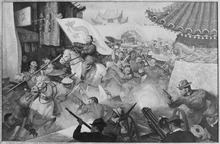

By 1900, many new forms of media had matured, including illustrated newspapers and magazines, postcards, broadsides and advertisements, all of which presented images of the Boxers and of the invading armies.[173] The rebellion was covered in the foreign illustrated press by artists and photographers. Paintings and prints were also published including Japanese wood-blocks.[174] In the following decades, the Boxers were a constant subject for comment. A sampling includes:
- In the Polish play The Wedding by Stanisław Wyspiański, first published on 16 March 1901, even before the rebellion was finally crushed, the character of Czepiec asks the Journalist (Dziennikarz) one of the best-known questions in the history of Polish literature: "Cóż tam, panie, w polityce? Chińczyki trzymają się mocno!? ("How are things in politics, Mister? Are the Chinese holding out firmly!?").[175]
- Liu E, The Travels of Lao Can[176] sympathetically shows an honest official trying to carry out reforms and depicts the Boxers as sectarian rebels.
- G. A. Henty, With the Allies to Pekin, a Tale of the Relief of the Legations (New York: Scribners, 1903; London: Blackie, 1904). Juvenile fiction by a widely read author, depicts the Boxers as "a mob of ruffians."
- A false or forged diary, Diary of his Excellency Ching-Shan: Being a Chinese Account of the Boxer Troubles, including text written by Edmund Backhouse, who claimed he recovered the document from a burnt building. It is suspected that Backhouse falsified the document, as well as other stories, because he was prone to tell tales dubious in nature, including claims of nightly visits to the Empress Dowager Cixi.[177]
- In Hergé's The Adventures of Tintin comic The Blue Lotus, Tintin's Chinese friend Chang Chong-Chen when they first meet, after Tintin saves the boy from drowning, the boy asks Tintin why he saved him from drowning as, according to Chang's uncle who fought in the Rebellion, all white people were wicked.
- The novel Moment in Peking (1939), by Lin Yutang, opens during the Boxer Rebellion, and provides a child's-eye view of the turmoil through the eyes of the protagonist.
- Tulku, a 1979 children's novel by Peter Dickinson, includes the effects of the Boxer Rebellion on a remote part of China.
- The Diamond Age or, A Young Lady's Illustrated Primer (New York, 1996), by Neal Stephenson, includes a quasi-historical re-telling of the Boxer Rebellion as an integral component of the novel
- The novel The Palace of Heavenly Pleasure (2003), by Adam Williams, describes the experiences of a small group of foreign missionaries, traders and railway engineers in a fictional town in northern China shortly before and during the Boxer Rebellion.
- Illusionist William Ellsworth Robinson (a.k.a. Chung Ling Soo) had a bullet-catch trick entitled "Condemned to Death by the Boxers", which famously resulted in his onstage death.
- The 1963 film 55 Days at Peking directed by Nicholas Ray and starring Charlton Heston, Ava Gardner and David Niven.[178]
- In 1975 Hong Kong's Shaw Brothers studio produced the film Boxer Rebellion (Chinese: 八國聯軍; pinyin: bāguó liánjūn; Wade–Giles: Pa kuo lien chun; lit. 'Eight-Nation Allied Army') under director Chang Cheh with one of the highest budgets to tell a sweeping story of disillusionment and revenge.[179]
- Hong Kong's Shaw Brothers Legendary Weapons of China (1981), director Lau Kar Leung. A comedy starring Hsiao Ho (Hsiao Hou) as a disillusioned boxer of the Magic Clan who is sent to assassinate the former leader of a powerful boxer clan who refuses to dupe his students into believing they are impervious to firearms.
- There are several flashbacks to the Boxer Rebellion in the television shows Buffy the Vampire Slayer and Angel. During the conflict, Spike kills his first slayer to impress Drusilla, and Angel decisively splits from Darla.
- The film Shanghai Knights (2003), starring Jackie Chan and Owen Wilson, takes place in 1887 and features Boxers as the henchmen of the film's lead antagonist, English Lord Rathbone (Aiden Gillen), either working as mercenaries for Rathbone, or helping him as part of their support for the anti-imperialist leader Wu Chow (Donnie Yen), Rathbone's ally.
- The Last Empress (Boston, 2007), by Anchee Min, describes the long reign of the Empress Dowager Cixi in which the siege of the legations is one of the climactic events in the novel.
- Mo, Yan. Sandalwood Death. Viewpoint of villagers during Boxer Uprising.[180]
- The pair of graphic novels by Gene Luen Yang, with colour by Lark Pien, Boxers and Saints, describes the "bands of foreign missionaries and soldiers" who "roam the countryside bullying and robbing Chinese peasants." Little Bao, "harnessing the powers of ancient Chinese gods", recruits an army of Boxers, "commoners trained in kung fu who fight to free China from 'foreign devils.'"[181]
- The 2013 video game BioShock Infinite featured the Boxer Rebellion as a major historical moment for the floating city of Columbia. Columbia, in an effort to rescue American hostages during the rebellion, opened fire upon the city of Peking and burned it to the ground. These actions resulted in the United States recalling Columbia, which led to its secession from the Union.
- The Boxer Rebellion is the historical backdrop for the episode titled "Kung Fu Crabtree" (Season 7, Episode 16, aired 24 March 2014) of the television series Murdoch Mysteries, in which Chinese officials visit Toronto in 1900 in search of Boxers who have fled from China.
See Also
- Battle of Peking (1900)
- Boxer Indemnity Scholarship Program
- Century of humiliation
- China Relief Expedition
- Spanish Civil War
- Donghak Rebellion, an anti-foreign, proto-nationalist uprising in pre-Japanese Korea
- Gengzi Guobian Tanci
- Imperial Decree on events leading to the signing of Boxer Protocol
- List of 1900–30 publications on the Boxer Rebellion
- Xishiku Cathedral (西什庫天主堂)
Sources
- Cohen, Paul A. (1997). History in three keys: the boxers as event, experience, and myth. Columbia University Press. ISBN 0-231-10651-3.
- Elliott, Jane E. (2002). Some Did It for Civilisation, Some Did It for Their Country : A Revised View of the Boxer War. Hong Kong: Chinese University Press. ISBN 9622019730. David D. Buck, "Review", The China Quarterly 173 (2003): 234–237. calls this a strong "revisionist" account.
- Edgerton, Robert B. (1997). Warriors of the rising sun: a history of the Japanese military (illustrated ed.). W. W. Norton & Company. ISBN 0393040852.
- Esherick, Joseph W. (1987). The Origins of the Boxer Uprising. U of California Press. ISBN 0-520-06459-3. Excerpt
- Harrington, Peter (2001). Peking 1900: The Boxer Rebellion. Oxford: Osprey. ISBN 1-84176-181-8.
- Klein, Thoralf (2008). "The Boxer War-the Boxer Uprising". Online Encyclopedia of Mass Violence.
- Leonhard, Robert R. "The China Relief Expedition Joint Coalition Warfare in China Summer 1900" (PDF). The Johns Hopkins University Applied Physics Laboratory. Archived from the original (PDF) on 6 December 2016. Retrieved 8 August 2014.
- Preston, Diana (2000). The Boxer Rebellion : The Dramatic Story of China's War on Foreigners That Shook the World in the Summer of 1900. New York: Walker. ISBN 0802713610.. Questia edition; British title: Besieged in Peking: The Story of the 1900 Boxer Rising (London: Constable, 1999); popular history.
- Thompson, Larry Clinton (2009). William Scott Ament and the Boxer Rebellion: Heroism, Hubris, and the "Ideal Missionary". Jefferson, NC: McFarland. ISBN 978-0-78645-338-2.
- Xiang, Lanxin (2003). The Origins of the Boxer War: A Multinational Study. Psychology Press. ISBN 0-7007-1563-0.
- Xu, Guangqiu (2012). "Eight Foreign Armies Invasion of China". In Li, Xiaobing (ed.). China at War: An Encyclopedia. Santa Barbara, CA: ABC-CLIO. ISBN 9781598844153.
Further Reading
General Accounts and Analysis
In addition to those used in the notes and listed under References, general accounts can be found in such textbooks as Jonathan Spence, In Search of Modern China, pp. 230–235; Keith Schoppa, Revolution and Its Past, pp. 118–123; and Immanuel Hsu, Ch 16, "The Boxer Uprising", in The Rise of Modern China (1990).
- Bickers, Robert A., and R. G. Tiedemann, eds., The Boxers, China, and the World. Lanham: Rowman & Littlefield, 2007. ISBN 978-0-7425-5394-1.
- Bickers, Robert A. The Scramble for China: Foreign Devils in the Qing Empire, 1800–1914 (London: Allen Lane, 2011).
- Buck, David D. "Recent Studies of the Boxer Movement", Chinese Studies in History 20 (1987). Introduction to a special issue of the journal devoted to translations of recent research on the Boxers in the People's Republic.
- Der Ling, Princess (1928). Old Buddha, Dodd, Mead & Company. Chapters XXXII-XXXVIII.
- Harrison, Henrietta. "Justice on Behalf of Heaven" History Today (Sep 2000) , Vol. 50 Issue 9, pp 44–51 online; popular history..
- Shan, Patrick Fuliang (2018). Yuan Shikai: A Reappraisal, The University of British Columbia Press. ISBN 9780774837781.
- Purcell, Victor (1963). The Boxer Uprising: A background study. online edition
- Silbey, David. The Boxer Rebellion and the Great Game in China. New York: Hill and Wang, 2012. 273p. ISBN 9780809094776.
- "In Our Time – discussion show on The Boxer Rebellion". BBC Radio4.
Missionary Experience and Personal Accounts
- Bell, P, and Clements, R, (2014). Lives from a Black Tin Box ISBN 978-1-86024-931-0 The story of the Xinzhou martyrs, Shanxi Province.
- Brandt, Nat (1994). Massacre in Shansi. Syracuse University Press. ISBN 0-8156-0282-0. The story of the Oberlin missionaries at Taigu, Shanxi.
- Clark, Anthony E. (2015). Heaven in Conflict: Franciscans and the Boxer Uprising in Shanxi. Seattle and London: University of Washington Press. ISBN 978-0-295-99400-0
- Price, Eva Jane. China Journal, 1889–1900: An American Missionary Family During the Boxer Rebellion, (1989). ISBN 0-684-18951-8. Review: Susanna Ashton, "Compound Walls: Eva Jane Price's Letters from a Chinese Mission, 1890–1900." Frontiers 1996 17(3): 80–94. ISSN 0160-9009. The journal of the events leading up to the deaths of the Price family.
- Sharf, Frederic A., and Peter Harrington (2000). China 1900: The Eyewitnesses Speak. London: Greenhill. ISBN 1-85367-410-9. Excerpts from German, British, Japanese, and American soldiers, diplomats and journalists.
- Sharf, Frederic A., and Peter Harrington (2000). China 1900: The Artists' Perspective. London: Greenhill. ISBN 1-85367-409-5
- Tiedemann, R.G. "Boxers, Christians and the culture of violence in north China" Journal of Peasant Studies (1998) 25:4 pp 150–160, DOI: 10.1080/03066159808438688
Allied intervention, the Boxer War, and the Aftermath
- Bodin, Lynn E. and Christopher Warner. The Boxer Rebellion. London: Osprey, Men-at-Arms Series 95, 1979. ISBN 0-85045-335-6 (pbk.) Illustrated history of the military campaign.
- Fleming, Peter (1959). The Siege at Peking. New York: Harper. ISBN 0-88029-462-0.
- Hevia, James L. "Leaving a Brand on China: Missionary Discourse in the Wake of the Boxer Movement", Modern China 18.3 (1992): 304–332.
- Hevia, James L. "A Reign of Terror: Punishment and Retribution in Beijing and its Environs", Chapter 6, in English Lessons: The Pedagogy of Imperialism in Nineteenth Century China (Durham, NC: Duke University Press, 2003), pp. 195–240. ISBN 0-8223-3151-9
- Hunt, Michael H. "The American Remission of the Boxer Indemnity: A Reappraisal", Journal of Asian Studies 31 (Spring 1972): 539–559.
- Hunt, Michael H. "The Forgotten Occupation: Peking, 1900–1901", Pacific Historical Review 48.4 (November 1979): 501–529.
- Langer, William. The Diplomacy of Imperialism 1890–1902 (2nd ed. 1950), pp. 677–709.
Contemporary Accounts and Sources
- Broomhall, Marshall (1901). Martyred Missionaries of The China Inland Mission; With a Record of The Perils and Sufferings of Some Who Escaped. London: Morgan and Scott.. A contemporary account.
- Conger, Sarah Pike (1909), Letters from China with Particular Reference to the Empress Dowager and the Women of China (2nd ed.), Chicago: A.C. McClurg
- E. H. Edwards, Fire and Sword in Shansi: The Story of the Martyrdom of Foreigners and Chinese Christians (New York: Revell, 1903)
- Isaac Taylor Headland, Chinese Heroes; Being a Record of Persecutions Endured by Native Christians in the Boxer Uprising (New York, Cincinnati: Eaton & Mains; Jennings & Pye, 1902).
- Arnold Henry Savage Landor, China and the Allies (New York: Scribner's, 1901). 01008198 Google Books: China and the Allies
- Pierre Loti, The Last Days of Pekin (Boston: Little, Brown and Co., 1902): tr. of Les Derniers Jours De Pékin (Paris: Lévy, 1900).
- W. A. P. Martin, The Siege in Peking, China against the World (New York: F. H. Revell company, 1900).
- Putnam Weale, Bertram Lenox, (1907). Indiscreet Letters from Peking: Being the Notes of an Eyewitness, Which Set Forth in Some Detail, From Day to Day, The Real Story of the Siege and Sack of a Distressed Capital in 1900– The Year of Great Tribulation. Dodd, Mead. Free ebook. Project Gutenberg.
- Arthur H.Smith, China in Convulsion (New York: F. H. Revell, 2 vols. 1901). Internet Archive Volume I Volume II, An account of the Boxers and the siege by a missionary who had lived in a North China village.
External Links
- Lost in the Gobi Desert: Hart retraces great-grandfather's footsteps, William & Mary News Story, 3 January 2005.
- September 1900 San Francisco Newspaper
- 200 Photographs in Library of Congress online Collection

Wikimedia Commons has media related to Boxer Rebellion. - 55 Days at Peking at IMDb
- Pa kuo lien chun at IMDb
- University of Washington Library's Digital Collections – Robert Henry Chandless Photographs
- Proceedings of the Tenth Universal Peace Congress, 1901
- Pictures from the Siege of Peking, from the Caldwell Kvaran archives
- Eyewitness account: When the Allies Entered Peking, 1900, an excerpt of Pierre Loti's Les Derniers Jours de Pékin (1902).
- Documents of the Boxer Rebellion (China Relief Expedition), 1900–1901 National Museum of the U.S. Navy (Selected Naval Documents).
- Internet Archive "Boxer Rebellion" Books, films, and audio

Colonial conflicts in the Italian Empire | ||
|---|---|---|
| East Africa | ||
| North Africa | ||
| South America | ||
| Asia | ||
| Europe | ||
.svg)
| By incident |
| ||||||||||
|---|---|---|---|---|---|---|---|---|---|---|---|
| By persecutor |
| ||||||||||
| By country | |||||||||||
| By persecuted group | |||||||||||
| Martyrs (list) |
| ||||||||||


| General | |
|---|---|
| National libraries | |

- Boxer Rebellion
- Wars involving the United States
- 1899 in China
- 1899 in Christianity
- 1900 in China
- 1900 in Christianity
- 1901 in China
- 1901 in Christianity
- Anti-Christian sentiment in Asia
- Anti-imperialism in Asia
- Attacks on diplomatic missions in China
- Battles involving the princely states of India
- Chinese nationalism
- Chinese Taoists
- Conflicts involving the German Empire
- Eight Banners
- History of the Royal Marines
- Looting
- Persecution of Christians
- Racially motivated violence against white people
- Rebellions in the Qing dynasty
- Shamanism
- United States Marine Corps in the 18th and 19th centuries
- United States Marine Corps in the 20th century
- Wars involving France
- Wars involving Germany
- Wars involving Italy
- Wars involving Japan
- Wars involving the Habsburg Monarchy
- Wars involving the Russian Empire
- Wars involving the United Kingdom


No comments:
Post a Comment